
In the race to squeeze every watt and hertz, the chip industry is facing an uncomfortable enemy: power delivery no longer scales as well as transistors do. The denser and faster a processor becomes, the more difficult it is to keep the voltage stable when millions (or billions) of transistors switch states simultaneously. That voltage drop — the dreaded voltage droop — is one of those less “glamorous” issues that can determine whether a chip runs at high frequencies, reduces performance to protect itself, or consumes more than desired.
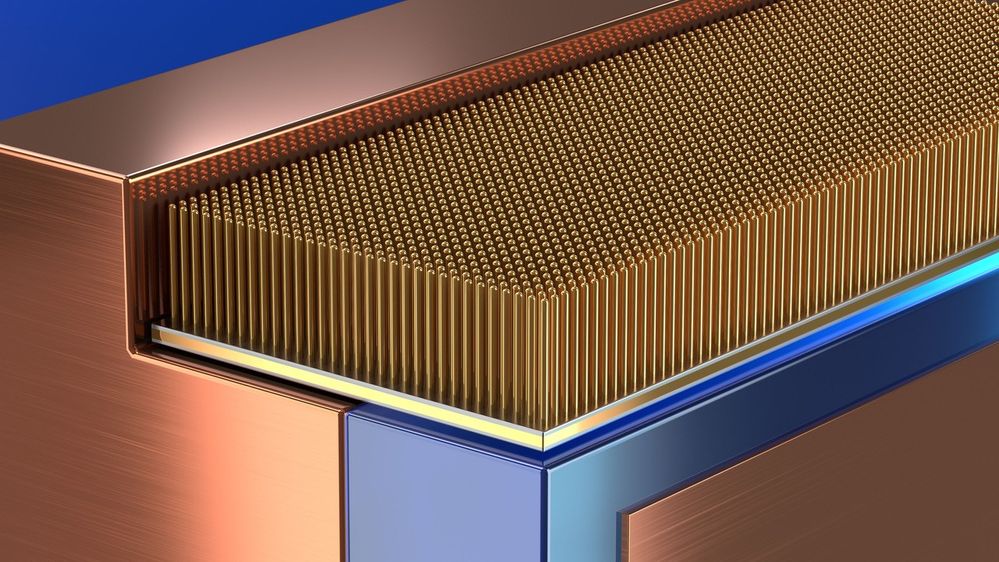
This is where the latest research from Intel and Intel Foundry enters, presenting a key breakthrough: new materials for metal-insulator-metal (MIM) integrated capacitors aimed at improving power delivery within the chip itself. In plain language: more “electrical capacity” in less surface area, without turning manufacturing into a nightmare of extra layers and costly processes.
What exactly has been announced?
Researchers have demonstrated three MIM material options with intrinsic capacitance densities reaching up to 98 fF/µm², significantly above the reference values cited for cutting-edge materials (37 fF/µm²). This number matters because decoupling capacitors (DCAP) act as small “charge reservoirs”: when the CPU or accelerator experiences a demand spike, this reservoir supplies current immediately and helps keep the voltage stable.
Intel outlines three pathways:
- Hafnium-zirconium oxide (HZO): leverages a voltage-dependent dielectric response to deliver 60–80 fF/µm².
- Titanium oxide (TiO): reaches around 80 fF/µm² thanks to a very high dielectric constant.
Beyond breaking records, Intel emphasizes the complete package: leakage currents below target levels, stability during extended testing, and long-term reliability projections at 90°C. This is critical because DCAPs must withstand sustained heat within demanding chips.
Why is this advance significant (even if it doesn’t sound revolutionary)?
In data centers, especially in Artificial Intelligence workloads, performance per watt is now the key metric. It’s not just about a chip being fast; it’s about how long it can sustain that performance without hitting thermal or power limits. More stable power delivery helps maintain high frequencies longer and avoids “performance sags.” In mobile devices, more efficient energy delivery doesn’t just improve peak performance; it also allows for quicker transitions to low-power states, resulting in better battery life in real-world use.
Additionally, Intel’s industry message is clear: many historically significant improvements in capacitance came from “tricks” such as more layers or deeper trenches—adding complexity. Material innovations, however, promise a leap forward without increasing manufacturing complexity, especially if integrated within advanced MIM structures already used in modern processes (Intel mentions MIM architectures incorporated within their manufacturing approach).
A quick comparison: what each material offers
| Material (MIM) | Cited Capacitance Density | Key Feature | Notable Reliability Note |
|---|---|---|---|
| HZO (ferroelectric) | 60–80 fF/µm² | Voltage-dependent dielectric response (“reactive” capacitance) | Long-term stability and high-temperature lifespan projections |
| TiO (high-k) | ~80 fF/µm² | Very high dielectric constant with low voltage dependence | Good margin at high voltages; leakage analysis via Poole–Frenkel mechanism |
| STO (ultra high-k) | 98 fF/µm² | Highest demonstrated density | Meets targets at lower voltages; process optimization still possible |
Behind the scenes: fighting droop and manufacturing costs
Intel explains the problem simply: when the chip demands current in a sudden spike, if energy doesn’t arrive quickly enough, voltage drops, and the system reduces frequency or becomes unstable. DCAPs act as “shock absorbers” to absorb these fluctuations. But manufacturing better capacitors typically requires more surface area or added complexity.
The material approach aims to avoid this toll: instead of stacking or complicating, it increases the “capacitance per area” of the dielectric itself. If these improvements are integrated into existing MIM structures used in advanced processes, the impact can be broad: CPUs, GPUs, NPUs, accelerators—anything susceptible to power peaks.
When will we see this in products?
Intel positions this as a research demonstration presented at the technical circuit conference (IEDM 2025), describing it as a “multi-generational” pathway: materials that could bring benefits across several process generations without requiring a complete manufacturing overhaul. That doesn’t mean we’ll see “HZO chips” tomorrow, but it highlights a real priority: internal power delivery is now as limiting as lithography nodes or core architectures in pushing performance.
Frequently Asked Questions
What is a decoupling capacitor (DCAP), and why does it matter in a CPU or GPU?
It’s an integrated capacitor that acts as an instant current reserve to stabilize voltage during demand spikes; it helps reduce voltage drops that can force frequency reductions or system instability.
Why is it measured in fF/µm², and what does “higher” mean?
It’s the capacitance (femtofarads) per square micron of area. The higher the number, the more “electrical capacity” fits into the same chip space.
Does this improve gaming performance or only data centers?
It can help both: more stable power delivery supports sustained high performance. The biggest benefits are seen in intensive workloads (AI, HPC, content creation) and scenarios where the chip rapidly switches between power states.
Why does Intel discuss materials (HZO, TiO, STO) instead of “more layers”?
Because adding layers or more complex structures usually increases manufacturing cost and complexity. The material approach seeks to boost capacitance without raising process complexity.
Source: community.intel