
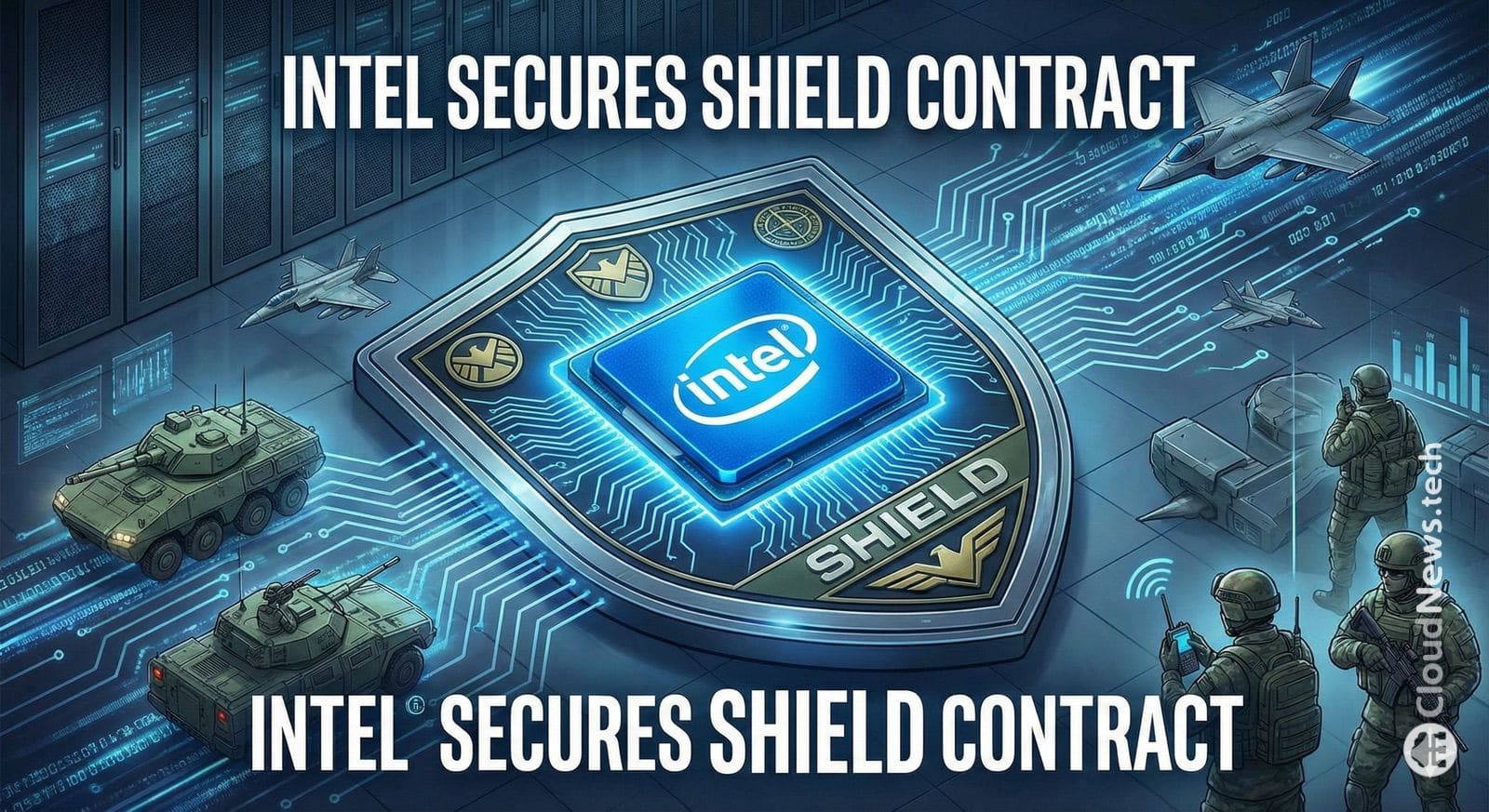
Intel is attempting to strengthen its profile as a “domestic” provider of semiconductors for critical U.S. missions after claiming its designation as an awardee of the SHIELD vehicle, the Scalable Homeland Innovative Enterprise Layered Defense contract. SHIELD is an IDIQ (indefinite-delivery/indefinite-quantity) contract with a ceiling of $151 billion. The figure sounds enormous, but it’s worth putting into perspective: in this type of contract, the “ceiling” indicates the maximum potential of the program, not guaranteed spending. The actual revenue depends on the task orders that are issued and awarded over the years.
The statement about Intel’s presence in SHIELD has circulated based on a LinkedIn post by James Chew, Vice President of Government Technology at the company, highlighting Intel’s ability to provide manufacturing within the U.S., advanced packaging, and supply chain resilience. However, beyond this corporate communication and the coverage it generates, the public traceability of Intel’s specific “award” within such a large IDIQ may be less transparent to the general reader—precisely because SHIELD is designed as an umbrella for multiple awardees.
What is SHIELD and why an IDIQ doesn’t equal a guaranteed “lot”
SHIELD is designed as an agile contracting mechanism: instead of negotiating each purchase from scratch, the government pre-selects a set of qualified companies, which can then receive specific task orders. Practically, the key for companies isn’t just “being in” but winning orders when internal competitions within the vehicle open.
This allows the administration to accelerate acquisitions in sensitive areas — electronics, systems integration, supply, and manufacturing — and adjust volumes according to budget and operational needs. Hence, the $151 billion ceiling functions more as a measure of ambition and programmatic scope than a guaranteed payment.
Why it matters to Intel: anchor contracts in a delicate moment
For Intel, these programs are attractive because they provide relatively stable demand aligned with national strategic priorities, especially as the company works to demonstrate that its industrial capacity in the U.S. can support significant production (not just for itself but for third parties as well).
Moreover, the “manufacturing in-house” approach and controlled supply chain have become key narratives in Washington. This is reflected in the previously awarded funds to Intel for the Secure Enclave program, a project focused on microelectronics related to national security, with a funding of up to $3 billion, according to Reuters.
In other words: although SHIELD is a competitive umbrella, any traction for Intel in this space reinforces two messages the company seeks to convey in the market: sovereign industrial capacity and reliability for sensitive loads.
The RAMP-C precedent: defense route to promote local manufacturing
The relationship between the Pentagon and the semiconductor industry predates SHIELD. Years earlier, the Department of Defense promoted initiatives like RAMP-C (Rapid Assured Microelectronics Prototypes – Commercial) to encourage a “leading-edge” option based in the U.S. and reduce dependence on Asia for chips and prototypes for critical systems. Reuters described this effort as an attempt to strengthen domestic manufacturing and create a commercially viable alternative within U.S. territory.
This context is important because it indicates continuity: U.S. defense has long used public-private contracting and funding to shape industrial capacity, not just buy components. SHIELD can be seen as the next step in that strategy.
Quick table: how SHIELD, Secure Enclave, and RAMP-C fit into the industrial strategy
| Program / Vehicle | Type | Publicized magnitude | Main goal | Implications for suppliers |
|---|---|---|---|---|
| SHIELD (MDA) | IDIQ (multi-award umbrella) | Ceiling: $151 billion | Accelerate delivery of capabilities and defense systems (project orders) | “Being qualified” enables competition; revenues depend on winning task orders |
| Secure Enclave | Funding / award | Up to $3 billion | Microelectronics related to national security | Supports investment and local industrial capacity |
| RAMP-C | DoD prototyping/industry program | (DoD initiative without a comparable single “ceiling”) | Prototypes and manufacturing assured in the U.S. | Structural boost to domestic supply chain |
What the market will really focus on: orders, nodes, and packaging
The narrative of “winning SHIELD” might seem like a definitive victory, but the market tends to be more cautious: it will want to see concrete orders, amounts, and continuity. And also the technological mix: defense uses everything from mature nodes (for reliability and certification) to advanced packaging for integrating heterogeneous functions. Intel’s industrial play comes into this, but it will still compete within an ecosystem where factories, integration, validation, and delivery track record are equally important.
Simultaneously, SHIELD arrives at a time when the industry is undergoing broader reconfiguration: export controls, technological sovereignty, and a race to secure critical component supplies. As a result, contracts like this serve as political and industrial signals, as well as procurement tools.
Frequently Asked Questions
What does it mean that SHIELD is an IDIQ contract, and why doesn’t it guarantee income for Intel?
Because an IDIQ establishes a framework and a group of qualified providers, but actual amounts depend on future orders (task orders) competed and awarded over time.
Will the $151 billion ceiling be fully spent?
Not necessarily. The ceiling sets the maximum allowed; actual spending depends on budgets, program priorities, and order execution during the contract period.
Why does the U.S. government prioritize chips “made in-house” for defense?
For supply chain control, reducing external dependence, and ensuring security and reliability in critical systems, along with industrial policy objectives.
What impact might this have on Intel Foundry in the medium term?
If it results in recurring orders, it could act as an anchor demand and reputation validation; but significant financial effects will only materialize with concrete awards and sustainable margins.