
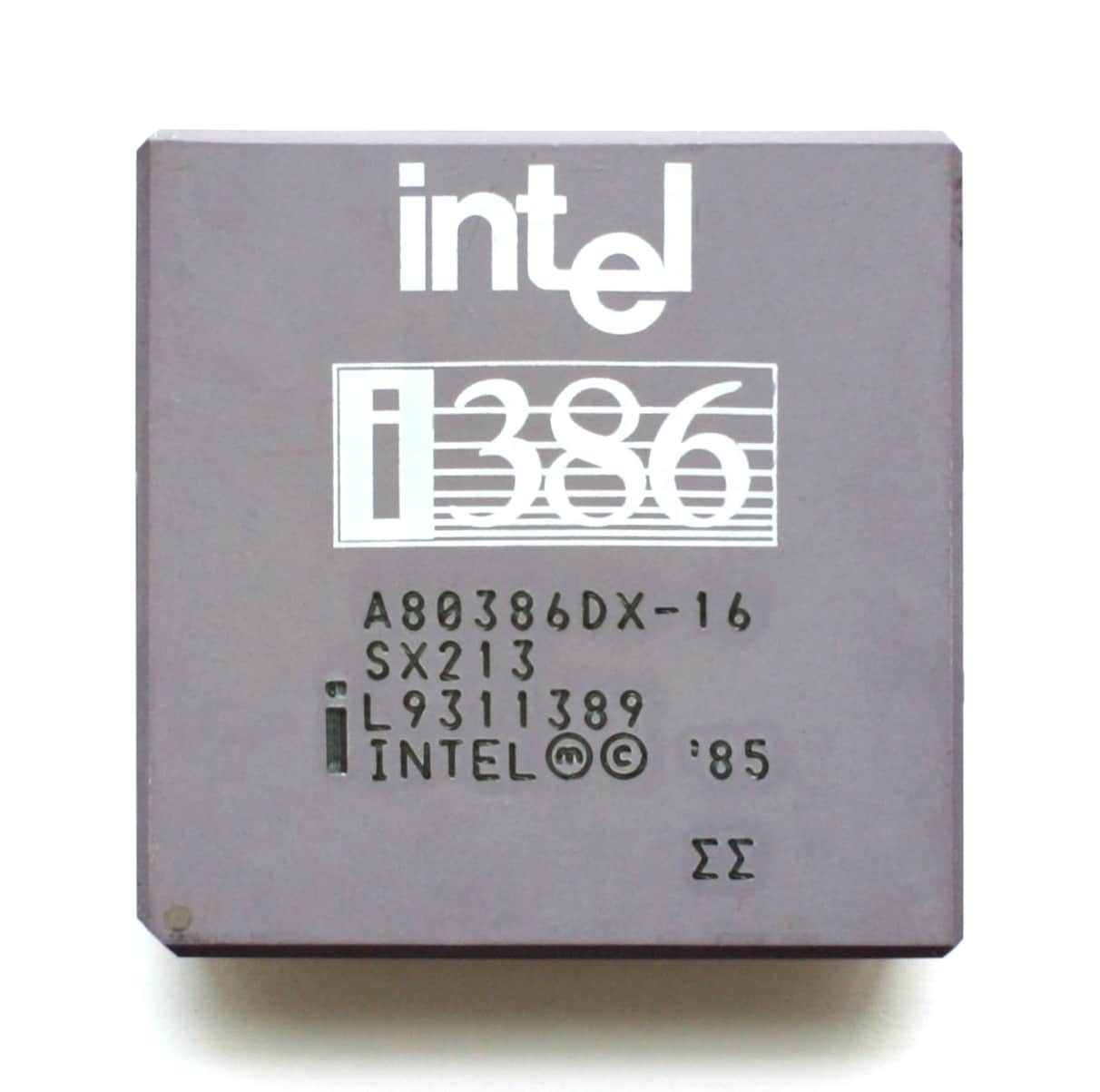
The Intel 80386 was not just a faster CPU within the x86 family. It was the processor that transformed the PC compatible into a platform ready for modern operating systems, multitasking, virtual memory, and much more demanding software. Four decades after its launch, celebrated in October 2025, the 386 remains an essential piece for understanding the evolution of Windows, Linux, and the IA-32 architecture.
Intel introduced the 80386 on October 17, 1985. At first glance, its specs are far from today’s hardware: 275,000 transistors, an initial clock speed of 16 MHz, and manufacturing aimed at a generation of personal computers still running DOS, floppy disks, and CRT monitors. But that chip marked a technical breakthrough for the PC. For the first time, the x86 architecture offered a full 32-bit processor with 32-bit general-purpose registers, an extended address bus, hardware paging, and an execution model that enabled much more ambitious systems.
The Technical Leap: From a Compatible PC to a Modern Platform
The Intel 80286 had already introduced protected mode and could address up to 16 MB of memory, a significant figure for the early 1980s. The problem was in its practical limitations. Switching between real mode and protected mode wasn’t straightforward, and 16-bit legacy software continued to dominate daily PC usage. The 386 addressed many of these barriers and added a decisive feature: the virtual 8086 mode.
This mode allowed running software designed for earlier processors inside isolated environments, while the operating system maintained control in protected mode. For users, the visible results included multiple DOS sessions, better memory management, and a more suitable foundation for graphical environments like Windows. For system developers, the change was even deeper. The 386 enabled working with paged virtual memory, process separation with greater security, and designing kernels closer to Unix workstations.
| Processor | Year | Architecture | Transistors | Addressable Physical Memory | Main Contribution |
|---|---|---|---|---|---|
| Intel 8086 | 1978 | 16-bit | 20,000 | 1 MB | Origin of the x86 family |
| Intel 80286 | 1982 | 16-bit | 134,000 | 16 MB | Initial protected mode |
| Intel 80386 | 1985 | 32-bit | 275,000 | 4 GB | IA-32, paging, virtual 8086 mode |
| Intel 80486 | 1989 | 32-bit | 1.2 million | 4 GB | Enhanced performance, integrated cache/FPU as per model |
| Intel Pentium | 1993 | 32-bit | 3.1 million | 4 GB | Superscalar design, performance leap |
The difference between the 286 and the 386 wasn’t just in word width. The 386 offered a much more practical architecture for system software. Its ability to address up to 4 GB of physical memory didn’t mean users would install that much RAM in 1986, but it eliminated a limit that would have hindered PC evolution for years. Additionally, its virtual memory space of up to 64 TB, according to Intel’s technical documentation, positioned the x86 to be much more competitive for advanced operating systems.
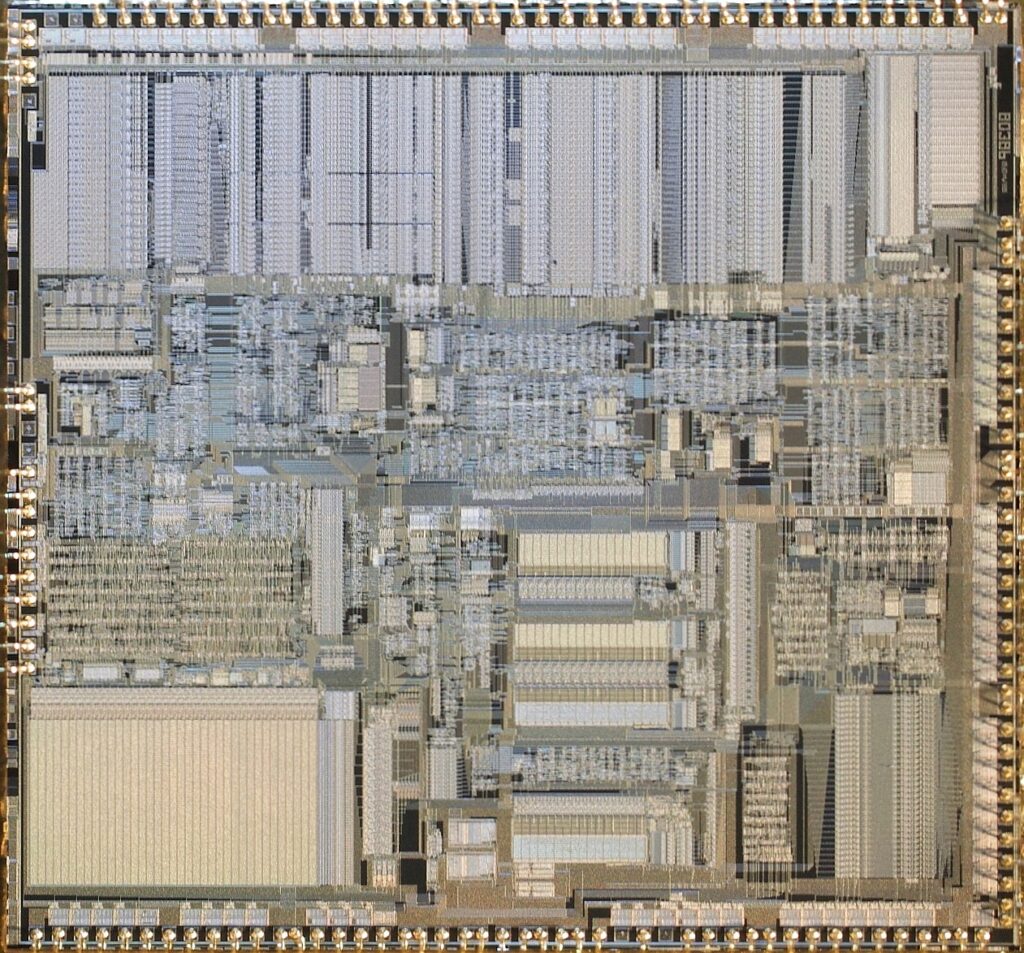
IA-32, the architecture that originated with the 386, became the common denominator for several processor generations. The 486, Pentium, and many later chips followed that path, adding performance, caches, integrated floating-point units, out-of-order execution, and multimedia extensions. Yet, the 32-bit foundation was already established.
Compaq, IBM, and the Shift of Power in the PC Market
The 386 also changed the industry because it broke a seemingly established dynamic. IBM had set the standard for PCs since 1981, but the first commercial computer based on the Intel 80386 wasn’t theirs. It was the Compaq Deskpro 386, announced in September 1986.
That detail carried enormous weight. Compaq proved that a compatible manufacturer could outpace IBM in a major technological generation. It was no longer just about cloning the original PC or building cheaper compatible machines. The Deskpro 386 showed that the market could advance through initiatives by other players, with Intel supplying the processor, Microsoft developing the software environment, and companies like Compaq competing to deliver the new architecture to professional clients first.
| Platform | Processor | Focus | Historical Context |
| IBM PC/AT | Intel 80286 | 16-bit professional PC | Consolidated the PC/AT standard |
| Compaq Deskpro 386 | Intel 80386 | High-performance compatible PC | Outpaced IBM and strengthened the compatible market |
| Apple Macintosh 128K | Motorola 68000 | Integrated graphics computer | Pioneered graphical interface and closed ecosystem |
| Commodore Amiga | Motorola 68000 | Multimedia and creativity | Excelled in graphics and sound |
| Unix workstations | RISC and other designs | Advanced professional environments | Set standards in multitasking and networking |
Understanding the competition with Motorola helps contextualize the significance. The Motorola 68000, used in early Macintosh, Amiga, Atari ST, and other systems, was a highly regarded architecture with internal 32-bit registers, though its external data bus was 16 bits and its address bus 24 bits. The 386, in contrast, shifted the full leap to 32 bits within the x86 ecosystem, maintaining compatibility that ultimately was decisive.
The result was a hard-to-match advantage. Manufacturers could sell more powerful PCs without breaking compatibility with existing software. Users could continue running familiar tools. Developers could begin designing more capable applications and systems. This continuity made x86 not just a technical architecture but a vast commercial platform.
Windows, Linux, and the Maturity of Software on x86
The real impact of the 386 emerged as software began to leverage its capabilities. Microsoft released Windows/386 as a variant designed to take advantage of the new processor’s features. Later, Windows 3.0 popularized the so-called “386 Enhanced Mode,” enabling multiple DOS applications to run in virtualized environments and making virtual memory more flexible.
This wasn’t modern virtualization as we know it today, but it introduced a familiar idea: isolating environments, managing resources by the OS, and giving users the feeling of multitasking. The 386 made the PC much better suited for that transition.
Linux also originated closely tied to the 386. The earliest notes of kernel 0.01 described it as a free Minix-like core for AT machines based on i386 or higher. Linus Torvalds chose this base intentionally. The protected mode, paging, and memory model of the 386 provided the necessary conditions to build a Unix-like system on PC hardware, much more accessible than traditional workstations.
| Technology | Relationship to the Intel 386 |
| IA-32 | 32-bit instruction set introduced with the 386 |
| Windows/386 | Leveraged processor capabilities to run DOS sessions |
| Windows 3.0 | Used the enhanced mode as one of its key features |
| Linux 0.01 | Originated targeting i386 or higher machines |
| Virtualization & emulators | Maintain compatibility with legacy x86 environments |
| x86-64 | Later evolution that preserved backward compatibility with x86 legacy |
For years, “i386” was a common label in Linux distros, compilers, and software packages. It indicated compatibility with a broad range of 32-bit x86 processors, not just Intel’s original chip. This persistence shows how much the 386’s influence extended beyond a specific product into an architectural benchmark.
The dedicated support for the 386 officially ended in the Linux kernel in 2012, when maintaining compatibility with a mid-80s CPU no longer justified the added complexity. Still, the legacy of IA-32 continued much longer in operating systems, enterprise applications, industrial environments, and legacy software.
The 386 also had a long life outside the desktop PC realm. Intel maintained variants of the chip for embedded systems until 2007. This highlights another part of its importance: its architecture was robust and stable enough to remain present in industrial equipment, controllers, and specialized devices long after being superseded in consumer computers.
Compared to today’s processors, the Intel 80386 seems almost prehistoric. Modern chips incorporate billions of transistors, multiple cores, specialized accelerators, integrated graphics, advanced security features, and instruction sets unimaginable in 1985. Yet, many foundational ideas that matured the PC as a software platform found their roots in the 386.
The 80386 didn’t earn its place in history by being the fastest processor for the longest period. It did so because it made the x86 architecture a viable 32-bit platform for serious operating systems without abandoning the past. This blend of technical progress and compatibility explains why the compatible PC became dominant in so many fields and why IA-32 remained one of the most important architectures in personal computing for decades.
Frequently Asked Questions
What was the Intel 80386?
The Intel 80386 was a 32-bit x86 microprocessor launched by Intel in 1985. It’s also known as i386 or 386.
Why is it considered so important?
Because it introduced IA-32, supported up to 4 GB of physical memory, and added key features like paging, protected mode, and virtual 8086 mode.
What was the difference between the 286 and the 386?
The 286 was a 16-bit processor with protected mode, while the 386 extended x86 to 32 bits and offered a much more practical architecture for multitasking and virtual memory.
What was the 386’s relationship to Linux?
Early versions of Linux were developed for i386 or higher machines, making the 386 a direct part of the operating system’s origin story.
