
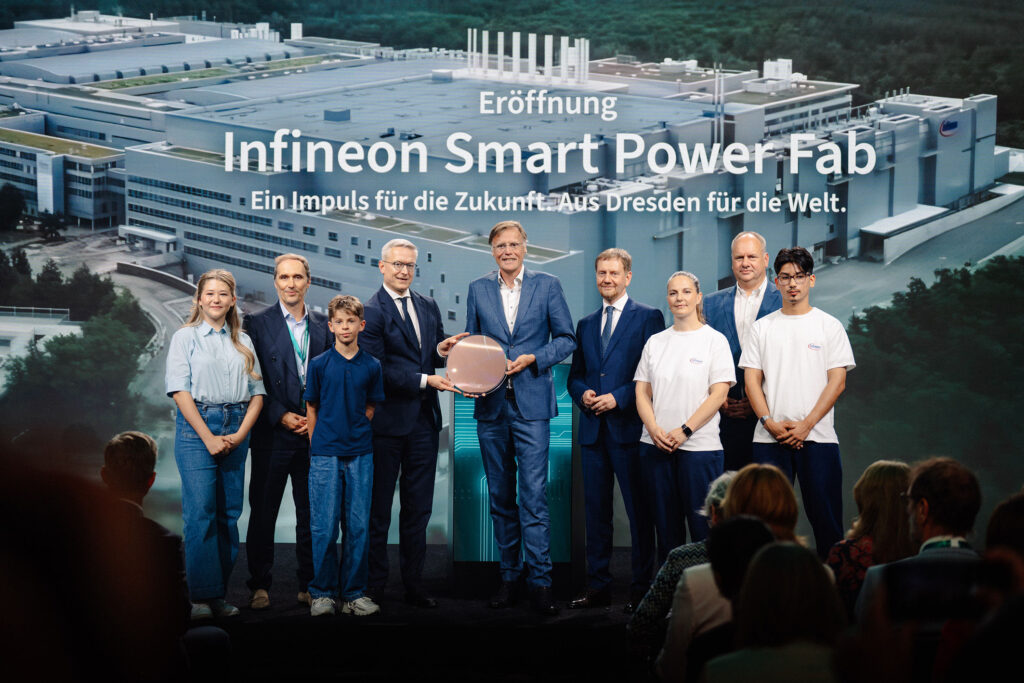
Infineon has inaugurated its new Smart Power Fab in Dresden, a semiconductor plant focused on power semiconductors and analog technologies, arriving at a particularly critical time for Europe. Artificial intelligence is driving up data center demand, electrification is putting pressure on the automotive industry, and electrical grids need more efficient components to integrate renewables, storage, and distributed consumption.
The investment totals €5 billion, the largest individual operation in Infineon’s history, and will create 1,000 direct jobs in Saxony’s capital. The company states that the new factory doubles its production capacity in Dresden and makes this site the world’s largest facility dedicated to intelligent power semiconductors, analog, and mixed-signal technologies.
Less flashy chips, but essential for AI
When talking about artificial intelligence, the focus usually falls on GPUs, large training clusters, or new data centers. But all this infrastructure also depends on less publicized components: chips capable of efficiently managing energy, converting current, controlling loads, measuring signals, and reducing losses.
This is where Infineon plays a key role. Power semiconductors don’t run AI models themselves, but they enable data centers to operate more efficiently. In an environment where electricity consumption has become one of the main limiting factors for AI deployment, every improvement in conversion, control, and energy distribution matters.
The chips manufactured in Dresden will be used in industrial and automotive applications, including power supplies for AI data centers, renewable energy systems, electrical grids, and software-defined vehicles. Infineon highlights smart switches that can not only control loads but also monitor electrical flow as an example.
The combination of power semiconductors with analog and mixed-signal components explains the name Smart Power Fab. It’s not only about manufacturing chips capable of handling high electrical loads but integrating them into solutions that can measure, decide, and act with greater precision.
A factory designed to accelerate production
The plant opened several months ahead of schedule. According to Infineon, one of the factors enabling the reduced timeline was the intensive use of digitalization from the factory’s design phase. The building and machine layout were planned using a digital twin, while system and process validation relies on artificial intelligence algorithms.
The company also connects the Dresden facility with its plant in Villach, Austria, under the concept of One Virtual Fab. The idea is for both factories to operate in a coordinated manner to speed up process and product qualification. In practice, this allows for more flexible production adjustments and quicker responses to demand shifts.
Infineon claims that the new plant can double its capacity speed compared to previous levels, depending on market needs. This is significant because the semiconductor industry experiences highly cyclical trends: shortages, inventory gluts, sudden changes in automotive, new industrial demands, and now increasing pressure from AI infrastructure.
The challenge is not just to produce more but to do so in Europe with agility. The pandemic, geopolitical tensions, and the concentration of advanced manufacturing in Asia have turned semiconductors into a strategic industry issue. For Germany and the EU, Dresden reinforces the idea that part of the value chain should remain close to home.
Silicon Saxony consolidates its importance in Europe
The new Smart Power Fab cements Dresden as one of Europe’s key microelectronics hubs. The Silicon Saxony cluster now includes over 80,000 employees engaged in semiconductors, suppliers, research, equipment, and industrial services.
Infineon emphasizes that the employment impact extends beyond the 1,000 direct jobs. According to studies cited by the company, each cleanroom position can generate six additional jobs in related areas. This helps explain why governments compete to attract chip factories: they are not just industrial plants but hubs that pull in suppliers, technical training, universities, and specialized services.
The political message is clear: the inauguration demonstrates that Germany and Europe can continue producing critical technology locally. In today’s context, that statement carries more weight than it seems. Technological sovereignty is not only about designing software or regulating digital markets; it also requires manufacturing facilities, materials, energy, talent, and stable supply chains.
While the Smart Power Fab does not directly compete with the most advanced logic chip fabs, it holds a vital position in the power electronics segment. Without these components, the electrification of vehicles, renewable energy systems, data centers, and connected industries wouldn’t operate with the required efficiency.
More sustainable manufacturing for a resource-intensive industry
Semiconductor manufacturing is water, energy, and chemical-intensive. That’s why Infineon has also prioritized operational sustainability at the new plant. The Smart Power Fab does not require natural gas, incorporates water treatment processes, and employs closed-loop systems.
The company expects to recycle approximately 90% of the water used in production. Additionally, these systems could recover up to 45% of the energy consumed. These are notable figures for an industry that needs to grow but will be increasingly scrutinized for its environmental footprint.
Balancing demand will be complex. AI, electrification, and energy transition all require more semiconductors, but their production demands resources. The advantage of facilities like Dresden’s is demonstrating that capacity can increase without replicating less efficient industrial models.
For Infineon, the opening arrives at a favorable business moment. Demand for power components is linked to markets with growth potential: electric vehicles, software-defined vehicles, energy grids, renewables, industrial automation, and data centers. For Europe, it means strengthening an element of its technological autonomy—not just in rhetoric but through actual installed industrial capacity.
The Dresden factory isn’t as visibly prominent as a GPU or as eye-catching as a supercomputer. But without chips that efficiently control and convert energy, the digital and energy infrastructures supporting the next decade would be more expensive, fragile, and less scalable. That’s the real significance of this inauguration.
Frequently Asked Questions
What has Infineon inaugurated in Dresden?
Infineon has opened the Smart Power Fab, a new power semiconductor and analog/mixed-signal technologies plant with an investment of €5 billion.
How many jobs will the new plant create?
The company estimates 1,000 direct jobs in Dresden, plus indirect impacts on suppliers and other companies within the Silicon Saxony cluster.
Why is this factory important for AI?
Because AI data centers need very efficient power systems. Power semiconductors help convert, control, and distribute electricity with less loss.
Which other sectors will use these chips?
Automotive, software-defined vehicles, electrical grids, solar and wind energy, industrial automation, and advanced power systems.
via: infineon
