
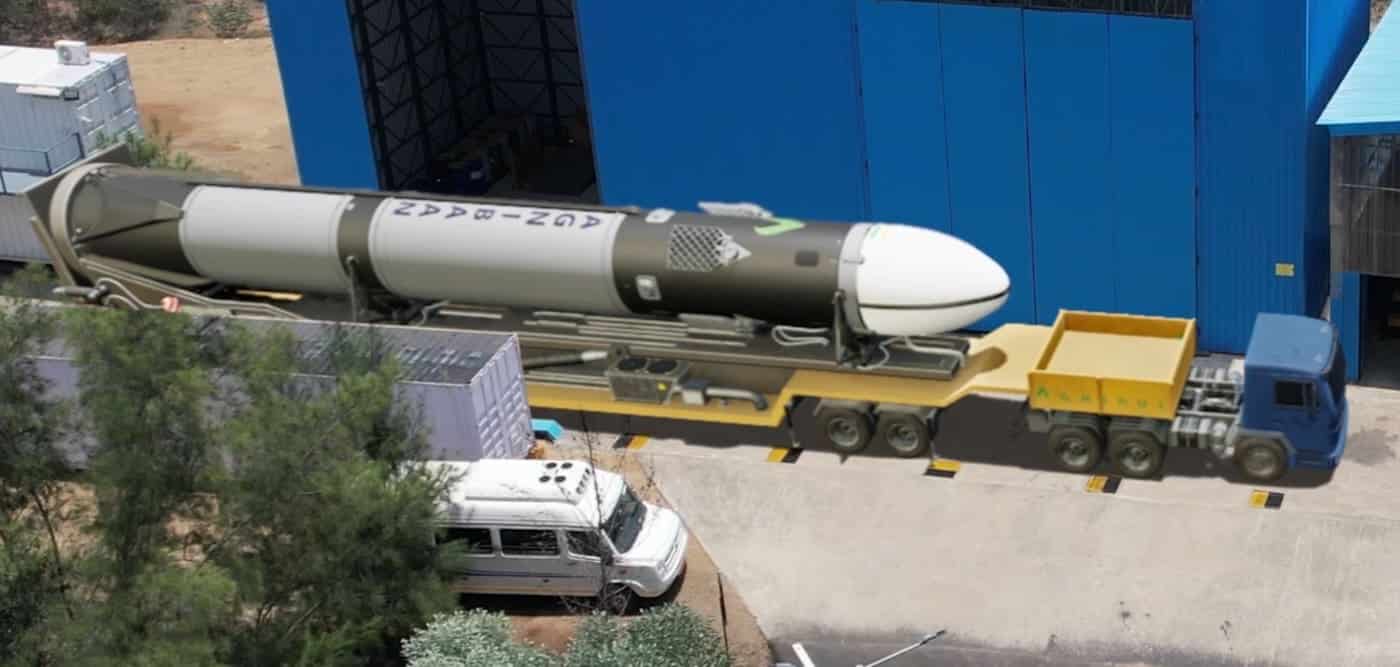
The race for Artificial Intelligence infrastructure is no longer confined to industrial parks, deserts with power substations, or massive “hyperscale” campuses. In recent weeks, a new concept has regained attention: raising computational capacity into space to run AI inference in orbit. In this context, the Indian space technology company Agnikul Cosmos and the AI cloud provider NeevCloud have signed an agreement to launch a “data center” module into orbit before the end of 2026, using a platform that leverages a key part of the rocket: its upper stage.
This announcement places India into a conversation that was previously more speculative than scheduled, but it’s now filling with concrete plans, regulator presentations, and commercial agreements. The gist: if AI needs increasing energy and silicon, some of that demand could shift to an orbital infrastructure powered by the Sun, with compute nodes close to where data is generated or captured (satellites, sensors, communication links), promising new models for latency, security, and availability.
An upper stage that isn’t discarded but “recycled” as an on-orbit platform
Agnikul, incubated within the IIT Madras ecosystem and known for developing rockets with 3D-printed components, proposes a shift from the traditional launch logic: instead of discarding the upper stage once the payload is deployed, their technology aims to turn that rocket part into a functional asset in space, capable of housing hardware and software.
G Srinath Ravichandran, Agnikul’s CEO, explained this mindset shift with a phrase that captures the change: the upper stage “remains active and functional” to become a reusable resource that can host compute or data capabilities. In other words, the vehicle that “lifts” something into orbit could also be a “home” for part of the infrastructure.
Meanwhile, NeevCloud brings the cloud and AI perspective. Founder and CEO Narendra Sen emphasizes that this isn’t just about a standalone data center but about a new layer of orbital inference infrastructure. The terminology (“orbital edge”, “space data center modules”) is an attempt to embed this concept into familiar language for developers and architects: edge computing, but literally with the system’s edge in Low Earth Orbit (LEO).
Timeline: pilot before the end of 2026, scaling to over 600 nodes
According to sources from India’s industry media, the agreement involves a first pilot scheduled for before the end of 2026. If the technical and operational validation succeeds, the plan is ambitious: exceed 600 “Orbital Edge Data Centers” within the three years following the pilot’s success.
This number alone signals intent. Even if “data center” in orbit doesn’t mean a terrestrial data center with thousands of racks, the projected scale suggests a modular approach: many small, repeatable, upgradable, and distributed nodes, deployed in successive phases.
What’s the point of a “cloud” in space?
The common use case cited is real-time inference: running models close to where quick decisions are needed or where data is generated that shouldn’t be fully sent back to Earth. The discourse includes sensitive industries like defense and finance, coupled with a particularly relevant argument for 2026: sovereign control of data and mitigation of geopolitical risks.
This isn’t a new concept, but its attempt to land in a commercial architecture is. The idea is to have LEO compute nodes that could handle inference requests, filter or preprocess data, and reduce the need to transport large volumes to terrestrial data centers. Additionally, the energy advantage is notable: space offers more constant solar radiation than surface locations, potentially allowing at least on paper to reimagine part of AI’s energy costs.
Challenges the industry can’t ignore
Enthusiasm coexists with a list of technical realities that any sysadmin would describe in one word: operation.
Building an “orbiting data center” means tackling radiation, component degradation, thermal management (in vacuum, heat isn’t dissipated like in air; radiators and system design are needed), limited maintenance, long replacement cycles tied to launches, and a connectivity chain reliant on space links and ground stations. Plus, at a constellation scale, regulatory and orbital sustainability concerns—space traffic, debris, international coordination—become critical.
Industry analysts warn that while more companies are exploring this route, “making it work” at scale will be the hard part. Agnikul and NeevCloud’s move is seen as a high-profile experiment: if the pilot proves real value—and not just a demo—the idea could gain traction.
A trend gathering speed: from announcement to proposals to regulators
India’s announcement comes amid other efforts pushing similar narratives. In the U.S., SpaceX has filed with the FCC a proposal for a constellation of up to 1,000,000 satellites aimed at “solar-powered data centers” in orbit. While analysts see this number as exaggerated, it signals a clear strategic direction. In parallel, Starcloud has surfaced with a proposal for up to 88,000 satellites, sparking a debate that appears to be a new “arms race” in space-based computing.
In this landscape, India aims to position itself with a narrative advantage: not just launch, but service. Agnikul isn’t just selling rides to space but also the “home” where compute loads are housed, potentially reducing—according to the company—the need for clients to design and deploy entire satellites.
What developers and infrastructure teams should keep an eye on
For technical professionals, perhaps the most important isn’t the headlines but the questions they raise:
- What types of workloads will actually run on these nodes? (light inference, streaming pipelines, filtering, compression, specialized models).
- How will they be deployed and updated? (immutable images, edge deployment, remote control, telemetry, rollback mechanisms).
- What SLA is realistic in an environment without instant physical intervention?
- How will these nodes integrate with ground infrastructure? (backhaul, stations, peering, end-to-end security).
By 2026, these remain more questions than answers. But the market signal is clear: the energy costs of AI, the drive for sovereignty, and the search for new surfaces of computation are pushing companies to treat space as the next “edge” of the system.
FAQs
What exactly does “space data center” mean in this announcement?
It refers to AI compute modules in Low Earth Orbit (LEO), intended for inference and processing tasks, not necessarily a traditional data center with thousands of servers.
Why might recycling a rocket’s upper stage reduce orbital deployment costs?
Because it avoids designing a satellite from scratch for hardware housing: the upper stage is repurposed as an active platform in orbit, lowering some of the costs and complexities of integration.
What technical advantages does orbital AI inference have over terrestrial data centers?
Primarily, it brings computation closer to specific data flows and allows operation with space-based edge nodes, plus explores an energy model based on solar power in orbit.
What are the major operational risks for an “orbital data center” from a sysadmin/dev perspective?
Thermal management in vacuum, radiation, limited maintenance, demanding remote updates, dependence on space links, orbital traffic regulation, and the complexity of monitoring and securing a distributed constellation.