
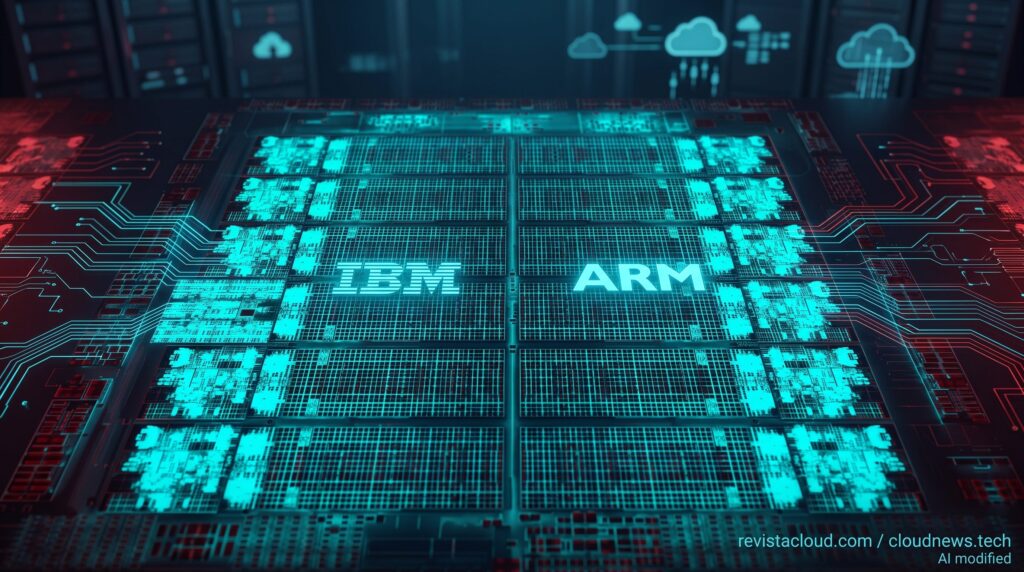
At Hot Chips, IBM revealed the design of its first dual-architecture processor for future IBM Z and LinuxONE systems, a chip that can run Arm instructions natively right alongside IBM’s enterprise ones. Still in development, it will be built on 2-nanometer technology, pack 11 cores running above 5.7 GHz, and put AI acceleration and input/output processing directly on the silicon.
The IBM-Arm processor in 30 seconds
- IBM is building a processor that runs Arm and IBM Z or LinuxONE instructions on the same cores, without splitting the two architectures physically.
- It will be made on 2-nanometer technology, with 11 high-performance cores running above 5.7 GHz.
- It will let Arm Linux environments run together with z/OS and Linux on IBM Z.
- It will carry accelerators for AI inference and a dedicated unit for input/output.
- This is the first concrete result of the IBM-Arm collaboration announced in April 2026.
The announcement stands out because IBM isn’t just planning to bolt auxiliary Arm processors onto its mainframes. The design has each core understand and run two different instruction sets, natively and at the same time.
The aim is to bring software written for the wide Arm ecosystem onto the systems long tied to transaction processing, large databases, and critical enterprise workloads.
Arm moves into the mainframe core itself
IBM Z runs on an architecture with decades behind it. Modern mainframes look nothing like their ancestors, but they keep a hardware and software environment built around very specific demands for availability, security, and transaction processing.
This approach changes something big.
IBM says the future processor won’t use a separate group of Arm cores and a separate group of IBM cores. Each core will run instructions for both Arm and IBM Z or LinuxONE.
That would let one system run native Arm Linux applications next to z/OS and Linux on IBM Z at the same time.
The distinction sounds technical, but it has practical weight. Arm carries a huge catalog of tools, frameworks, containers, and applications built for cloud servers, devices, and AI systems.
IBM puts the Arm ecosystem at more than 22 million developers worldwide.
The company wants to bring that software to its enterprise platforms without giving up what sets IBM Z and LinuxONE apart: hardware fault detection and recovery, encryption, secure key management, and high availability.
The work grew out of a strategic collaboration IBM and Arm announced on April 2, 2026. Back then, the two said they’d explore dual-architecture hardware and virtualization that could run Arm applications on IBM’s enterprise systems.
Four months later, IBM has shown the first concrete design from that deal.
2 nanometers, over 5.7 GHz, and AI acceleration
The early specs sketch the kind of processor IBM is building.
The chip will use a 2-nanometer process and pack 11 high-performance cores that can run above 5.7 GHz.
IBM hasn’t detailed every feature yet, and it hasn’t named a release date for the first commercial systems that will use it.
It has confirmed AI inference accelerators, continuing a line already running with processors like Telum II.
One use IBM names outright is fraud detection during transactions. The idea is to run certain AI operations right where the data is being processed, instead of shipping it out to external infrastructure for analysis.
The processor will also carry a Data Processing Unit (DPU) built to speed up input/output, plus a large-capacity cache aimed at heavy enterprise workloads.
Read those features in the context of much larger systems. IBM notes its Z and LinuxONE platforms can scale to hundreds of cores and tens of terabytes of memory.
So the goal isn’t to go head-to-head with ordinary Arm processors in single servers. IBM wants to fold the Arm ecosystem into machines built to consolidate huge amounts of enterprise processing.
Arm pushes into x86 and proprietary territory
The move reflects a wider shift in the server market.
Arm has been spreading past smartphones and embedded devices for years. Amazon Web Services builds its Graviton processors for cloud infrastructure, NVIDIA designed Vera for its future AI platforms, and other vendors keep pouring money into the architecture.
IBM is taking a different route.
Rather than swapping its traditional architecture for Arm, it wants both to live inside the same processor.
That would keep enterprise applications built over decades while pulling in modern workloads first written for Arm.
The strategy could be a strong fit for AI and cloud-native applications, two areas where software compatibility weighs heavily on architecture choices.
It could also lower one of the usual barriers of specialized systems: having to adapt or recompile applications for a different platform.
IBM still has to spell out how the compatibility works in practice, which Arm operating systems it will support, how it will manage resources between the architectures, and what running both at once does to performance.
The company stresses these are future plans that can change, and the features announced aren’t the final specs of a product you can buy today.
What showed up at Hot Chips is mostly a fairly concrete statement about where future IBM Z and LinuxONE generations are headed.
For years, mainframe modernization has mostly meant bringing Linux, containers, and cloud tools onto a historic platform. With this processor, IBM wants to go a step further: let some of the software built for Arm reach the mainframe without Arm becoming an outside platform.
Frequently Asked Questions
Will the new IBM processor have separate Arm cores?
No. According to IBM, each core is designed to run both Arm and IBM Z or LinuxONE instructions natively, rather than dividing the processor into two separate core groups.
What are the processor’s specifications?
IBM revealed a 2-nanometer design with 11 high-performance cores above 5.7 GHz, including AI inference accelerators, an integrated DPU for input/output, and a broad cache architecture.
Will it run Arm Linux applications?
That’s one of its main goals. IBM wants future systems to run native Arm Linux environments alongside z/OS and Linux on IBM Z.
When will it reach IBM Z and LinuxONE servers?
IBM hasn’t announced a commercial release date. It describes the processor as technology in development for future generations of IBM Z and LinuxONE.
