
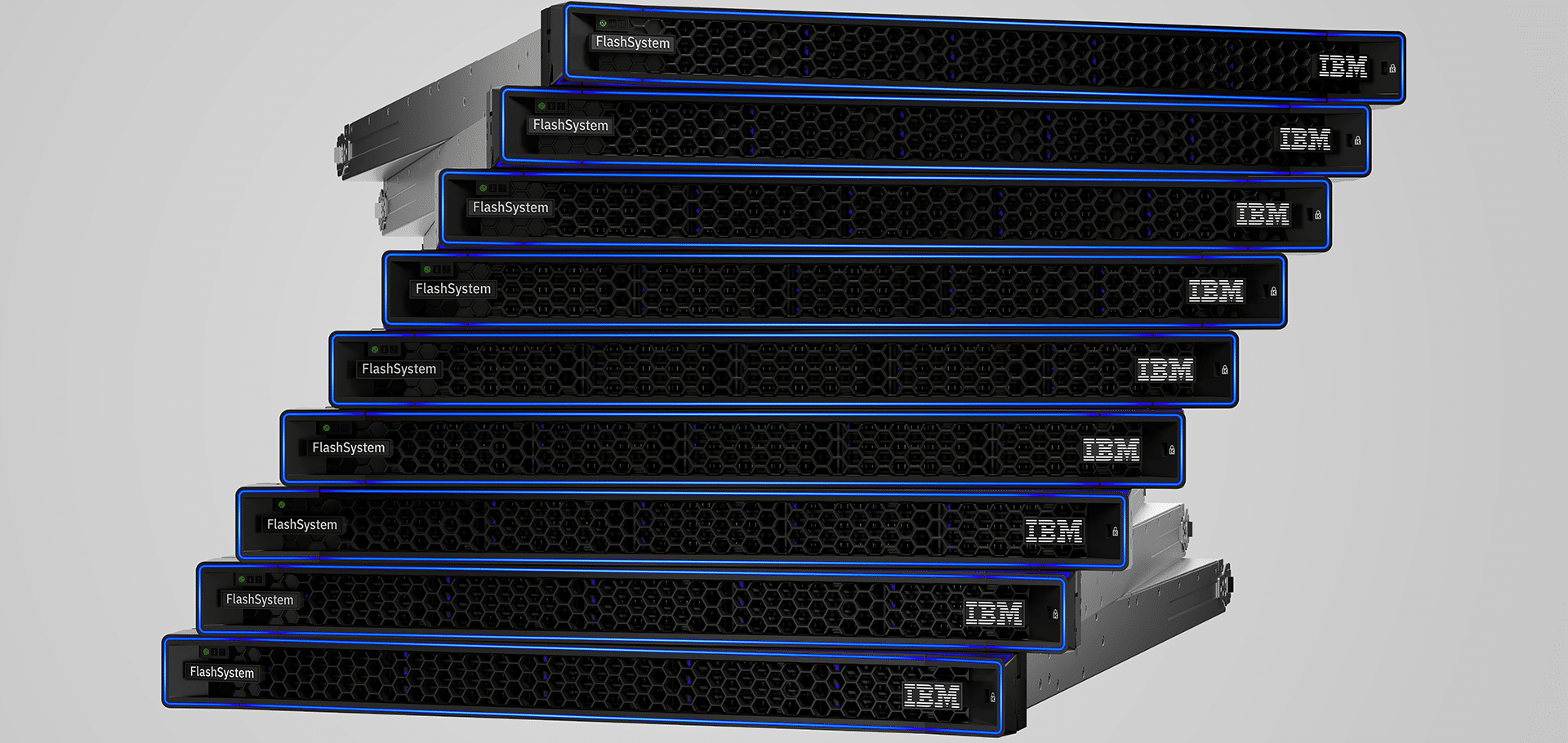
IBM has decided to take the conversation about enterprise storage into a territory that until recently sounded more like a laboratory promise than a catalog product: flash arrays capable of operating with “co-administrators” based on Artificial Intelligence agents, automating decisions and enhancing resilience against ransomware. In an announcement dated February 10, 2026, the company introduced the new generation of its IBM FlashSystem family—featuring models 5600, 7600, and 9600—and a new layer of services called FlashSystem.ai, aimed at drastically reducing the operational load of storage teams and turning the cabinet into a kind of “always-active” intelligence layer within the data center.
The move responds to a scenario common in most large organizations: accelerated data growth, pressure to consolidate platforms, stricter compliance requirements, and increasingly hostile perimeters. Added to this is the arrival of Artificial Intelligence projects in production, which spike demand for performance and require storage to be more than just capacity. IBM frames this movement as the beginning of an “era of autonomous storage,” where the system not only stores information but analyzes threats, adjusts performance, proposes recoveries, and documents decisions with less human intervention.
Three new systems for different business sizes (and a leap in efficiency)
The new portfolio revolves around three models that cover needs from “midrange” to mission-critical environments:
- IBM FlashSystem 5600: designed for organizations seeking enterprise capabilities in a compact format. IBM claims it can reach up to 2.5 PBe of effective capacity in a 1U chassis and achieve 2.6 million IOPS, with a design particularly suited for space-constrained locations (edge, remote offices, or small data centers).
- IBM FlashSystem 7600: built for growing workloads and scalability, with up to 7.2 PBe of effective capacity in 2U and up to 4.3 million IOPS. IBM positions it as ideal for large virtualized environments, analytics, and application consolidation.
- IBM FlashSystem 9600: aimed at critical operations, with up to 11.8 PBe of effective capacity in 2U and up to 6.3 million IOPS. The company associates it with use cases such as core banking, ERPs, and AI-driven applications demanding low latency and advanced security. It also claims it can reduce operational costs by up to 57% compared to the previous generation, leveraging automation and consolidation.
In terms of efficiency, IBM guarantees that the new systems offer up to 40% more data efficiency than the previous generation, and that the storage footprint can be reduced between 30% and 75% depending on the model and scenario. Additionally, models 7600 and 9600 introduce the option to visually display system status through new interactive LED bezels—a sign that operational experience is also being redesigned for daily use.
FlashSystem.ai: agents as “co-pilots” for the administrator
The most striking element of the announcement is FlashSystem.ai, described as a set of intelligent services to manage, monitor, diagnose, and correct incidents across the entire data flow. IBM states that these agents execute thousands of decisions daily that previously required human oversight, supported by models trained with tens of billions of data points collected from telemetry and operational experience.
Practically, IBM’s message is clear: complexity no longer scales linearly with data center size. Therefore, storage must automate repetitive tasks and reduce human error margins. The company quantifies this impact, noting that FlashSystem.ai can cut manual management efforts by up to 90% in certain routine operations, based on internal assessments of representative tasks.
Beyond optimization and automation, IBM emphasizes auditing and compliance: FlashSystem.ai is designed to halve the time needed to prepare documentation thanks to explainable operational reasoning generated by AI—something that can make a difference between “having controls” and being able to demonstrate them quickly, especially in regulated sectors.
Fifth-generation FlashCore Module: ransomware detection in less than a minute
If FlashSystem.ai is the brain, the announcement also reserves a leading role for hardware: the fifth generation of the FlashCore Module (FCM). IBM describes these modules as all-flash units with up to 105 TB of capacity and hardware-accelerated analytics capable of calculating I/O operation statistics to detect anomalies with low latency.
Regarding cyber resilience, IBM guarantees ransomware detection can occur in less than 60 seconds from the start of encryption, based on internal experiments. It claims that the system is trained to keep false positives below 1% in its latest detection model. The approach is ambitious: rapid detection, early alerts, and autonomous recovery actions “at the hardware layer,” aiming for the cabinet to be not just a repository but a proactive defense point at the source.
Background: AI drives the redesign of the storage stack
IBM places this leap at a moment when the industry is trying to industrialize agent-based workflows. The company cites a study by IBM Institute for Business Value (IBV), which indicates that 76% of surveyed executives state that their organizations are developing, testing, or scaling proofs of concept to automate intelligent workflows using autonomous agents. This figure helps explain why the vendor seeks to transfer this logic to storage: if the “work” of the data center is automated, then the storage system cannot remain the most manual piece of the puzzle.
The vision also resonates with market analysts. IDC, through Natalya Yezhkova, notes that these capabilities enable optimal workload placement, strengthen security, and proactively address compliance, with adaptive SLAs that do not add to the administrator’s load. Some IBM integrators and partners interpret this move as a shift from “integrated protection” to “generalized intelligence”: storage that learns, adapts, and supports the human team in critical decisions.
Availability and support: commercial launch in March
IBM announced that the new FlashSystem portfolio will be generally available on March 6, 2026. The company also links the launch to its IBM Technology Lifecycle Services (TLS), which include AI-enabled monitoring, automated incident detection, and preventive checks to reduce downtime risk.
Overall, the announcement signals a direction: all-flash storage is no longer competing solely on IOPS or latency but on ability to operate smoothly, resist attacks, and support increasingly demanding workloads—including those driven by Artificial Intelligence—without scaling hardware at the same pace as data growth.
Frequently Asked Questions
What does “autonomous storage” mean in enterprise flash arrays like IBM FlashSystem?
It refers to cabinets capable of automating operational tasks (provisioning, adjustments, diagnostics, and remediation) with the help of Artificial Intelligence agents, reducing manual work and improving operational consistency.
How does ransomware detection in storage work, and what are the advantages of doing it within the cabinet?
IBM claims that its fifth-generation FlashCore Module uses hardware-accelerated analytics to identify anomalous patterns in I/O operations and alert in less than a minute. Detecting threats within the cabinet allows near-data response, with less dependence on external layers.
What are the practical differences between IBM FlashSystem 5600, 7600, and 9600 when choosing a model?
The 5600 emphasizes density in 1U for space-constrained environments; the 7600 balances scalability and performance for consolidation and virtualization; the 9600 targets mission-critical workloads, maximum scale, and advanced security for core banking, ERPs, and AI workloads.
What does FlashSystem.ai contribute to daily management within a data center?
IBM presents it as a layer of intelligent services with agents that automate decisions, speed up diagnostics, and assist in preparing audit evidence and compliance, aiming to reduce operational effort and human risk.
via: newsroom.ibm