
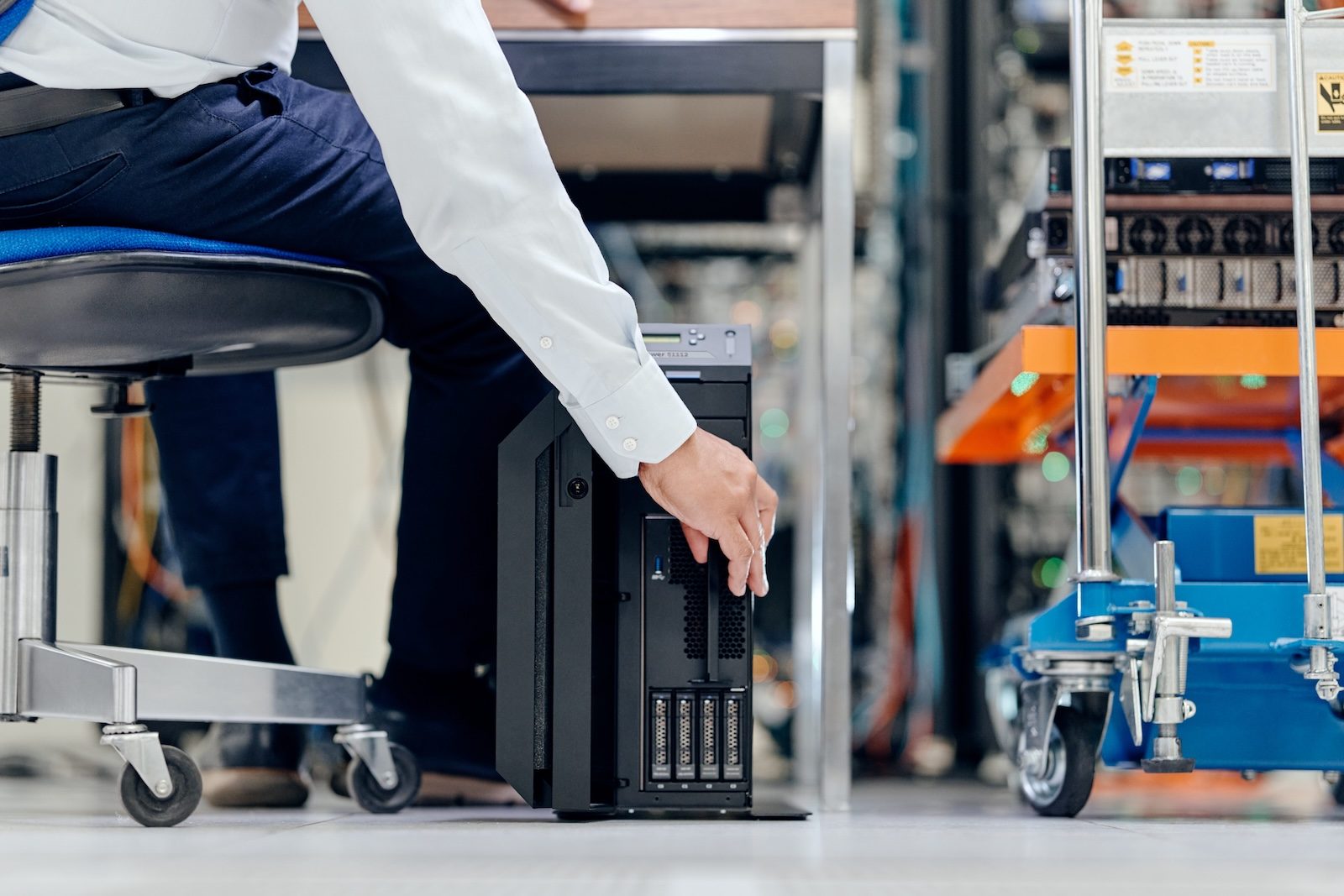
IBM has announced a new entry-level Power11 server and two AI agent-based tools for infrastructure management and enterprise application modernization. The Power S1112 will enable AI inference on-premises, while Power Autonomous Operations will monitor systems and propose corrective actions through a conversational interface. The company also expands IBM Bob to make maintaining software written for IBM i easier.
The key highlights of IBM Power in 30 seconds
- Power S1112 is a single-socket Power11 server designed for mid-sized companies, remote sites, and local AI workloads.
- Power Autonomous Operations will use an agent to detect capacity issues and recommend or execute fixes with human approval.
- IBM Bob Premium Package for i helps understand, document, and modify applications written in RPG.
- The server will launch on July 24, 2026, and the autonomous operations platform on September 23, 2026.
These innovations are part of IBM’s effort to bring the AI agent model to a platform that still supports critical processes for banks, insurers, governments, resellers, and industrial companies. In these environments, automation must do more than generate responses: it must respect permissions, logs, and prevent incorrect decisions from disrupting billing, inventory, or payment systems.
IBM Power Autonomous Operations will focus on infrastructure performance. IBM Bob will address application development cycles, especially on IBM i, while the new Power S1112 will offer a more compact physical option for running traditional workloads and inference models close to data.
Power S1112 brings Power11 closer to smaller facilities
Power S1112 is a single-socket server aimed at the entry-level Power11 family. IBM presents it as an alternative for organizations needing to maintain on-premises applications, run IBM i, AIX, or Linux partitions, and add AI inference without deploying a larger system.
The Power11 processor includes built-in Matrix Math Acceleration (MMA). This unit is designed to perform matrix operations used by machine learning models, allowing certain inferences to run without necessarily installing an external GPU.
| Feature | IBM Power S1112 |
|---|---|
| Processor | IBM Power11 |
| Configuration | Single socket |
| Supported Systems | IBM i, AIX, Linux |
| AI Acceleration | Integrated MMA acceleration |
| Target Audience | Medium-sized businesses, remote sites, local deployments |
| Estimated Availability | July 24, 2026 |
| New Support Offerings | Power Expert Care Premium Essentials |
IBM claims that the S1112 delivers twice the performance per core compared to the Power S914 and three times that of the Power S814. It also reports up to a 69% improvement in performance per watt over the S914.
These figures are based on internal measurements and extrapolations. IBM calculates performance using the Commercial Processing Workload (CPW) metric, traditionally used to estimate IBM i workloads. They do not necessarily reflect performance in databases, Linux applications, or specific AI models.
| IBM’s Published Comparison | Claimed Improvement |
|---|---|
| Performance per core vs. Power S914 | 2x |
| Performance per core vs. Power S814 | 3x |
| Performance per watt vs. Power S914 | Up to 69% |
| Local inference | Via MMA acceleration in Power11 |
The ability to perform local inference may interest companies that prefer not to send certain data to a public cloud or require low-latency responses. A system could classify transactions, analyze internal documents, or detect anomalies within the same installation where applications reside.
This does not make the S1112 a direct substitute for servers equipped with large GPU arrays. Its role is tailored to enterprise models and inferences compatible with its computing and memory capacity. IBM has not published testing results with specific models, token throughput, or comparisons with external accelerators.
The company will support the server with Power Expert Care Premium Essentials, a new incident-focused support level that offers prioritized access to specialists, faster response times, and support automation.
An agent managing infrastructure through conversation
Power Autonomous Operations introduces a natural language interface to query and manage IBM Power environments. Administrators can request info about capacity, performance, or system status without manually navigating multiple dashboards.
The agent will monitor metrics, analyze alerts, and generate recommendations. It will also prepare corrective actions, though IBM states that some interventions will still require human approval before execution.
| Operation Stage | Agent Function |
|---|---|
| Monitoring | Collect system metrics and alerts from Power servers |
| Diagnosis | Analyze potential causes of issues |
| Recommendation | Suggest capacity or configuration changes |
| Validation | Present actions for human review |
| Correction | Apply authorized measures |
| Follow-up | Verify if the environment returns to expected levels |
IBM claims that the platform can resolve capacity issues up to 15 times faster than manual intervention. This figure is based on an internal test involving eleven Power systems with predefined thresholds and policies.
In the test, manual review of dashboards, data export, analysis, and adjustments took an average of 52.59 minutes, while Power Autonomous Operations completed the same tasks in just 3.33 minutes, including diagnostics and actions requiring approval.
| IBM Internal Test | Average Time |
|---|---|
| Manual process | 52.59 minutes |
| Power Autonomous Operations | 3.33 minutes |
| Reported improvement | Up to 15x faster |
| Systems involved | 11 Power servers |
This doesn’t imply all incidents will be resolved fifteen times faster. The test was conducted under controlled capacity conditions with predefined rules. Hardware failures, network issues, or application bugs may require different investigative approaches.
Automation can effectively reduce repetitive tasks. Reviewing metrics across multiple servers, comparing resource consumption, identifying resource-starved partitions, and preparing changes are operations that take time but follow known procedures.
The main risk arises when an agent has permissions to modify critical infrastructure. A mistaken recommendation could reassign resources, restart services, or change configurations essential for application stability. Human approval, access controls, and activity logs are crucial for evaluating the product once deployed in real environments.
IBM Bob aims to reduce dependency on RPG specialists
The third announcement component is IBM Bob Premium Package for i, available from June 24, 2026. It is an assistant focused on the IBM i operating system and applications written in languages like RPG.
Many organizations still run legacy programs that handle financial, logistical, and administrative processes for decades. The challenge isn’t just in their operation but also in finding developers who understand the code, conventions, and dependencies accumulated over time.
IBM Bob can analyze applications, explain their structure, follow field logic, generate documentation, and assist in planning modifications. The company describes it as an agent-based experience for the software development lifecycle.
| IBM Bob Capabilities for IBM i | Expected Utility |
|---|---|
| Explain RPG code | Help new developers understand complex applications faster |
| Track fields and dependencies | Understand data flow within applications |
| Generate Documentation | Reduce undocumented knowledge |
| Plan changes | Support modernization projects |
| Assist during development | Help modify and review applications |
| Compatibility with IBM i patterns | Tailor responses to the platform |
Heartland Co-Op, one of IBM’s early users, estimates that newly hired developers understand complex applications about 60% faster with the tool. This is a customer testimonial included by IBM, not an independent test or universally applicable result.
Bob Richardson, a support analyst at Wynne Systems, also states that the plans generated by Bob were more detailed than those produced by other AI tools using similar instructions. However, the comparison does not specify the models used or an evaluable methodology.
The utility of these assistants depends on their ability to understand proprietary code, internal libraries, business rules, and data structures that are rarely fully documented. A model might correctly explain a single function but not detect dependencies on other processes or external integrations.
Therefore, code generation must be accompanied by testing, peer review, and version control. In systems managing orders, payroll, or accounting, even small changes can significantly impact business outcomes.
IBM aims to make Power a partially autonomous platform
These three innovations span different layers of the platform. The server provides compute capacity; Autonomous Operations handles management; and Bob focuses on applications. IBM’s goal is to extend automation from code to execution environment.
| IBM Power Layer | Innovation | Function |
|---|---|---|
| Hardware | Power S1112 | Run applications and inference locally |
| Operations | Power Autonomous Operations | Monitor, diagnose, and fix |
| Development | IBM Bob Premium Package for i | Understand and modernize applications |
| Cloud | Power Virtual Server | Run IBM i, AIX, and Linux as a managed service |
| Support | Expert Care Premium Essentials | Priority support for S1112 |
The company links this strategy to its forecasted growth in enterprise agents. An IBM Institute for Business Value study indicates that surveyed organizations expect to deploy an average of 1,661 AI agents by 2027, a 38% increase. This data comes from their own research and reflects respondents’ expectations, not actual installations.
Expanding the number of agents increases the volume of automated actions that organizations need to oversee. If each system queries data, calls tools, or modifies processes, administrators must control identities, permissions, logs, and operational boundaries.
IBM wants Power to serve as a foundation for these workloads without sacrificing platform characteristics like availability, continuity, and backwards compatibility. This approach is especially relevant for companies that cannot immediately migrate core systems to new architectures.
The challenge will be demonstrating that autonomy reduces workload without introducing new uncertainties. An agent recommending capacity upgrades can save time; one applying a wrong change on a critical system could cause harm instead.
Power S1112 will launch on the announced date, July 24, 2026. Power Autonomous Operations will follow on September 23, 2026, and IBM Bob Premium Package for i has been available since June. Until these capabilities are tested in production, performance and productivity improvements are based on IBM’s reports and initial user feedback.
Frequently Asked Questions
What is IBM Power S1112?
It’s a single-socket Power11 server designed for IBM i, AIX, and Linux workloads. It can also run AI inference with its integrated matrix acceleration.
Will Power Autonomous Operations modify systems automatically?
It can detect issues, generate diagnostics, and prepare corrective actions. IBM states that its internal testing involved human approval before applying suggested measures.
What is IBM Bob used for on IBM i?
It helps understand, document, and modify applications, especially those written in RPG. Its goal is to ease onboarding new developers and support modernization efforts.
When will these new features be available?
IBM Bob Premium Package for i is available since June 24, 2026. Power S1112 launches on July 24, 2026, and Power Autonomous Operations on September 23, 2026.
via: newsroom.ibm
