
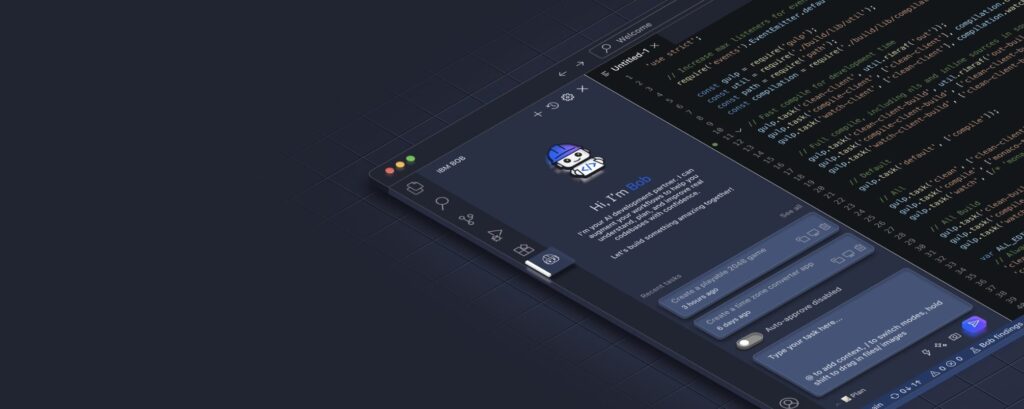
IBM wants its programming assistant to evolve beyond a tool limited to generating code snippets. The company has enhanced IBM Bob with sub-agents, parallel tool execution, AI consumption monitoring, and specialized workflows to modernize business applications built on IBM Z, IBM i, and Java.
The proposal addresses a problem already emerging in companies using AI for software development: faster coding doesn’t guarantee earlier deployment. Reviews, testing, dependency analysis, security, and validation can become the new bottleneck. Bob aims to cover this entire process through repeatable workflows involving models, automated tools, and people.
IBM Bob: key points in 20 seconds
- IBM Bob incorporates sub-agents operating in separate contexts.
- Can run multiple tools in parallel for a single task.
- Bobalytics allows monitoring AI usage, performance, and costs.
- Workflows structure modernization projects with auditable, repeatable steps.
- IBM offers specific packages for IBM Z, IBM i, and Java applications.
- The Java package plans migrations up to Java 25.
- Works with RPG, COBOL, CL, DDS, and Db2 for i on IBM i.
- Includes knowledge on COBOL, PL/I, JCL, and mainframe dependencies for IBM Z.
- Actions modifying files or executing commands still require authorization.
- The enhancements target enterprise teams, not just individual developers.
IBM Bob V2 reached general availability on June 24, 2026, with a rebuilt architecture. The new version separates agent reasoning, shared infrastructure, and developer work environments. IBM states that over 100,000 of its employees are already using the platform, from mainframe teams to cloud-native projects.
It’s no longer just about writing code
Early AI-based programming assistants focused on completing functions, explaining snippets, and generating tests. While useful for specific tasks, this approach shows limitations when working on applications with thousands of files, multiple databases, and decades of business logic.
Updating a Java platform from version 8 to 25, for example, involves more than syntax transformation. It requires identifying incompatible libraries, reviewing configurations, updating dependencies, modifying pipelines, running tests, and ensuring system behavior hasn’t changed.
The complexity increases on IBM Z and IBM i. Many critical applications in banking, insurance, distribution, and industry combine code from different eras, incomplete documentation, and knowledge often held by near-retirement professionals.
IBM presents Bob as a platform capable of planning, executing, validating, and governing such changes. The agent can study repositories, propose strategies, implement modifications, and pause at points where human review or approval is needed.
The distinction from traditional assistants lies in scope. The goal is no longer to respond to isolated requests but to maintain the state of multi-phase tasks and coordinate various resources for completion.
Sub-agents to prevent context overload
One of the most notable innovations is the use of sub-agents. When Bob needs to investigate a specific part of the system, it can spawn a separate context for that task.
A sub-agent might analyze how authentication works, trace calls among modules, or find all dependencies of a class. It then sends a summary back to the main agent and discards intermediate steps no longer needed.
This separation aims to address common limitations of language models. Each file read, search, or test consumes context window space. In large projects, the agent can accumulate irrelevant information, losing sight of the initial goal.
IBM states that Bob V2 extends its context window from 200,000 to 270,000 tokens, but perhaps the most valuable change is avoiding filling it with all ongoing investigative details.
The company describes these features as part of an evolution toward multi-agent systems. The term is nuanced: Bob already uses specialized sub-agents, but autonomous coordination of multiple agents on a single task is an ongoing development line in IBM’s documentation.
What changes with IBM Bob V2
| Capability | Functionality | Business benefit |
|---|---|---|
| Sub-agents | Research specific tasks in separate contexts | Reduce noise and context consumption |
| Parallel calls | Execute multiple reads, searches, or tools simultaneously | Shorten tasks with many dependencies |
| Agent, Plan, and Ask modes | Separate execution, planning, and querying | Adjust autonomy levels |
| Background tasks | Maintain multiple active jobs with independent contexts | Avoid blocking developers |
| Rollback | Save file states per task and operation | Facilitate reverting changes |
| Document reading | Process PDFs, DOCX, and XLSX directly | Include specifications and test cases |
| Workflows | Automate, incorporate AI, and human approvals | Make processes repeatable and auditable |
| Bobalytics | Measure consumption, performance, and costs | Help control AI spend |
Bob V2 also allows requesting multiple tools in a single turn. Instead of sequentially reading a file, waiting, opening another, and then searching, the system can launch these operations concurrently. IBM’s internal measurements suggest that some tasks previously taking about 30 seconds can now finish in under ten. These are IBM’s figures, not an independent benchmark, and results may vary by project.
Queries that only seek information can run with fewer interruptions. Operations that modify project state—like editing files, executing commands, or calling specific MCP tools—still require explicit authorization.
Bobalytics integrates AI cost management into the workflow
Choosing a cheaper model doesn’t guarantee an overall cost-effective task. An agent may perform numerous searches, repeatedly read the same files, open auxiliary contexts, and run multiple tools before delivering an answer.
IBM integrated Bobalytics to provide visibility into AI usage. It helps monitor consumption, allocate resources, and correlate costs with productivity, quality, and performance outcomes.
This control is particularly relevant when hundreds or thousands of developers use agents daily. Small differences in calls or tokens can scale into significant costs across an organization.
IBM’s approach involves adjusting the entire execution system: selecting the model, assigning tasks to agents, calling tools, and managing context usage. The goal is to prevent individual developers from manually choosing models without understanding the final workflow costs.
Bobalytics also addresses concerns of finance and AI governance departments. Companies need insights into who uses models, for which projects, with what budgets, and what results are achieved.
Three packages for systems that can’t be modernized with a simple prompt
The standout aspect of the announcement is in the premium packages. IBM has translated its expertise in enterprise platforms into specific workflows that can be tailored for each organization.
| Package | Main technologies and tasks |
|---|---|
| IBM Bob Premium Package for Z | COBOL, PL/I, JCL, impact analysis, dependencies, mainframe application modernization |
| IBM Bob Premium Package for i | RPG, COBOL, CL, DDS, Db2 for i, documentation, refactoring, testing |
| IBM Bob Premium Package for Java | Java migrations, dependency analysis, interface modernization, WebSphere Liberty migration |
IBM Z: understanding before changing
The IBM Z package evolves from watsonx Code Assistant for Z and aims to analyze entire applications, not just isolated programs. It uses language insights, middleware, metadata, and static analysis to build a browsable view of an application’s dependencies.
A seemingly minor change in a table can affect COBOL programs, batch processes, JCL, interfaces, and subsequent systems. Bob seeks to identify these relationships before modifying code and applying organizational standards throughout the process.
IBM claims their structured workflows can reduce effort by 50% to 80% in certain scenarios and accelerate complex tasks by 20% to 40%. These are vendor estimates; actual results depend on code quality, documentation, testing maturity, and team readiness.
IBM i: recovering decades of RPG expertise
The IBM i package connects directly to environments, source members, and applications on this platform. It can read, write, and compile code without forcing developers to relocate code to disconnected tools.
Included workflows cover explaining RPG and COBOL programs, converting fixed-format RPG to free-format, refactoring monolithic applications, generating documentation, and creating unit tests.
It also provides a database-centered mode for reviewing SQL, DDS, and queries on Db2 for i. IBM sees these features as a way to preserve knowledge trapped in extensive, poorly documented codebases.
Java: from legacy versions to Java 25
The Java modernization package addresses three main areas: updating old versions to Java 11, 17, 21, or 25; migrating interfaces built with technologies like JSF or Struts to modern web architectures; and shifting applications from WebLogic, Tomcat, or WebSphere Traditional to WebSphere Liberty.
Workflows in this package include dependency analysis, incompatibility detection, code and config changes, validation runs, documentation generation, and human approval points.
IBM highlights Blue Pearl, which reportedly completed a Java 11 to Java 25 modernization in three days—compared to over 30 days with conventional methods. IBM estimates a 90% reduction in time, although this is a case study prepared by IBM, not an independent benchmark.
Value will be in testing, not just generated code
IBM Bob exemplifies a market shift. Code assistants are increasingly competing on their ability to operate within complex enterprise processes without losing control, traceability, or security—rather than on how quickly they can generate functions.
Automatic generation can increase the volume of software subject to review. However, if testing, security analysis, and validation don’t keep pace, bottlenecks simply shift downstream.
Bob’s workflows aim to reduce this variability, defining when automation is appropriate, when models are useful, and when human intervention is necessary. The system maintains state, manages errors, and repeats sequences across different applications.
This approach aligns with IBM’s core expertise. The company understands mainframe, IBM i, and Java environments where general-purpose assistants often lack context, and errors can impact mission-critical services.
The real test will be how well the announced results generalize. Well-documented code, automated tests, and known dependencies make modernization easier than working with decades-old, poorly tested applications.
Bob can speed up research, suggest changes, and coordinate tasks. Final deployment decisions remain with the organization. For critical systems, the balance between autonomy and oversight remains more important than the lines of code produced.
Frequently Asked Questions
What is IBM Bob?
A software development platform with AI that helps plan, execute, validate, and govern tasks throughout an application’s lifecycle.
Does IBM Bob utilize multiple agents?
Yes. The platform includes sub-agents working in separate contexts and provides mechanisms for broader multi-agent coordination, which IBM continues to develop.
What is Bobalytics?
A feature that analyzes usage and costs associated with Bob. It monitors AI consumption, performance, and resource allocation.
Can it modernize COBOL and Java applications?
Yes. IBM offers dedicated packages for IBM Z, IBM i, and Java, though effectiveness depends on the application’s dependencies and available testing coverage.
via: newsroom.ibm
