

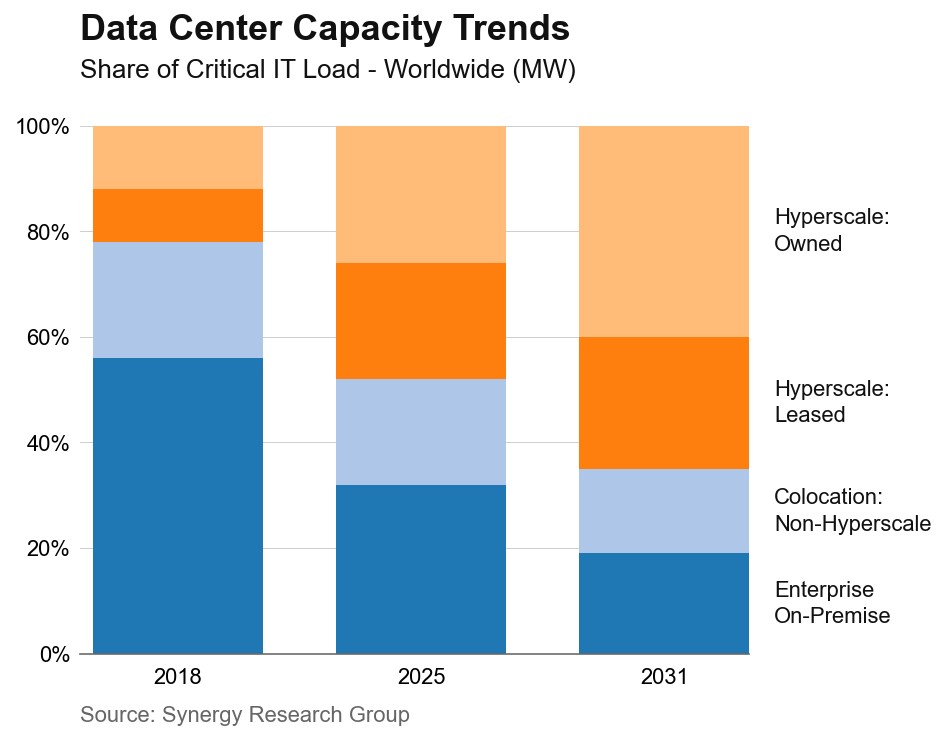
The global data center landscape is changing at a pace that leaves little room for doubt. Major hyperscale operators—companies supporting large public clouds and global digital platforms—already hold 48% of the world’s total data center capacity, according to Synergy Research Group. The firm also estimates that this share will continue to grow, reaching 67% by 2031, in a market driven by AI, cloud computing, and digital services fueling a new phase of massive expansion.
This figure is impressive on its own, but the most important aspect is the underlying trend. By the end of Q4 2025, Synergy reported 1,360 large data centers operated by hyperscale companies. Nearly 60% of that capacity is in facilities built and owned by these companies, while the rest is spread across leased centers. Simultaneously, the dominance of traditional corporate data centers continues to decline: today, they account for 32% of total capacity, down from 56% in 2018.
AI accelerates an already underway shift
Synergy’s research indicates that cloud services and consumer digital services have been moving capacity away from corporate data centers towards much larger, specialized, and centralized facilities for years. But in the past three years, AI has sped up this trend. John Dinsdale, the firm’s chief analyst, summarizes this shift clearly: AI technology has intensified a structural change already in progress, and the world is heading toward a scenario where hyperscalers will be responsible for the majority of global capacity.
This assessment aligns with other market analyses. JLL projects that between 2026 and 2030, nearly 100 GW of additional data center capacity will come online worldwide, roughly doubling the sector’s size. The consulting firm attributes this growth mainly to hyperscale cloud expansion and AI demand, adding that the market could require up to $3 trillion in total investment during this period, including real estate development and tech infrastructure deployment.
Therefore, the key isn’t just the increasing number of data centers but who is leading this expansion. Synergy highlights that hyperscale capacity will grow more than threefold by 2031, while the overall market capacity continues to expand strongly. This means that even though colocation will keep growing in absolute terms—and on-premises infrastructure may see some boost from generative AI and GPUs—its relative share will decline compared to the investment and operational muscle of major cloud providers.
On-premises data centers hold up better but lose relative importance
One of the most interesting nuances of the report is that traditional corporate data centers are not disappearing. In fact, Synergy notes that, after a long period of almost no growth, on-premises facilities are receiving a small boost thanks to generative AI applications and the need to deploy GPU infrastructure in certain companies. Still, this improvement doesn’t alter the overall picture: their market share will continue declining at about 2 percentage points per year, reaching 19% by 2031.
Colocation is not badly off in absolute terms, either, representing another 20% of global capacity today, and Synergy expects it to continue growing at close to double-digit rates year after year. The challenge for this segment isn’t demand, but rather that the speed of hyperscale capacity construction is even greater. In other words, colocation will keep growing, but within an ecosystem increasingly dominated by large-scale clients and operators.
This helps explain why so many developers, funds, and electrical infrastructure providers are leaning toward large-scale AI-related projects. JLL warns that demand is also creating bottlenecks in energy supply, grid connection, batteries, and construction, with waiting times in some markets exceeding four years to access certain electrical connections. In short, hyperscale growth depends not only on capital but also on securing land, power, equipment, and timelines in an increasingly strained market.
AWS, Microsoft, and Google continue leading the charge
Synergy has been highlighting this concentration since late 2025. In its analysis of Q3 2024, the firm pointed out that the three companies with the largest global data center footprint—Amazon, Microsoft, and Google—together represented 58% of all hyperscale capacity. Behind them were Meta, Alibaba, Tencent, Oracle, Apple, and ByteDance, among other major players. Now, the difference is that this capacity isn’t just growing but is beginning to absorb a larger share of the total global market.
The pipeline is also significant. Synergy mentions nearly 800 potential hyperscale data centers identified across various stages of planning, construction, or commissioning. With this portfolio, the firm believes hyperscale capacity could double in just three years. This explains why industry discussions are shifting from whether hyperscale will dominate to how fast it will do so and what impact it will have on the rest of the ecosystem: colocation operators, companies with their own infrastructure, energy markets, equipment manufacturers, and governments seeking to attract investment without overstressing their grids.
Ultimately, Synergy’s new report depicts a profound redistribution of the physical power behind digital infrastructure. AI has accelerated this process, cloud continues to fuel it, and the result is a market where hyperscalers are no longer just one segment among others but the central force in global data center capacity.
Frequently Asked Questions
What percentage of the global data center capacity do hyperscalers already control?
According to Synergy Research Group, hyperscale operators already account for 48% of the world’s total data center capacity as of the end of Q4 2025.
What share could they reach by 2031?
Synergy projects this share to reach 67% by 2031, making hyperscalers responsible for around two-thirds of global capacity.
Will on-premises corporate data centers disappear?
No. Synergy predicts they will continue to exist and may even receive some support from generative AI and GPU infrastructure, but their relative market share will decline from 32% today to 19% in 2031.
What’s driving this rapid growth?
Primarily, the expansion of cloud services and AI demand. JLL estimates the sector could add nearly 100 GW between 2026 and 2030, fueled by hyperscale cloud growth and the surge in AI-related workloads.
via: srgresearch