
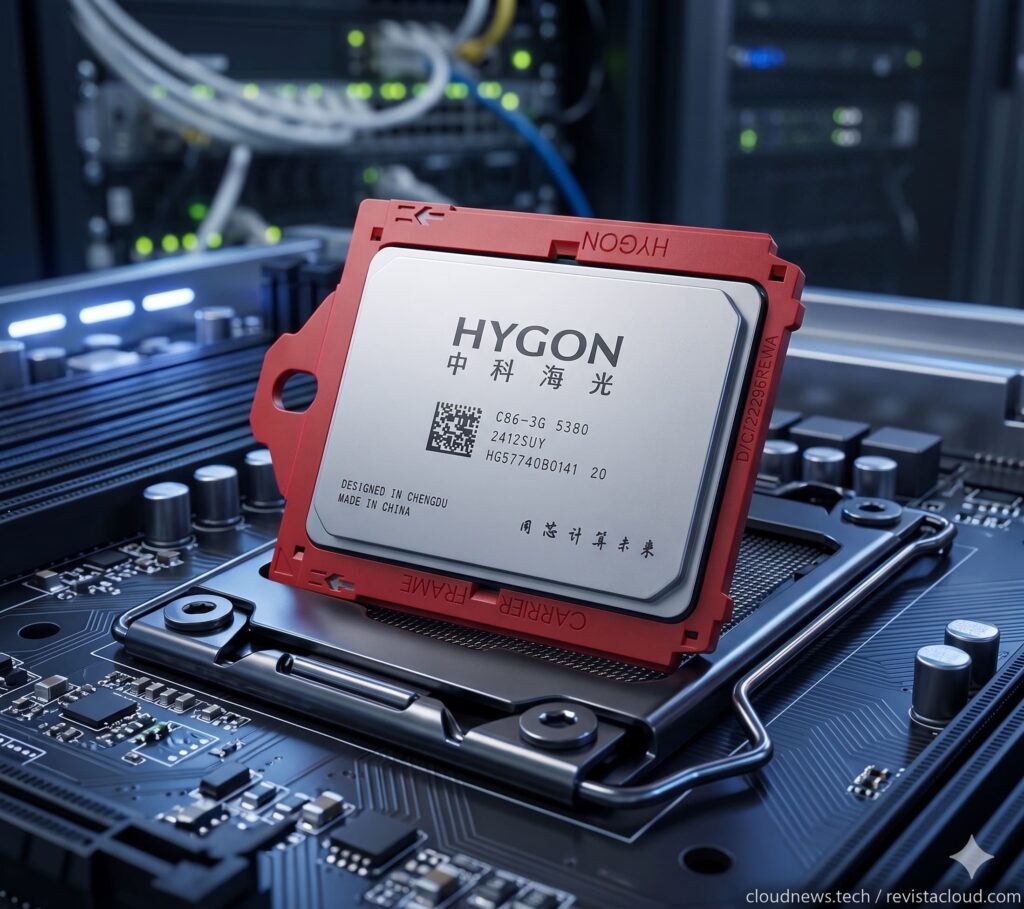
China aims to reduce its technological dependence on servers, data centers, and artificial intelligence, and Hygon has become one of the most interesting pieces of that strategy. The company is preparing a new generation of C86 processors for the Chinese domestic market, featuring a particularly eye-catching model: the Hygon C86-5G, a general-purpose x86 CPU that, according to its leaked roadmap, could reach up to 128 cores and 512 threads thanks to SMT4 technology—meaning four threads per physical core.
The data is impressive because it positions Hygon in a space where China isn’t just aiming to have “a national CPU,” but a complete platform for enterprise workloads, HPC, and AI. The company promises a new microarchitecture with an IPC improvement of over 15%, support for AVX-512, new AI acceleration instructions like INT8 and BF16, DDR5-5600 memory across 16 channels, and compatibility with CXL 2.0. On paper, the goal is clear: compete in its market with high-end processors like Intel Xeon.
A Chinese CPU with SMT4 and Data Center Ambitions
The most striking feature of the Hygon C86-5G is its adoption of SMT4. Most modern x86 server processors, like many generations of Intel Xeon and AMD EPYC, typically have two threads per core. Hygon, however, proposes four threads per core—a solution that could be useful in highly concurrent workloads, provided the core design, cache hierarchy, memory subsystem, and OS scheduler can feed that many threads without bottlenecks.
The maximum figure of 512 threads makes the C86-5G suitable for scenarios where massive parallelism matters: virtualization, private cloud, databases, concurrent services, analytics, certain HPC runs, and AI tasks supported by vector instructions. However, more threads don’t always translate directly to higher real-world performance. The effectiveness of SMT4 will depend on architecture, memory latency, bandwidth, workload behavior, and software maturity.
Another relevant point is the 16 DDR5-5600 channels. If final products confirm this spec, Hygon would be attempting to match that dense thread count with a very wide memory subsystem—an essential feature in high-performance servers. Support for CXL 2.0 also indicates a design tailored for future disaggregated memory architectures, accelerators, and coherent expansion in data centers.
| Planned Feature | Hygon C86-5G |
|---|---|
| Segment | Server, enterprise, HPC, AI |
| Max Cores | 128 |
| Max Threads | 512 |
| Multithreading Tech | SMT4 |
| Declared IPC improvement | Over 15% |
| Memory | DDR5-5600 |
| Memory Channels | 16 |
| Vector Instructions | AVX-512 |
| AI Acceleration | INT8 and BF16 |
| Interconnection | CXL 2.0 |
| Estimated Timeline | Late 2026 or 2027, no final commercial confirmation |
More Than a CPU: Accelerators, Networking, and Interconnects
The roadmap attributed to Hygon extends beyond the C86-5G processor. The company is also developing a broader ecosystem that includes DCU accelerators for AI and computing, HBM memory, support for formats like FP64, FP16, and BF16, PCIe 5.0 switches, scaling interconnection technologies, and networking chips or fabric capable of 400G and 400/800G with RDMA.
This part is nearly as crucial as the CPU itself. In the current data center market, having a powerful processor alone isn’t enough. Modern AI and HPC platforms depend on a combination of CPU, accelerators, memory, low-latency networks, efficient interconnection, and software. NVIDIA’s dominance stems from offering not just GPUs but a complete ecosystem of hardware, networking, libraries, tools, and software. Intel and AMD are also increasingly integrating their platforms.
Hygon appears to follow this same logic but with a national perspective: building a Chinese server stack that reduces reliance on foreign technology. This aligns with the pressure China has faced for years from export controls, US restrictions, and limited access to advanced components. For Beijing, having its own CPUs, accelerators, and networks isn’t just an industrial matter—it’s a strategic one.
Legacy of AMD and the Transition to a Proprietary Architecture
Hygon has a peculiar history. Its first x86 processors emerged from an agreement between AMD and THATIC announced in 2016 to develop x86 chips for the Chinese server and workstation market. Those processors, known as Hygon Dhyana, were based on AMD’s Zen architecture and closely resembled early EPYC models.
This heritage explains why Hygon is so interesting. It isn’t a company starting from scratch but a manufacturer that inherited a modern x86 foundation and has since attempted to evolve toward more proprietary designs. According to recent information on the newer C86 generations, Hygon is already talking about a self-developed microarchitecture or at least a heavily modified base compared to its origins.
The big question is how much of the C86-5G is truly proprietary architecture and how much still derives from that initial foundation. Public details on manufacturing processes, foundries, clock speeds, power consumption, cache organization, real performance per watt, or commercial availability remain limited. Without those details, any direct comparison with Intel Xeon 6 or AMD EPYC must be viewed with caution.
Impact of US Sanctions
In 2019, the U.S. Department of Commerce added several entities related to Hygon, THATIC, and Sugon to the Entity List, tightening licensing requirements for exports, reexports, and technology transfers. This decision was justified by national security concerns and the entities’ involvement in China’s high-performance computing development.
This context helps explain why Hygon emphasizes concepts like technology under its own control, national autonomy, and a domestic platform. Sanctions not only restricted Western technology transfers but also accelerated China’s efforts to replace critical components with domestic alternatives.
The C86-5G should be viewed within this race. While independent testing and commercial confirmations are still pending, its roadmap indicates that China is not content merely to produce low-performance CPUs for administrative compliance. It aims to be competitive in servers, HPC, and AI, where dependence on U.S. hardware remains a strategic challenge.
A Potential Competitor, Not a Proven Threat
Nonetheless, it’s important not to conflate ambition with results. Hygon can promise 128 cores, SMT4, AVX-512, and a comprehensive platform, but the server market is won through real performance, efficiency, stability, availability, compatibility, support, ecosystem, and trust. Intel Xeon 6 and AMD EPYC benefit from years of validation, global vendors, server manufacturers, hypervisors, OS support, compilers, and enterprise-optimized software.
Hygon, on the other hand, mainly targets the Chinese market where the priority may not be to outperform Intel or AMD on all benchmarks but to offer a locally capable alternative for critical workloads under national control. If the C86-5G delivers significantly on its promises, it could become a key component for Chinese data centers, domestic cloud, administration, research, and public enterprises.
The broader takeaway is that the competition in semiconductors is no longer just about who has the fastest CPU but about who controls the entire ecosystem surrounding the chip. In this arena, China is striving to move from dependence toward vertical integration.
Frequently Asked Questions
What is the Hygon C86-5G?
The Hygon C86-5G is a Chinese x86 CPU aimed at servers, HPC, and AI. According to its leaked roadmap, it will feature up to 128 cores and 512 threads, support SMT4, AVX-512, DDR5-5600 across 16 channels, and CXL 2.0.
What does SMT4 mean in the Hygon C86-5G?
SMT4 indicates that each physical core can run up to four parallel threads. For the C86-5G, this could allow scaling from 128 physical cores to 512 logical threads—targeting highly concurrent workloads.
Can it truly compete with Intel Xeon 6?
On paper, Hygon aims to compete with high-end server processors like Intel Xeon 6. However, independent benchmarks, detailed architecture insights, and final data on power, clock speeds, or commercial availability are still missing.
Why is Hygon important for China?
Because it represents China’s effort to develop an indigenous server and AI platform, with domestically produced CPUs, accelerators, networking, and interconnects. This reduces reliance on foreign suppliers amidst technological restrictions and geopolitical tensions.
