
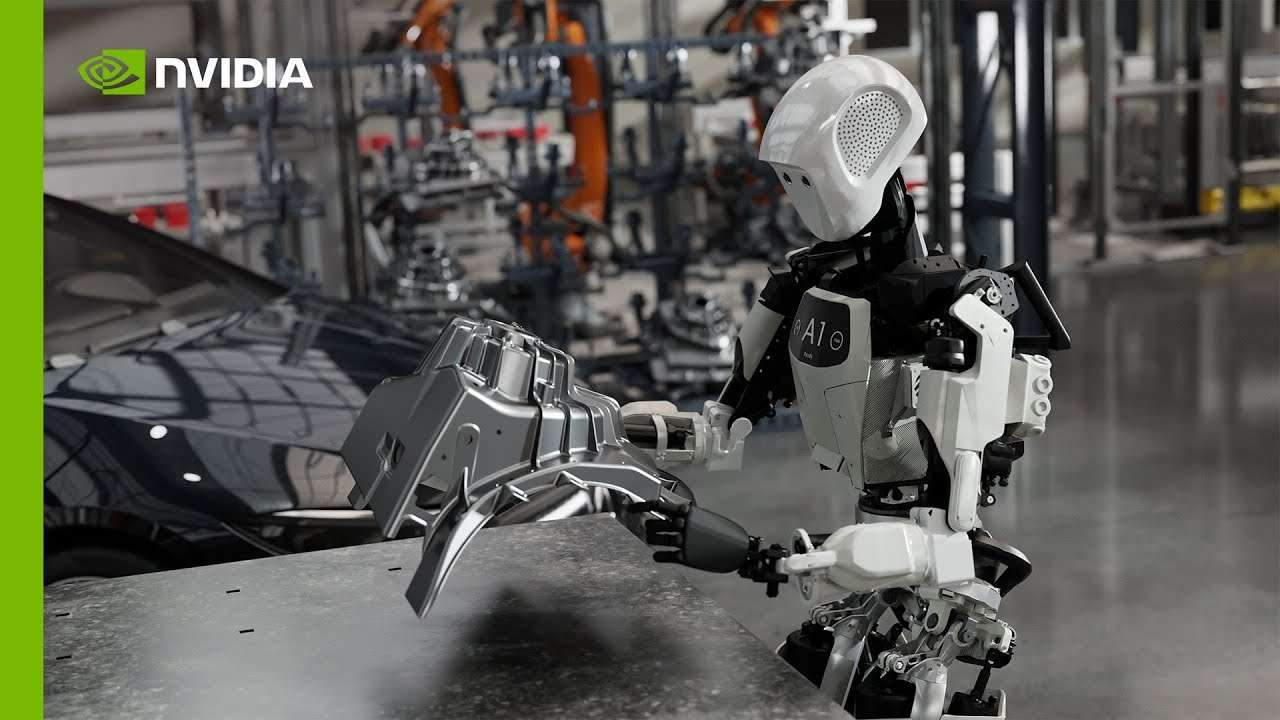
Humanoid humanoid robotics has just received one of those signals that demand a closer look at the industry. The British startup Humanoid has signed an agreement with Schaeffler to deploy between 1,000 and 2,000 humanoid robots in the group’s real manufacturing operations through 2032, according to information released by the company and reported by Reuters. The first phase will begin between December 2026 and June 2027 at two Schaeffler plants in Germany, performing box handling tasks in Herzogenaurach and conducting scale operation tests in Schweinfurt.
The announcement is significant due to the volume of robots involved, but the more interesting detail lies on the other side of the contract. Parallel to the deployment, Schaeffler becomes a preferred supplier of actuators for Humanoid’s wheeled humanoid platforms. The agreement covers over half of the startup’s jointed actuator demand through 2031 and involves a seven-digit quantity of parts. In other words: at least one million actuators.
From there, market interpretations begin. Forbes has suggested that if a wheeled unit requires around 18 to 22 actuators relevant to Schaeffler, and the German supplier covers slightly more than 50% of that demand, this million components could point to an ambition of nearly 100,000 robots in five years. This is an estimate, not an official production figure. But it helps grasp the scope of the commitment: Humanoid isn’t designing a lab pilot project, but rather a commercial chain aiming to scale quickly if the technology performs in manufacturing.
An industrial rollout, not a trade show demonstration
The first phase of the agreement has a practical interpretation. In Herzogenaurach, robots will manipulate boxes in a real production environment. In Schweinfurt, the deployment will start with a three-month showcase of capabilities and integration tests, followed by another three months onsite to validate stable, near-scale operations. The model is envisioned as Robot-as-a-Service, with fleet management software, maintenance, 24/7 support, and performance monitoring included in the package.
This aspect matters because humanoid robotics still experience a clear tension between visually impressive demos and the industry’s operational demands. A robot can impress in a video, but a factory requires availability, safety, repeatability, seamless integration with existing lines, and cost-effectiveness. That’s where it will be seen whether the Humanoid-Schaeffler deal is a step toward broader adoption or a provisional early bet with many technical uncertainties to resolve.
It’s also noteworthy that the contract focuses on wheeled robots. Humanoid works with both wheeled and bipedal platforms, but Schaeffler has chosen the more pragmatic option for industrial environments. In settings with flat surfaces, controlled aisles, and repetitive tasks, wheels generally offer greater stability, less mechanical complexity, and easier maintenance than legs. While the image of a humanoid robot walking is more striking, it might not be the most efficient for many industrial applications.
Humanoid, legally SKL Robotics Ltd., was founded in 2024 by Artem Sokolov and unveiled its HMND 01 Alpha in September 2025. The company positions itself as a UK-based AI and robotics firm focused on commercial humanoid robots, with offices in London, Boston, and Vancouver. Its website states a team of 160 professionals with backgrounds in robotics hardware, machine learning, control systems, and deployment; other sources estimate around 200 profiles from companies like Apple, Tesla, Google, Boston Dynamics, Sanctuary AI, and NVIDIA.
Schaeffler aims to be both buyer and supplier
The most strategic aspect of this move is with Schaeffler itself. The German group isn’t just acquiring robots to automate parts of its operations. It also intends to become a critical component supplier for many manufacturers working to industrialize humanoid robotics.
Schaeffler announced in April 2026 a partnership with Hexagon Robotics to develop components and deploy at least 1,000 AEON robots across its global manufacturing network over the next seven years. Earlier, in November 2025, they also established a collaboration with Neura Robotics to develop and supply components for humanoid robots and explore integration into their own assembly lines.
The company has stated that its portfolio for humanoid robotics includes bearings, precision actuators, motors, sensors, thermal management, and battery solutions. In particular, actuators are a sensitive element: they enable movement of joints like shoulders, elbows, or torsos, and capture a significant portion of the cost, reliability, and performance profile of a robot.
According to Reuters, Schaeffler’s CEO Klaus Rosenfeld said this month that the company is in contact with about 45 humanoid robotics firms worldwide and aims to build a backlog of hundreds of millions of euros in this segment by 2030. The firm estimates that its hardware can cover roughly 50% of the typical humanoid bill of materials and aspires to capture about 10% of this accessible market segment.
This dual role as industrial customer and component supplier explains why some analysts compare Schaeffler’s position to NVIDIA’s in AI. The comparison is compelling but should not be overstressed. NVIDIA dominates a critical layer of AI computing today; Schaeffler seeks to position itself in the physical layer of humanoid robotics before the market matures. The difference is that mass production, plant reliability, and sustained economic return are yet to be demonstrated here.
Humanoid robotics enters its real-world testing phase
The agreement also raises a fundamental question for the European industry. If humanoid robots move from demos to repetitive factory tasks, the advantage won’t just be about software or embedded AI. It will also depend on the ability to produce high-precision mechanical components, maintain fleets, certify safety, and adapt existing manufacturing processes.
Europe has industrial companies with significant expertise in motion, mechatronics, automation, and quality production. Schaeffler aims to leverage that knowledge in a market that, if it takes off, could open a new business line just as traditional automotive sectors face cost pressures, electrification challenges, Chinese competition, and declining demand in some regions.
The promise of humanoids in factory settings is clear: handle repetitive, physically demanding, or hard-to-fill tasks. But promise alone isn’t enough. Adoption will depend on robots working many hours with few failures, being safe around humans, integrating seamlessly with existing systems, and not requiring an engineer around every time the task changes.
That’s why the Humanoid-Schaeffler deal is noteworthy but still requires cautious interpretation. It’s one of the largest announced deployments so far in industrial humanoid robotics, and the actuator contract suggests a much larger production ambition. The real test will be how these robots perform on actual lines—shifts, incidents, maintenance, and productivity metrics.
If the German phase succeeds, it will serve as a valuable benchmark for the industry. If not, it will still offer important insights into current technological limits. Humanoid robotics has moved beyond viral videos; now it’s entering a less glamorous but far more critical phase: proving it can add value in manufacturing environments without becoming another costly experiment.
Frequently Asked Questions
How many robots will Humanoid deploy at Schaeffler?
The agreement envisions a four-digit number. Reuters estimates between 1,000 and 2,000 robots across Schaeffler’s global facilities until 2032.
When will deployment start?
The first phase is planned between December 2026 and June 2027 at two German plants: Herzogenaurach and Schweinfurt.
Why is the actuator contract important?
Because Schaeffler will be the preferred supplier for more than 50% of Humanoid’s joint actuator demand until 2031. The contract involves a seven-figure volume, meaning at least one million units.
Does this mean Humanoid will produce 100,000 robots?
Not an official figure. It’s an estimate from Forbes based on the minimum actuator volume and approximate actuator count per robot. It’s useful to gauge the deal’s ambition but should be viewed as an inference.
