
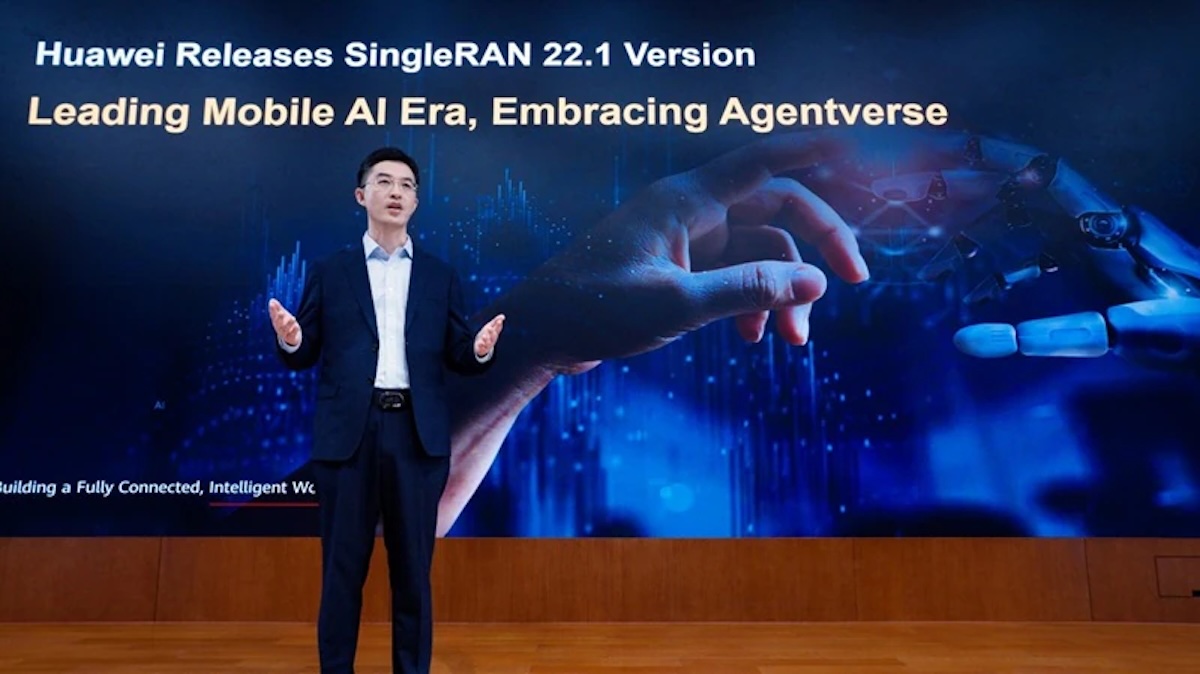
Huawei has launched SingleRAN 22.1, a new commercial version of its radio access network (RAN) software meant to adapt operators’ infrastructure to the growth of AI-powered mobile services. The update brings six technologies focused on raising uplink capacity, reusing spectrum better, improving speeds, cutting energy use, and applying AI to network management itself.
Huawei SingleRAN 22.1 in 20 seconds
- SingleRAN 22.1 integrates six technologies designed for networks carrying more AI services.
- Huawei says GigaUplink improved uplink performance by more than 30% in validation tests on real networks.
- GigaBand enables spectrum sharing between 4G and 5G.
- RANSpirit uses a telecom foundation model and a digital twin of the RAN.
- Huawei says the version is already in commercial use by 35 operators across 23 countries.
Behind the announcement is an intriguing question for the future of telecom. So far, much of the AI-infrastructure conversation has centered on GPUs, data centers, and electrical capacity. Huawei expects the spread of multimodal assistants and agents running from phones and other devices to also push demand onto mobile networks.
Uplink traffic in particular will matter. An application that constantly sends images, videos, audio, or sensor data to AI systems creates a very different pattern from traditional networks built around content consumption.
GigaUplink aims to get 5G ready to send much more data
One of the main features in SingleRAN 22.1 is GigaUplink, a mix of hardware and software technologies built to boost uplink capacity.
Huawei uses FDD 8T8R and Massive MIMO along with intelligent multi-layer convergent reception and uplink CoMP improvements to cut interference.
By validation tests on commercial networks the company shared, that combination raised uplink performance more than 30% and generally delivered 20 Mbps upload speeds in the evaluated scenarios.
These results come from Huawei and don’t guarantee any operator will automatically get such gains. Final performance depends on spectrum, radio deployment, devices, traffic, configuration, and network conditions.
The importance of uplink could grow if the forecasts about mobile AI play out.
A phone that just receives a text response needs relatively little bandwidth. Multimodal applications are different. An assistant that interprets what a camera sees in real time, listens to audio, or continuously analyzes environmental data can send far more information to inference systems.
And smartphones are only part of the picture. Vehicles, cameras, robots, industrial devices, and various connected equipment could also become data sources for AI models.
Huawei wants to use existing 4G and 5G spectrum better
SingleRAN 22.1 also introduces GigaBand, which tries to jointly use FDD spectrum allocated to both 4G and 5G networks.
The technology pools spectrum resources and plans across time, frequency, space, and power domains so 5G can reuse capacity already used by 4G.
Huawei reports that testing produced a 1.2x better 5G experience without hurting 4G service.
That’s valuable because the move between mobile generations is gradual. Operators have to raise 5G capacity while still serving millions of devices on 4G.
Dynamic spectrum sharing can add capacity without waiting for new frequency bands to be allocated.
Another feature, iBeam 3.0, moves precise beam management from the control plane to the user plane using channel-condition data and real-time planning.
Huawei says validations on real networks reached over 15% improvements in download speeds compared to earlier iBeam versions.
AI starts managing the mobile network itself
Maybe the most AI-related feature is RANSpirit.
Huawei pairs a telecom-focused foundation model with a digital twin of the radio access network.
The aim is for the infrastructure to read intentions and use that data to dynamically manage resources across users and services.
That points toward networks with more autonomy. Instead of relying only on manual configuration and operations, certain processes can use AI to analyze the infrastructure’s state and decide how to allocate resources.
Huawei talks about moving from manual operations and maintenance toward autonomy within the RAN domain.
That doesn’t mean SingleRAN 22.1 turns mobile networks into fully autonomous systems. Huawei presents RANSpirit as a technology to automate specific decisions around resources, user experience, operations, and energy efficiency.
Another feature, IDEA, lets operators set different speed levels by user and service. It also uses dynamic slicing to estimate the resources needed and reserve blocks accordingly.
Differentiating services could matter more if operators start supporting AI applications with very different requirements. A text chatbot, a normal video call, and a multimodal agent processing video in real time all have different latency, uplink, and capacity needs.
AI raises traffic, but networks also have to cut energy use
The update also brings 0 Bit 0 Watt 0 Loss, a technology to lower infrastructure energy use during low-traffic periods.
The system extends the times resources can stay idle and allows fast reactivation when demand climbs again.
Huawei reports real-world validations reached over 10% cuts in energy use.
Energy efficiency has become a critical issue in telecom. Adding capacity, antennas, and processing raises what a network can do but also raises operating costs.
Algorithms that adapt resources dynamically aim to balance those factors.
From connecting smartphones to connecting AI agents
Huawei uses an especially ambitious phrase for its vision: a world with trillions of interconnected agents.
That’s a business forecast, not current reality, and it’s still impossible to predict how many autonomous agents connected through mobile networks will reach.
But the technical direction shows where infrastructure vendors are starting to look.
AI doesn’t just need massive data centers to train models. If agents are embedded across phones, vehicles, robots, cameras, and industrial devices, then the network linking those devices with inference capabilities will have to evolve.
SingleRAN 22.1 aims to prepare that layer with more uplink capacity, better spectrum use, intelligent resource management, and infrastructure automation.
Huawei says the version already meets general availability criteria and is in commercial use by 35 operators across 23 countries. The company doesn’t name the operators or the exact scope of each deployment in this announcement.
So-called Mobile AI is still early, but it introduces a concept likely to grow in importance: the infrastructure needed to scale AI doesn’t end at the data center. It also includes the networks that carry data between millions of devices and the systems that process it.
Frequently Asked Questions
What is Huawei SingleRAN 22.1?
It’s a new version of Huawei’s SingleRAN software for mobile networks, with technologies to improve capacity, spectrum efficiency, energy use, and AI-driven automation.
How does GigaUplink improve performance?
Huawei says validation on real networks reached over a 30% gain in uplink performance and general upload speeds of 20 Mbps in the tested scenarios.
How does RANSpirit use AI?
RANSpirit pairs a telecom-specific foundation model with a digital twin of the RAN to automate tasks around resource management and allocation.
Is SingleRAN 22.1 already in commercial use?
Yes. Huawei says the version has reached general availability and is used by 35 operators across 23 countries, though it doesn’t disclose the full list of operators.
via: Huawei
