
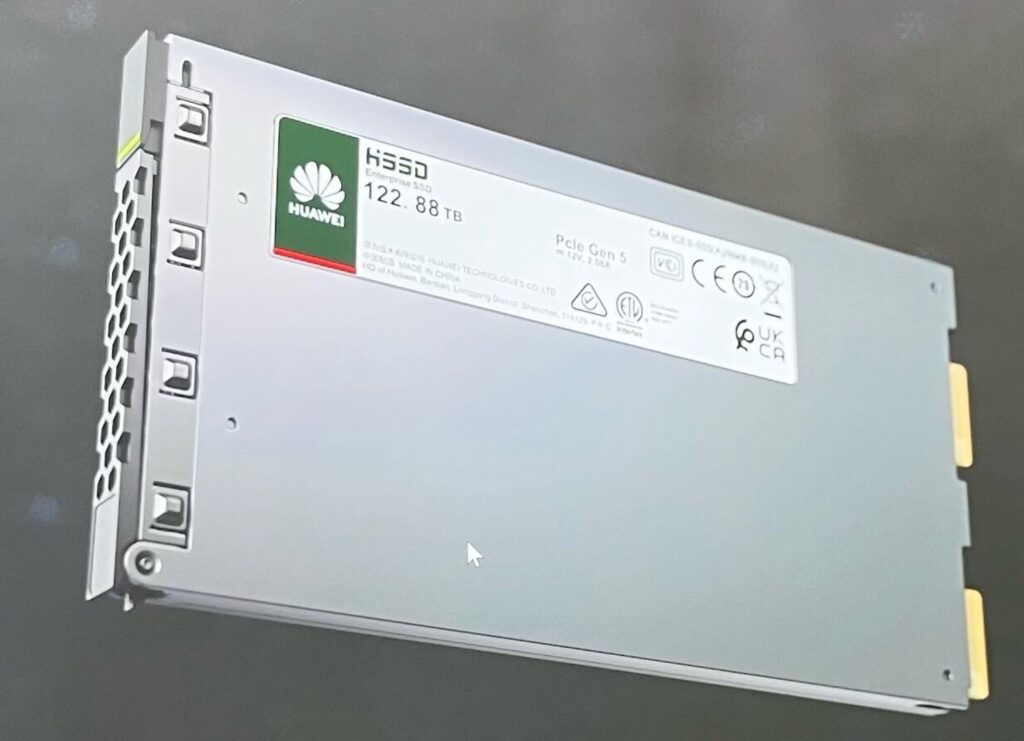
Huawei has found a unique way to compete in high-capacity storage despite U.S. technological restrictions. The company has developed SSDs of 61.44 TB and 122.88 TB supported by its own Die-on-Board (DoB) packaging technology, a solution that allows increasing NAND chip density by mounting them directly onto the circuit board, instead of relying on traditional packaging used by major international manufacturers.
While this move doesn’t yet place Huawei ahead of the 245 TB SSDs that are starting to appear in other providers’ roadmaps, it highlights something important: China is seeking to bypass its limitations on access to advanced NAND through innovation in integration, board design, and packaging. In other words, if it can’t compete exactly with the same memory capacities as Samsung, Kioxia, SanDisk, or Micron, it aims to gain density through an alternative approach.
What is DoB and why does it matter
Die-on-Board technology involves placing the dies, in this case NAND chips, directly onto a base PCB. In conventional SSDs, manufacturers typically use packages like TSOP, BGA, or other formats that stack multiple dies within an encapsulation, which is then soldered onto the board. This is the standard approach in high-capacity units using modern 3D NAND.
According to Blocks & Files analysis, Huawei is using DoB to package NAND chips more densely available in China, thereby compensating for some of the disadvantages of not having direct access to the most advanced NAND from international suppliers subjected to U.S. technology restrictions. Huawei has been on the U.S. Entity List since 2019, limiting its access to certain technologies and components.
This difference is significant. In storage, capacity isn’t solely dependent on the number of layers in NAND; how chips are integrated, how many dies fit in a given space, heat management, electrical signal quality, and manufacturing costs all play a role. Packaging thus becomes a strategic part of the product, not just a technical detail.
Huawei already indicated in its document Data Storage 2030 that wafer-level innovations and technologies like Die-on-Board can directly integrate storage chips onto circuit boards to improve density and performance. This approach aligns with the current strategy: not just racing for more NAND layers, but enhancing physical system integration.
From 61 TB to 122 TB, with a 245 TB version on the roadmap
At the Huawei ID Forum 2026 held in Paris, the company referenced high-capacity SSDs in production with 61.44 TB and 122.88 TB, as well as a future 245 TB version. Blocks & Files also documented the OceanDisk 1800 Smart Disk Enclosure, which claimed 1.47 PB in 2U using “large capacity SSDs with DoB stacking technology.” Another system, OceanDisk 1610, appeared with up to 2.2 PB from 36 SSDs of 61.44 TB in a 2U chassis.
| Product or Data | Mentioned Capacity | Technology or Format | Technical Insight |
|---|---|---|---|
| Huawei DoB SSD | 61.44 TB | NAND with Die-on-Board packaging | Initial high-capacity step |
| Huawei DoB SSD | 122.88 TB | NAND with Die-on-Board packaging | Significant leap over conventional enterprise SSDs |
| Future Huawei SSD | 245 TB | Planned, not yet available as a general product | Target to compete with ultra-high-density units |
| OceanDisk 1800 | 1.47 PB in 2U | Large capacity SSD with DoB | High density in a compact chassis |
| OceanDisk 1610 | Up to 2.2 PB in 2U | 36 × 61.44 TB SSDs | Dense configuration using 61.44 TB SSDs |
| OceanStor Pacific 9926 | 4.42 PB gross in 2U | 36 × 122.88 TB NVMe PCIe 5 | High-density all-flash approach |
Huawei already markets OceanStor Pacific 9926 systems equipped with SSDs of 15.36 TB, 30.72 TB, and 61.44 TB, according to public documentation. The references to 122.88 TB and denser configurations suggest an evolving product lineup aimed at massive data workloads, especially in AI, analytics, training, inference, and unstructured storage.
Comparing to other providers is also relevant. For instance, Kioxia announced the LC9 SSDs of 245.76 TB in E3.L format, targeting generative AI and high-density workloads. Micron has showcased 245 TB units for data centers. Huawei hasn’t yet matched this capacity with readily available products, but its DoB strategy narrows the gap.
Sanctions, Chinese NAND, and the new engineering of scarcity
The story of these SSDs cannot be separated from the technology war between the U.S. and China. U.S. restrictions have limited Huawei’s access to certain components, equipment, and advanced technologies. In NAND memory, this compels the company to rely on Chinese suppliers like YMTC and to develop its own solutions in controllers, packaging, integration, and system design.
YMTC has advanced with its Xtacking technology and made significant progress in 3D NAND. TechInsights describes Xtacking 4.0 as an evolution with improvements in density, speed, and efficiency compared to previous generations. Still, the Chinese industry continues to operate under manufacturing restrictions, making packaging and system architecture increasingly strategic.
DoB does not solve all issues. Mounting dies directly onto the board presents thermal, signal, repair, sustained performance, validation, and mass production challenges. In high-capacity SSDs, any thermal dissipation or electrical integrity problem can impact latency, reliability, and lifespan. Huawei will need to demonstrate not only density but also production stability, enterprise support, and real-world performance behavior.
Additionally, it’s important to clarify that “derives from sanctions” doesn’t mean Huawei escapes their impact. Rather, it adapts its design to reduce dependence on certain components or formats dominated by international suppliers. It’s an engineering response to a geopolitical restriction, not a complete solution to the problem.
The significance of this announcement lies in that fact. Sanctions block not just technology but also force product redesigns. Sometimes these redesigns cause delays; other times they prompt new solutions. Huawei’s DoB packaging demonstrates China’s willingness to explore alternative paths to sustain its data infrastructure, especially as AI demands ever faster, denser, and more efficient storage increasingly.
For data centers, these units are attractive: more capacity in less space, fewer devices to reach petabyte scales, potential reduction in power per TB, and less rack pressure. But enterprise buyers don’t measure density alone—they value dependability, availability, support, ecosystem, compatibility, and total cost of ownership. Huawei will need to prove that DoB isn’t just a clever workaround to sanctions but a competitive long-term technology.
The storage race is no longer only about how many layers NAND has but also how it’s packaged, integrated into the system, and who controls the supply chain. Huawei appears to understand that when it can’t buy the latest components, it can try to change some of the rules of manufacturing.
FAQs
What exactly has Huawei developed?
Huawei has shown high-capacity SSDs of 61.44 TB and 122.88 TB based on Die-on-Board packaging technology, with a 245 TB version planned in its roadmap.
What is Die-on-Board packaging?
It’s a technique that places memory dies directly on the circuit board, instead of assembling them first into traditional packages like BGA or TSOP. This can boost density but introduces thermal and electrical challenges.
Why is it related to U.S. sanctions?
Because Huawei’s access to certain advanced technologies and components is restricted. DoB allows increasing capacity using NAND available within China’s ecosystem and reducing reliance on conventional formats.
Is Huawei already competing with 245 TB SSDs from other manufacturers?
Not yet with the same level of availability. Its 122.88 TB SSDs close the gap, but other companies are already demonstrating or sampling 245 TB units for data centers.
via: blocksandfiles
