
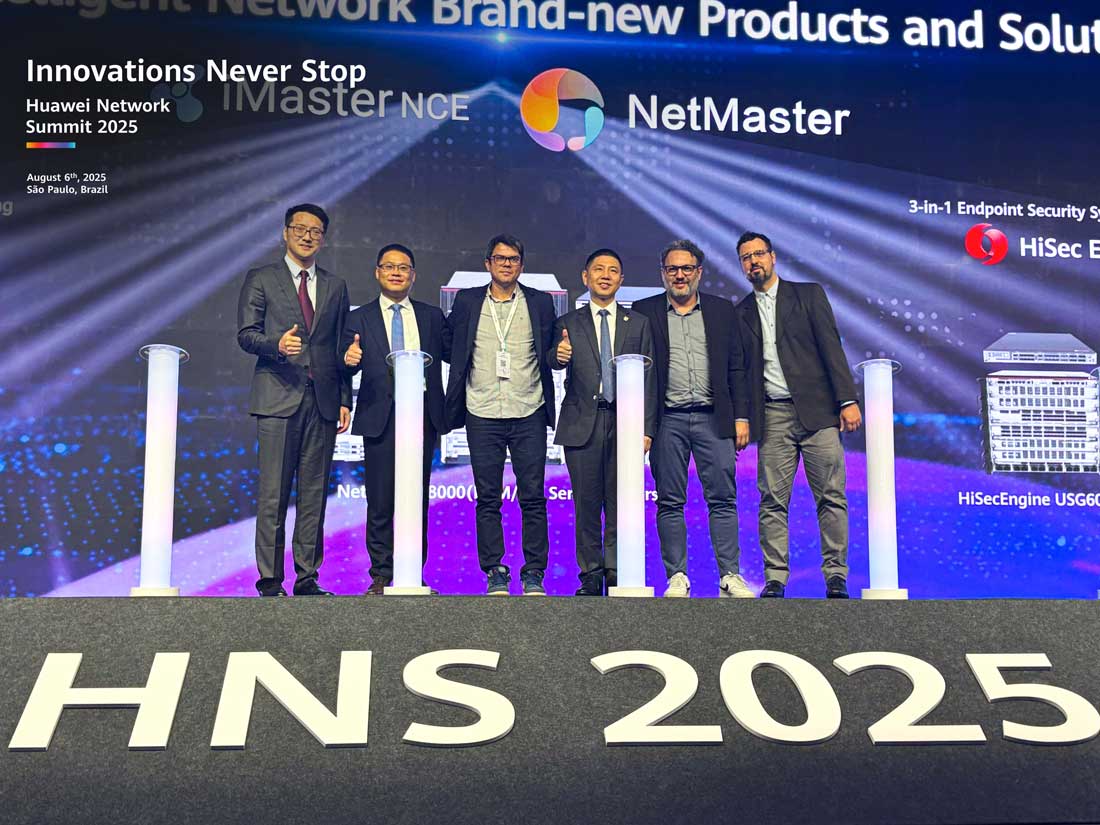
Huawei has made Latin America a strategic hub within its global digital transformation plan. During the Huawei Network Summit 2025 held in São Paulo, the Chinese company unveiled its renewed Xinghe Intelligent Network portfolio and the Xinghe AI Fabric solution for data centers, aiming to accelerate the shift toward intelligent and resilient infrastructure across the region.
The event gathered over 600 industry leaders, network experts, and business representatives from Brazil, Mexico, Colombia, and other Latin American countries. The message was clear: the next revolution isn’t solely about cloud technology or artificial intelligence but also about networks capable of supporting this ecosystem with security, low latency, and consistent performance.
Huawei’s approach centers on a philosophy summed up as “AI for all, all in IP.” Mitchell Zhang, President of Huawei Enterprise Latin America, explained that emerging AI applications require networks that combine massive bandwidth, minimal latency, and a robust security focus.
“The network is the foundation of an AI-driven society,” Zhang said during the opening keynote. “Without reliable and flexible infrastructure, it won’t be possible to sustain the new wave of intelligent applications transforming entire industries.”
Huawei aims to meet this challenge with a portfolio that includes campus networks, WANs, data center networks, and security, all integrated within the Xinghe Intelligent family.
The flagship announcement was an update to the Xinghe AI Fabric solution, designed for data center networks. Built on a three-layer architecture—AI Brain, AI Connection, and AI Network Element—it promises high resilience, maximum computing capacity, and always-on services.
- AI Brain integrates Huawei’s digital network map and the AI agent NetMaster, enabling service orchestration through drag-and-drop, automating operations and maintenance, and managing heterogenous end-to-end networks. The goal is to multiply data center operational efficiency.
- AI Connection uses Huawei’s exclusive NSLB load balancing algorithm to optimize routing and eliminate bottlenecks. Huawei claims this improves AI training performance by over 10%, while the iReliable technology multiplies network reliability tenfold.
- AI Network Element combines CloudEngine switches with StarryLink optical modules that detect packet loss and latency in real-time. It also features intrinsic security technologies and group-based isolation to strengthen protection against cyber threats.
Security and efficiency are also key priorities. Huawei introduced Wi-Fi Shield, the industry’s first solution that encrypts the physical layer with AI-based signal coding, ensuring zero data leaks and enhanced office environment security.
On a broader scale, Huawei’s Xinghe Intelligent Network Security integrates AI-driven collaborative defense across cloud, network, edge, and endpoints. The company reports a 95% detection rate of malware variants and the ability to trace threats across up to 100 network hops using an advanced correlation analysis engine.
Regionally, several companies shared real-world experiences. Eduardo Anhaia, Network Director at Brazil-based Brazil Compwire, highlighted that Xinghe AI Fabric enabled their highly resilient, multi-vendor networks with simplified joint maintenance. Brazilian bank Bradesco also adopted the solution to execute thousands of network changes annually without errors, reducing risks and increasing agility in response to new financial sector demands.
Huawei’s latest Wi-Fi access points, such as the AP266 model, contribute to energy efficiency, consuming only 9.4 watts—61% less than the industry average. This commitment to sustainability aligns with the increasing importance of environmentally friendly practices in the tech sector.
This deployment comes at a pivotal moment, as Latin America transitions rapidly toward cloud-based models, data analytics, and AI across sectors like banking, education, healthcare, and logistics. Huawei aims to position itself as a strategic partner in this shift, competing with giants like Cisco, Juniper, and HPE by embedding AI directly into the core of the networks, not just in the applications.
Beyond technical aspects, there’s a clear geopolitical angle. As the U.S. tightens export restrictions on cutting-edge chips to China, Huawei is strengthening its influence in emerging markets like Latin America by offering resilient, secure, and energy-efficient networks. This approach also addresses regional debates on digital sovereignty, data localization, and cybersecurity, providing an alternative to reliance on foreign infrastructure and fostering local capacity building.
Despite the enthusiasm, challenges remain. Latin America still faces a significant digital divide, with disparities in connectivity and infrastructural investment hampered by budget constraints and complex regulations. Huawei relies on its solutions’ efficiency and ease of deployment to convince companies and governments to adopt a comprehensive network intelligence approach, with ongoing collaboration tailored to various sectors.
Ultimately, Huawei’s presence at Network Summit 2025 underscores a core idea: artificial intelligence cannot scale without the supporting network infrastructure. From data centers to offices and critical applications in healthcare and education, the future of AI depends heavily on network robustness.
With Xinghe Intelligent and Xinghe AI Fabric, Huawei aims to be the backbone of this infrastructure in Latin America. Whether its promises of efficiency, security, and sustainability will lead to widespread adoption remains to be seen, but the race to build the networks of the future is already underway, with Latin America emerging as one of its most critical battlegrounds.
Frequently Asked Questions (FAQs)
What is Xinghe AI Fabric and why does it matter?
It’s Huawei’s AI-based solution for data center networks, ensuring always-on services, greater reliability, and optimized performance for critical applications like AI and cloud.How are Xinghe Intelligent networks different from other solutions?
Huawei integrates AI directly into network elements, employing algorithms for load balancing, physical layer security, and automation—delivering a safer and more efficient experience compared to traditional models.What tangible benefits have Latin American companies reported?
Cases with Bradesco and Brazil Compwire highlight reductions in network change errors, increased resilience in multi-vendor environments, and faster deployment of services.How do these solutions contribute to sustainability?
Huawei introduced equipment consuming up to 61% less energy than the industry average, alongside solutions using sensors to optimize building energy use—cutting costs and emissions.