
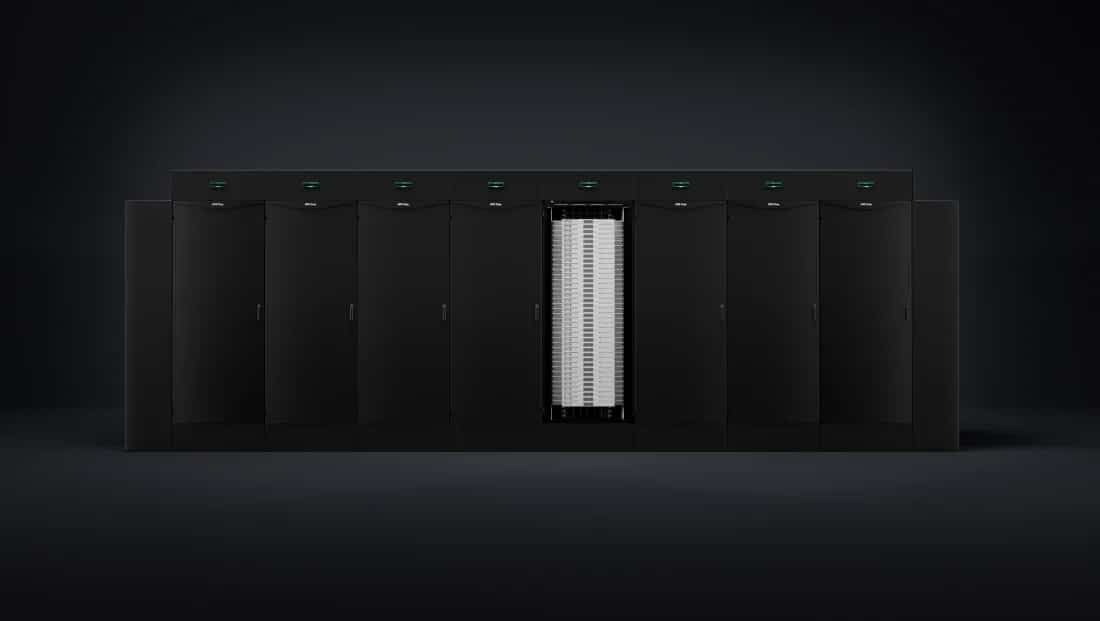
Hewlett Packard Enterprise (HPE) has taken another step forward in its strategy to lead supercomputing in the era of artificial intelligence. The company has announced an expansion of its next-generation HPE Cray Supercomputing portfolio, focused on three new high-density compute blades, a unified management software, and an interconnection and storage system designed for mixed AI and HPC workloads at scale.
The goal is clear: to deliver a unified architecture capable of serving research centers, sovereign entities, and large enterprises that need to combine traditional scientific simulation with increasingly demanding generative AI models.
A platform for convergence between AI and HPC
The new generation of HPE Cray Supercomputing is built around the GX5000 platform, recently introduced and specifically designed for AI and HPC convergence. Based on this, HPE now introduces:
- Three multi-partner, multi-workload compute blades, all cooled with 100% liquid cooling.
- The HPE Supercomputing Management Software, unifying system management throughout the infrastructure lifecycle.
- An adapted version of the HPE Slingshot 400 interconnect tailored for the new platform.
- The storage system HPE Cray Supercomputing Storage Systems K3000, with built-in DAOS software.
The company claims that, collectively, this architecture offers one of the highest compute densities in the industry, ready to handle the explosive growth of AI models, complex simulations, and massive data loads.
Three blades for nearly any supercomputing scenario
The core of the offering is the new compute blades, designed to provide different CPU and GPU configurations depending on the workload:
HPE Cray Supercomputing GX440n Accelerated Blade
Designed as a “universal” compute engine for mixed-precision GPU-centered workloads:
- 4 NVIDIA Vera CPUs
- 8 NVIDIA Rubin GPUs
- Up to 24 blades per rack, equating to up to 192 Rubin GPUs per rack
This blade is clearly aimed at those leveraging the NVIDIA ecosystem for training and deploying large AI models, as well as for massive GPU-accelerated simulations.
HPE Cray Supercomputing GX350a Accelerated Blade
Targeted at organizations seeking a full AMD stack for AI and HPC:
- 1 AMD EPYC “Venice” generation CPU
- 4 AMD Instinct™ MI430X GPUs, the latest MI400 series aimed at sovereign AI and HPC
- Up to 28 blades per rack, with up to 112 MI430X GPUs per rack
This design aims to enhance technological sovereignty and avoid over-reliance on a single vendor, combining EPYC and Instinct architectures for supercomputing.
HPE Cray Supercomputing GX250 Compute Blade
A blade focused on CPU-only partitions for traditional HPC double-precision workloads:
- 8 AMD EPYC “Venice” CPUs per blade
- Up to 40 blades per rack, delivering a top-tier x86 core density
The design allows hybrid configurations: a GPU partition (using GX440n or GX350a blades) and a pure CPU partition based on GX250, within the same system, depending on the center’s needs.
All blades share key elements:
- 100% liquid direct cooling, suitable for high-density and the increasing power consumption of new-generation GPUs.
- Up to 4 or 8 HPE Slingshot 400 Gbps endpoints per blade, for integration into large-scale low-latency networks.
- Option to add NVMe drives per blade, for caching critical data or accelerating I/O workflows close to computation.
Unified multitenant management for AI and HPC infrastructures
Managing large systems securely and efficiently is a key challenge. HPE introduces HPE Supercomputing Management Software, a software layer that centralizes:
- Provisioning, monitoring, and scaling of the infrastructure.
- Management of power and energy, with metrics aiding consumption estimates and integration with “power-aware” schedulers.
- Support for multi-tenant, virtualized, and containerized environments, enabling user and team isolation.
- Enhanced security and governance features, critical for environments handling sensitive data and models.
The aim is for major supercomputing centers to operate their systems as a shared platform for AI and HPC, avoiding silos for each workload type.
HPE Slingshot 400: interconnect designed for the exa-AI era
The network component is another pillar of the solution. HPE Slingshot 400, previously announced, now adapts to the GX5000 format:
- A new chassis for liquid-cooled switch blades, with 64 ports of 400 Gbps per switch.
- Possible configurations:
- 8 switches with 512 ports
- 16 switches with 1,024 ports
- 32 switches with 2,048 ports
Slingshot 400 aims to deliver:
- Lower latency and greater sustained bandwidth
- Congestion management and reliability tailored for AI-scale traffic patterns and parallel simulations
- Full utilization of the GX5000 high-performance topology, maintaining cost effectiveness compared to more customized designs.
K3000: DAOS storage optimized for data-intensive AI
The other major component is the HPE Cray Supercomputing Storage Systems K3000, based on HPE ProLiant DL360 Gen12 servers, integrated with Distributed Asynchronous Object Storage (DAOS) software out of the box.
This system targets applications where I/O is the bottleneck, especially:
- Training and fine-tuning of large AI models
- Massive data analytics workloads with complex access patterns
- Scientific simulations producing enormous volumes of results
Configuration options include:
- Performance-optimized servers with 8, 12, or 16 NVMe drives
- Capacity-optimized servers with 20 NVMe drives
- Per-drive capacities of 3.84 TB, 7.68 TB, or 15.36 TB
- Memory options of 512 GB, 1,024 GB, or 2,048 GB, depending on the storage configuration
Connectivity options involve:
- HPE Slingshot 200 and 400
- InfiniBand NDR
- 400 Gbps Ethernet
The combination of DAOS, NVMe, and these interconnects is designed to provide low latency and sustained high performance, ensuring storage does not limit AI cluster productivity.
Germany as a testing ground: Herder and Blue Lion
HPE’s commitment isn’t just theoretical: two major academic supercomputing centers in Germany have selected the HPE Cray GX5000 as the foundation for their upcoming flagship systems:
- The High-Performance Computing Center of the University of Stuttgart (HLRS), which will deploy the supercomputer Herder.
- The Leibniz Supercomputing Centre (LRZ) of the Bavarian Academy of Sciences and Humanities, with its future system Blue Lion.
Both institutions highlighted two key factors:
- Performance leap: LRZ anticipates a sustained improvement of up to 30 times over their current system, enabling a combination of classical simulation with advanced AI techniques.
- Energy efficiency and sustainability: Blue Lion will utilize direct liquid cooling capable of operating at temperatures up to 40°C, facilitating reuse of residual heat within the Garching research campus.
Thus, HPE reinforces its position within the European HPC and AI ecosystem, at a time when technological sovereignty and energy efficiency have become strategic priorities.
Market timing and overview
HPE has outlined a phased rollout:
- The GX440n, GX350a, and GX250 blades, along with HPE Supercomputing Management Software and HPE Slingshot 400 for GX5000, will be available from early 2027.
- The K3000 storage system with ProLiant servers will arrive earlier: early 2026.
Meanwhile, the industry is experiencing rapid growth in both HPC and generative AI, with rising demand for infrastructure that can scale without soaring costs or energy consumption. HPE’s new Cray generation aims precisely at this: delivering an architecture prepared for the coming years, where the line between scientific supercomputers and “AI factories” becomes increasingly blurred.
For data centers, universities, and big corporations contemplating new investments, the message is clear: the next wave of supercomputing will be measured not just in petaflops or exaflops but in flops per watt, in flexibility to mix AI and HPC, and in the ability to manage complex infrastructures as a single platform. The new HPE Cray Supercomputing portfolio aims to be a leading candidate in this space.
via: hpe