
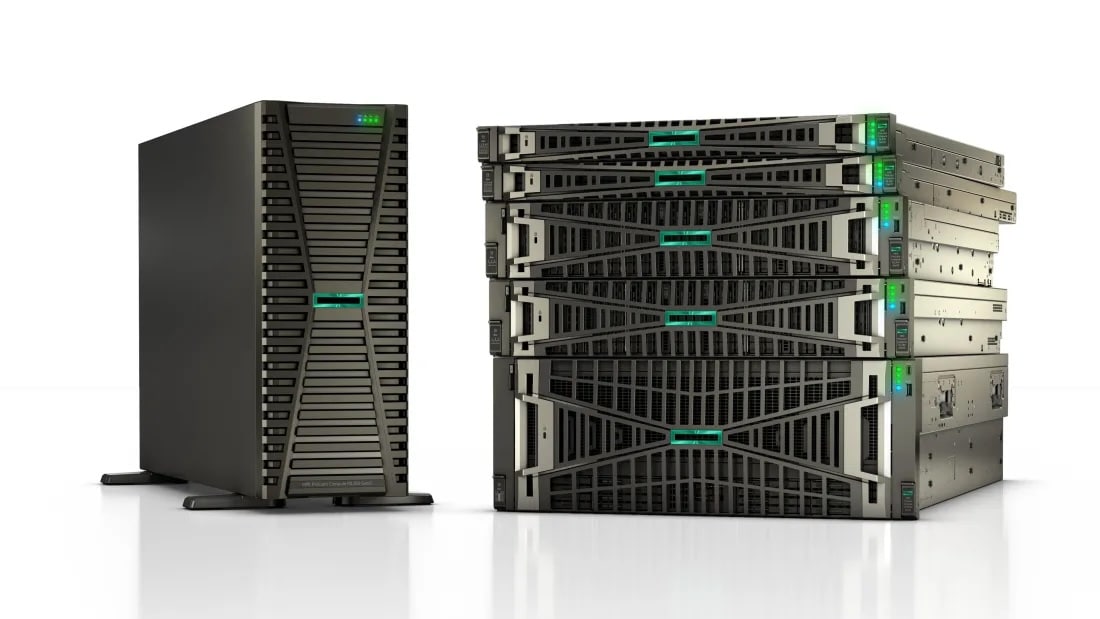
Hewlett Packard Enterprise (HPE) has announced four new ProLiant Gen13 servers equipped with sixth-generation AMD EPYC processors, designed to run artificial intelligence (AI) workloads, inference, virtualization and high-performance computing. The systems bring improvements in compute capacity, memory and connectivity, along with new automated security features and infrastructure management capabilities, although they will reach the market in stages between late 2026 and 2027.
The new HPE ProLiant Gen13 servers in 30 seconds
- HPE introduces four models: DL525, DL585a, XD245 and XD285, with different configurations for enterprise data centers.
- The systems combine sixth-generation AMD EPYC processors with higher core density, high-bandwidth memory and PCIe Gen6 connectivity.
- The DL585a supports up to eight double-wide PCIe GPUs, while the DL525 reaches 256 cores in a single-processor configuration.
- HPE adds automatic drive encryption, two-person authorization for sensitive actions, and post-quantum cryptography readiness.
- The DL525 arrives in late 2026; the other three models are planned for 2027, with the DL585a landing early in the year.
The launch reflects how enterprise servers are evolving toward infrastructure capable of handling both traditional applications and AI systems that run tasks autonomously. HPE is positioning this new generation for organizations that need to process large volumes of data, run models and keep production services running without losing sight of security, resource consumption and system management.
The company also maintains a distinction between servers aimed at general-purpose workloads and platforms built for high-density deployments. The four announced models don’t share the same architecture: two prioritize compute configurations for enterprise use and GPU acceleration, while the other two are designed to pack more processing capacity into the available rack space.
Four servers for different workloads
The new HPE ProLiant Gen13 systems use sixth-generation AMD EPYC processors and pair their capabilities with improvements in memory and I/O. According to HPE, this configuration is meant to cover everything from AI inference and analytics to scientific simulation, financial processing and virtualization.
The HPE ProLiant DL585a Gen13 is aimed at the most demanding workloads. It supports up to two sixth-generation AMD EPYC processors, eight double-wide PCIe GPUs and PCIe Gen6 connectivity. HPE presents it as a platform for maximizing accelerator utilization and token-generation performance, as well as running inference, virtualization and model fine-tuning through retrieval-augmented generation (RAG).
The architecture is also designed for scenarios where models need to query external information or work with enterprise datasets. In these applications, available memory and bandwidth between components can affect overall performance just as much as GPU compute power.
The HPE ProLiant DL525 Gen13 takes a different approach. It’s a compact one-rack-unit (1U) server with a single processor, with sixth-generation AMD EPYC configurations of up to 256 cores. It includes 16-channel memory and support for high-performance DDR5 and MRDIMM modules, plus PCIe Gen6.
HPE positions it for tasks that require processing large volumes of information quickly, such as fraud detection, market data analysis, risk and pricing models, electronic design automation and simulation. It can also be used for AI inference. Its compact form factor packs compute capacity into less space, a relevant feature for data centers with physical space constraints or high density requirements.
The other two models target deployments that want to increase the number of processors per rack. The HPE ProLiant XD245 uses a four-node design in a single Open Rack Unit (1OU), with direct liquid cooling and the ability to house up to eight sixth-generation AMD EPYC processors, according to the configuration described by the company.
The HPE ProLiant XD285, meanwhile, uses two nodes across two Open Rack Units (2OU) with air cooling. Both systems comply with Open Compute Project (OCP) standards, an initiative that promotes open designs for data center infrastructure. HPE positions them for compute-intensive workloads, artificial intelligence and high-performance computing (HPC), including scientific models, computer-aided engineering, weather forecasting and financial simulation.
The choice between liquid and air cooling will depend on the available infrastructure and the thermal requirements of each deployment. The XD245’s four-node design aims to pack compute capacity using direct liquid cooling, while the XD285 offers an air-cooled alternative for other data center environments.
HPE says the Gen13 family will grow with new models aimed at enterprises, remote offices, virtualization, databases and software-defined infrastructure. For now, the announcement is limited to these four systems.
Automated security and management across the full lifecycle
Beyond the hardware, HPE highlights the new security features in HPE Integrated Lights-Out 8 (iLO 8) and the management capabilities of HPE Compute Ops Management. The goal is to reduce manual tasks and improve control over servers from deployment through retirement or replacement.
Among the new features is automatic encryption of self-encrypting drives, known as Auto-SED. According to HPE, this feature protects stored data from first boot without requiring additional configuration, external key managers or manual activation. The company presents this capability as a pioneering feature in the industry.
Another addition is multi-person authorization, or MPA, which requires approval from two authorized users to carry out certain high-impact operations. Examples mentioned include key provisioning and secure erasure. This mechanism can reduce the risk of individual errors or misuse, although its effectiveness will also depend on how each organization configures permissions and approval procedures.
HPE is also expanding its post-quantum cryptography (PQC) readiness, which in this generation extends beyond firmware to also protect the server’s communications against future threats. The company does not claim that all risks related to quantum computing are resolved, but rather that its systems include measures to prepare for the evolution of cryptographic algorithms.
Component verification rounds out this set of features. Based on HPE Silicon Root of Trust, it checks the authenticity and integrity of critical components when they are added, replaced or modified over the server’s service life. This control aims to detect tampering in infrastructure where hardware can change over time due to repairs, upgrades or expansions.
On the operations side, HPE Compute Ops Management adds tools to simplify onboarding new equipment and provide near-real-time visibility into available power capacity. HPE says organizations using the platform spent 50% less time managing servers and achieved a 209% return on investment. These figures come from the manufacturer and should not be interpreted as guaranteed results for every deployment.
Phased availability through 2027
The new servers won’t all arrive at once. HPE expects the ProLiant DL525 Gen13 to be available in late 2026. The DL585a Gen13 is scheduled for early 2027, while the XD245 and XD285 models will arrive during 2027. The company does not provide an exact date for these last two systems in the announcement.
HPE also highlights the ProLiant family’s validation process. According to the company, each new generation undergoes more than 1,000 tests and 10,000 hours of validation, with stress testing and extreme scenarios that exceed published operating limits. The company adds that reliability has been the top purchase driver for its ProLiant customers for four consecutive years, with 81% citing reliable performance as a differentiating factor.
These figures come from HPE, and the announcement does not include all the methodological details needed to directly compare the results with those of other manufacturers. The company also attributes to HPE Tech Care Service a reduction of up to 97% in unplanned downtime. That is a maximum figure reported by the vendor, not a reduction that can be assumed for every environment.
According to HPE, the systems can be acquired through HPE Financial Services’ 90/9 Advantage program, which offers 90 days with no payments followed by nine months of 1% monthly payments, subject to the program’s terms. Interested companies should review the applicable financial terms before making a decision.
The new generation aims to cover different needs within a single infrastructure strategy: more compute capacity per server, options to accelerate AI workloads with GPUs, high-density configurations and built-in security controls. The actual availability of each model and its fit for a specific deployment will determine when they can be adopted in enterprise projects.
HPE’s previous ProLiant Gen12 generation already introduced AI-driven automated management for virtualization and edge computing, a direction this Gen13 refresh now extends with higher core counts and expanded security features.
Frequently asked questions
What processors do the new HPE ProLiant Gen13 servers use?
All four announced servers are equipped with sixth-generation AMD EPYC processors. Configurations vary by model and can include one or two processors, while the XD245 supports up to eight in its four-node design.
Which HPE ProLiant Gen13 server is built for GPU workloads?
The HPE ProLiant DL585a Gen13 supports up to eight double-wide PCIe GPUs and is aimed at AI inference, virtualization and model fine-tuning. It also includes PCIe Gen6 connectivity.
When will the new HPE servers be available?
The DL525 Gen13 is expected in late 2026. HPE expects the DL585a to arrive in early 2027, with the XD245 and XD285 models available during 2027.
What new security features do the HPE ProLiant Gen13 servers include?
They include automatic drive encryption, two-person authorization for certain sensitive operations, expanded post-quantum cryptography readiness, and component verification based on Silicon Root of Trust.
