
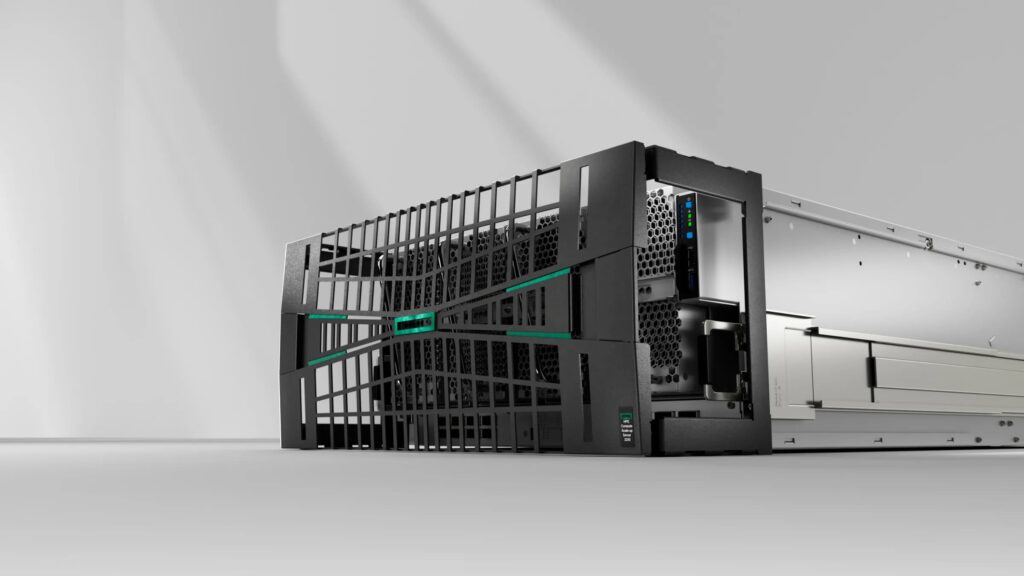
HPE unveiled at Computex 2026 the new HPE ProLiant Compute DL394 Gen12, a 2U server based on the NVIDIA Vera CPU designed to address a new phase of enterprise artificial intelligence. The company positions it for agentic AI workloads, reinforcement learning, intensive data processing, and environments where latency, per-core performance, and memory bandwidth are critical factors.
The announcement confirms a growing trend in data centers: AI is no longer dependent solely on increasingly powerful GPUs. As companies transition from generative models that answer questions to agents that reason, plan, consult tools, and execute complex workflows, the CPU regains importance as an orchestration component. In this context, Vera arrives as a CPU engineered to coordinate AI factories, move data swiftly, and reduce bottlenecks in sequential workloads.
A CPU Designed for Agents, Data, and Low Latency
The HPE ProLiant Compute DL394 Gen12 is presented as a dedicated platform for the next generation of AI workloads. According to HPE, the shift from generative to agentic systems is redefining the role of computing within enterprises. It’s no longer just about content generation but executing operations: interpreting data, initiating actions, monitoring results, making intermediate decisions, and maintaining chained workflows.
Antonio Neri, HPE President and CEO, summarizes this idea by stating that agentic systems require high-performance servers with exceptional CPU capacity to enable real-time reasoning in AI applications and financial services. The new ProLiant is positioned as infrastructure tailored for environments where decision speed and operational confidence are as important as raw computational power.
The collaboration announced with NVIDIA and Redpanda also features a particularly demanding use case: the New York Stock Exchange (NYSE). NYSE is exploring this architecture to enhance latency, performance, and reliability in infrastructure processing over 1.1 trillion messages daily, according to Lynn Martin, President of NYSE Group. This exemplifies where Vera could fit: systems where every microsecond, latency variation, and processing decision matter.
| Element | Key Data |
|---|---|
| Server | HPE ProLiant Compute DL394 Gen12 |
| Form Factor | 2U |
| CPU | NVIDIA Vera |
| Memory | LPDDR5X |
| Aggregate Bandwidth | 1.2 TB/s |
| Per-Core Bandwidth | Up to 14 GB/s |
| Management | HPE Compute Ops Management |
| Security | Silicon Root of Trust, iLO 7, and Secure Enclave |
| Availability | Fall 2026 |
| Highlighted Use Case | NYTech NYSE exploration with Redpanda and NVIDIA |
The Memory Challenge Vera Aims to Solve
A key feature of the HPE ProLiant Compute DL394 Gen12 is its memory architecture. HPE emphasizes that NVIDIA Vera utilizes a monolithic design, unlike traditional multi-core architectures based on chiplets, which can suffer from non-uniform memory access issues known as NUMA. In workloads where predictable latency is essential, such behaviors can introduce undesirable variability.
To mitigate this, the server employs LPDDR5X memory, an efficient DRAM technology capable of achieving 1.2 TB/s of total bandwidth, with up to 14 GB/s per core. This figure is significant because agentic AI not only needs to run models but must also ingest, transform, and move data continuously across different processing stages.
An enterprise agent might query a database, read documents, retrieve information, execute code, review results, call APIs, and replan. In this workflow pattern, the CPU acts as a resource coordinator. If memory or latency are not aligned, the system’s efficiency drops, even if it has powerful accelerators at other layers.
Jensen Huang, NVIDIA’s founder and CEO, has argued that agentic AI requires a new kind of CPU, and that Vera was designed to orchestrate AI factories, offering twice the efficiency and faster task completion than x86, according to HPE’s announcement. This comparison still needs validation under real deployments and specific workloads but reflects the product’s ambitious intent.
Security and Management: Two Enterprise Purchase Factors
HPE emphasizes not just performance. The server integrates Silicon Root of Trust, iLO 7, and a secure enclave—an innovation aimed at protecting the server throughout its lifecycle. The company also claims that these new ProLiants are the first to meet NIST’s requirements for post-quantum cryptography, an important point for organizations handling sensitive data or operating in regulated environments.
Management features are also part of the package. HPE Compute Ops Management provides a unified console for administering and automating distributed servers. In enterprise AI deployments, this layer can be as crucial as the hardware. Organizations need not only to deploy servers but to monitor them, perform updates, detect issues, minimize administration time, and prevent outages affecting critical services.
This approach aligns with overall market trends. Companies transitioning from pilot AI projects to production demand platforms that offer security, management, support, financing options, and predictable operations. HPE seeks to position the DL394 Gen12 within the NVIDIA AI Computing by HPE portfolio, not as a standalone server.
Agentic AI Shifts Focus Toward Complete Systems
The appearance of servers like the HPE ProLiant Compute DL394 Gen12 signals that AI infrastructure is entering a more complex phase. During the early surge of generative AI, the emphasis was on GPUs. Now, the conversation broadens to include CPUs, memory, networking, storage, data streaming, security, and operational management.
Collaborations with Redpanda and the NYSE’s interest exemplify this convergence. Agentic AI applications do not operate in isolation; they depend on real-time data, messaging systems, low latency, reliability, and event responsiveness. In sectors like finance, telecommunications, industry, energy, and cybersecurity, such architectures must deliver reliable performance, not just demos.
HPE also offers the server through the 90/9 Advantage financial program from HPE Financial Services, with 90 days without payments and nine months at 1% interest. It’s a commercial detail but highlights a broader reality: modernizing AI infrastructure will require substantial investments, and vendors are exploring ways to lower initial barriers.
The ProLiant Compute DL394 Gen12 is scheduled for release in fall 2026. Its success will depend on performance in real workloads, cost competitiveness against x86 and Arm alternatives, maturity of associated software, and how effectively HPE and NVIDIA can convince enterprises that agentic AI demands a different architecture.
What the announcement makes clear is that the race for enterprise AI is no longer just about the fastest accelerators. The new battleground involves building complete systems capable of moving data, reasoning, operating with low latency, and maintaining security throughout their lifecycle. Vera arrives at ProLiant just in time to compete on that layer.
Frequently Asked Questions
What did HPE announce at Computex 2026?
HPE announced the HPE ProLiant Compute DL394 Gen12, a 2U server based on NVIDIA Vera CPU, tailored for agentic AI, reinforcement learning, and intensive data processing.
Why is NVIDIA Vera significant for agentic AI?
Because agents need to coordinate data, tools, sequential logic, and complex workflows. Vera is designed to function as an orchestration CPU within AI factories.
What role does LPDDR5X memory play in this server?
It enables up to 1.2 TB/s total bandwidth and up to 14 GB/s per core, facilitating low-latency, high-throughput data handling.
When will the HPE ProLiant Compute DL394 Gen12 be available?
HPE expects it to be available in fall 2026 as part of the NVIDIA AI Computing by HPE portfolio.
via: hpe
