
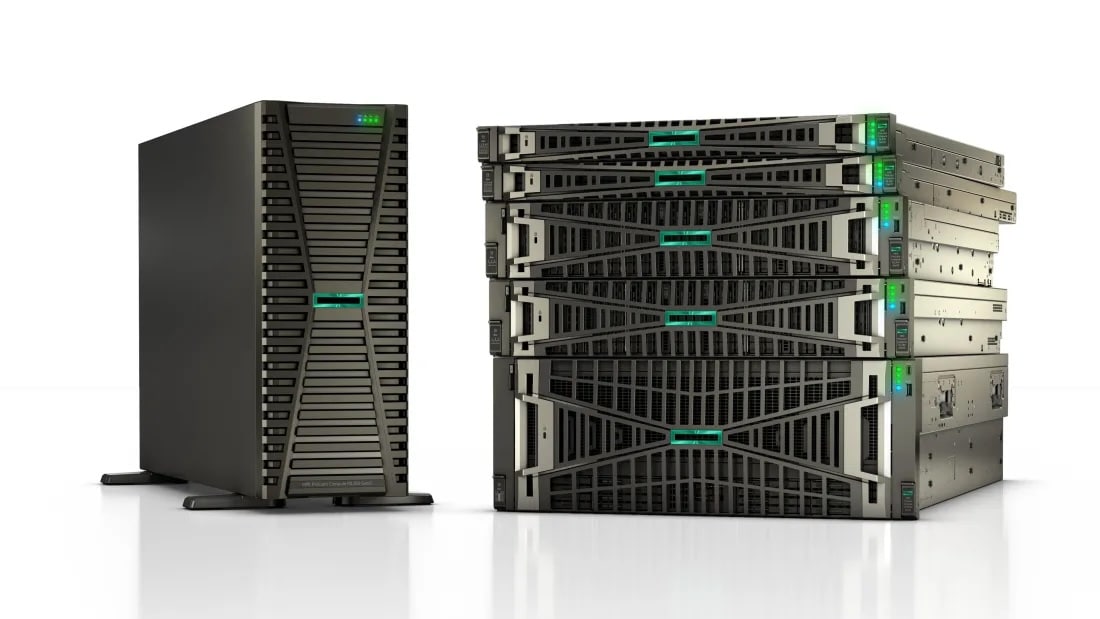
HPE has expanded its ProLiant family for an increasingly important scenario for businesses, government agencies, and critical industries: running AI workloads and essential applications away from data centers, in locations where heat, dust, vibrations, or a lack of technical personnel complicate traditional deployments.
The company has introduced the new HPE ProLiant Compute EL2000 chassis, the basis for the EL220 Gen12 and EL240 Gen12 servers, along with an upgraded version of the HPE ProLiant DL145 Gen11. The message is clear: edge is no longer just a small box for collecting data or performing light tasks. HPE aims to bring AI inference, disconnected services, distributed operations, and mission-critical workloads to harsh environments—from telecommunications and manufacturing to retail, transportation, or national security deployments.
Servers designed to operate where a data center doesn’t fit
The new HPE ProLiant Compute EL2000 is designed for environments constrained by size, weight, and power consumption, known in the industry as SWaP. Its role is to serve as a modular platform for either two HPE ProLiant Compute EL220 Gen12 servers or a single EL240 Gen12. According to HPE, these systems will be based on Intel Xeon 6 processors and can scale from 8 to 144 cores, with support for CPUs up to 350 watts TDP.
The significance isn’t only in processing power. HPE positions these systems within an operational range of -40°C to 55°C, with humidity tolerance up to 95%, plus resistance to vibrations, environmental contaminants, and electromagnetic interference. Such specifications move them away from typical enterprise rack servers and closer to scenarios like vehicles, industrial facilities, remote telco sites, warehouses, point-of-sale terminals, or temporary infrastructure.
The EL240 Gen12 variant can incorporate NVIDIA RTX PRO 4500 or NVIDIA RTX PRO 6000 Blackwell Server Edition GPUs. This detail directly points to AI inference at the edge: analyzing video, classifying images, processing sensor data, executing vision models, or making decisions close to the data source without sending everything to the cloud or a central data center.
| Platform | Focus | Processor / Acceleration | Availability |
|---|---|---|---|
| HPE ProLiant Compute EL2000 | Reinforced and modular edge chassis | Up to two EL220 Gen12 or one EL240 Gen12 | Later in 2026 |
| HPE ProLiant Compute EL220 Gen12 | Compact edge server | Intel Xeon 6 | Later in 2026 |
| HPE ProLiant Compute EL240 Gen12 | Edge with more expansion and GPU | Intel Xeon 6, NVIDIA RTX PRO 4500/6000 Blackwell | Later in 2026 |
| HPE ProLiant DL145 Gen11 enhanced | Distributed edge, telco, retail, manufacturing | AMD EPYC 8005, up to 84 cores | Available now |
| DL145 Gen11 Premier Solution for Azure Local | Azure services at edge locations | Designed for Azure Local Disconnected Operations | May 2026 |
The company also announced an Environmental Ruggedization Option Kit to adapt these systems to challenging locations. The goal is for these servers to operate in high or low altitude, extreme temperatures, vibration, or physical conditions that typically fall outside the design parameters of standard enterprise servers.
AI inference moves into the field
This announcement arrives at a time when many organizations are re-evaluating which parts of AI should run in the cloud and which should be localized near the data source. In a factory, waiting for an image to travel to a remote data center for defect detection could be too slow. In defense or emergency scenarios, connectivity may be intermittent. In retail, local processing can reduce latency and protect sensitive information.
This is where reinforced edge systems come into play. It’s not about replacing the data center, but about distributing computing power more intelligently. Data centers will still be needed for training, large-scale storage, big models, and core operations. The edge, on the other hand, makes sense when rapid reaction, continuity in case of network failure, or avoiding the transmission of all data off-site are priorities.
Krista Satterthwaite, senior vice president and general manager of Compute at HPE, summarizes this perspective: organizations are bringing AI inference and remote operations closer to the edge because traditional IT structures no longer suffice in many industries. The company emphasizes combining enterprise-grade security, tailored performance, and centralized management to deploy and operate distributed environments.
This point is crucial. The challenge of the edge isn’t just hardware resilience but managing those systems effectively. A server in a store, an antenna, an industrial plant, or a vehicle can’t always depend on local technical support. HPE offers its ProLiant edge systems with Integrated Lights-Out (iLO) and HPE Compute Ops Management for remote visibility, control, automation, and end-to-end security in distributed locations.
DL145 Gen11: quieter and telco-oriented edge
Alongside the new EL2000, HPE has enhanced the ProLiant DL145 Gen11 with upcoming AMD EPYC 8005 processors, codenamed “Sorano.” It targets distributed and telco environments, with up to 84 low-power cores in a compact 2U form factor also suitable for installations where noise, temperature, or space are concerns.
The DL145 Gen11 can operate up to 55°C, making it suitable for technical cabinets, small rooms, industrial sites, or edge points where traditional temperature control may be absent. HPE notes that a version of the DL145 Gen11 was validated in MLPerf Inference v6.0 results as an edge inference server with NVIDIA RTX PRO 4500 Blackwell Server Edition GPU.
An additional significant aspect is its integration with Azure Local. The HPE ProLiant DL145 Gen11 Premier Solution for Azure Local will be available in May 2026 and is designed for customers wanting to bring Azure services to edge locations, including disconnected operations. This approach fits sectors needing local services despite inconsistent connectivity.
The announcement also ties into the expansion of 5G, distributed RAN, and workloads requiring high availability in unattended sites. HPE claims its edge portfolio meets telecommunications standards for “five nines” availability in remote environments, along with compliance with U.S. standards related to environmental resilience and electromagnetic interference.
Enhanced security and less reliance on connectivity
The new systems are not only for experimentation with AI but also for deployments where failure could have serious operational consequences. In supply chains, manufacturing plants, security systems, telco networks, or remote operations, resilience to temperature, vibration, or partial connectivity is as critical as processing power.
Security is another focus. Edge devices are physically more exposed, often with less personnel and in harder-to-protect locations than data centers. HPE stresses the importance of integrated security features, remote management, and centralized control. It’s not enough to simply bring AI to the edge; it must be done so that servers can be monitored, updated, and secured remotely without always needing onsite intervention.
For IT teams, the practical message is that edge management is evolving from “installing a mini server at a branch” to operating a distributed fleet. This requires automation, unified policies, inventory management, observability, and response capabilities. Without these, the edge risks becoming a collection of hard-to-maintain islands.
HPE is not the only vendor moving in this direction, but its approach reinforces a clear trend: enterprise AI will not only reside in large GPU clusters. It will also need smaller, rugged, manageable systems deployed near cameras, sensors, antennas, machinery, vehicles, or end-users.
The EL2000 will arrive in late 2026 alongside the EL220 and EL240 Gen12. The upgraded DL145 Gen11 and environmental ruggedization kit are already available, while the DL145 Gen11 solution for Azure Local is scheduled for May 2026. The phased rollout underscores that HPE aims to build an ecosystem, not just a single product.
The next question is how customers will respond. The demand for edge AI exists, but each sector has its own constraints: certifications, budgets, connectivity, power, physical security, legacy software, and skilled personnel. HPE is attempting to address this complexity with rugged hardware and centralized management. Success will depend on whether these systems can not only survive in tough environments but also make AI outside data centers more practical and accessible.
Frequently Asked Questions
What has HPE announced?
HPE has expanded its ProLiant edge portfolio with the EL2000 chassis, EL220 and EL240 Gen12 servers, an upgraded DL145 Gen11, and an environmental ruggedization kit.
What are these reinforced edge servers used for?
They are designed to run AI, inference, remote operations, and mission-critical workloads in locations where traditional data centers don’t fit—such as factories, telco sites, retail outlets, defense, or severe environments.
What sets the EL240 Gen12 apart?
The EL240 Gen12 can support NVIDIA RTX PRO 4500 or RTX PRO 6000 Blackwell Server Edition GPUs, targeting more demanding AI inference workloads at the edge.
When will they be available?
The EL2000, EL220, and EL240 Gen12 are expected in late 2026. The upgraded DL145 Gen11 and ruggedization kit are already available. The DL145 Gen11 for Azure Local will launch in May 2026.
via: hpe
