
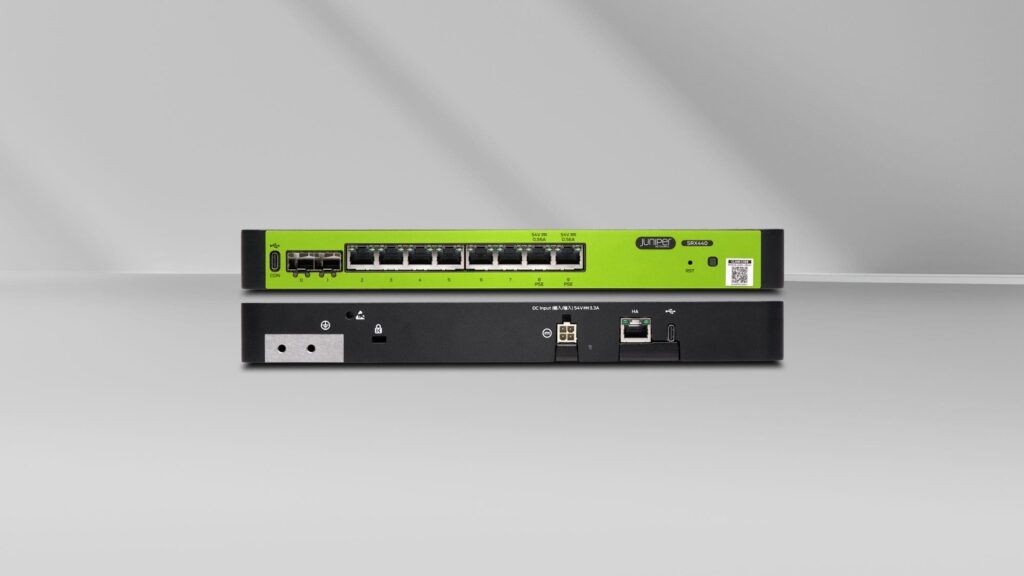
HPE took advantage of the RSA Conference 2026 to introduce a wide array of security innovations with a very clear message: adopting Artificial Intelligence can no longer be separated from operational resilience, data control, and the ability to enforce consistent policies from the core network to the edge. The company announced on March 24 new HPE Juniper Networking SRX400 Series firewalls, an expansion of its hybrid mesh firewall architecture, and several enhancements focused on recovery, payload confidentiality, and post-quantum readiness.
The announcement goes beyond a simple product launch. HPE aims to respond to an increasingly visible reality in businesses: AI is no longer confined to data centers or large public clouds; it is beginning to deploy at remote sites, branches, campuses, clinics, stores, and hybrid environments where access control, observability, and data protection become much more complex. Therefore, the company emphasizes that, in this new phase, security cannot be added afterward or managed in isolation.
This context also aligns with the messaging that HPE has been reinforcing through its recently expanded HPE Threat Labs. In their report “In the Wild 2026,” they reviewed 1,186 active campaigns observed between January 1 and December 31, 2025, leveraging telemetry from Juniper Advanced Threat Prevention Cloud and a global network of honeypots. The core message of the report is that attackers are operating at increasing scale, discipline, and persistence, which compels companies to better integrate network, security, and automation.
Edge becomes one of the most critical points
A central element of the announcement is the new HPE Juniper Networking SRX400 series. HPE presents it as a family of firewalls designed to deliver carrier-grade protection to smaller environments with limited space, without compromising overall security stance. The company underscores that these devices include hardware-based protections to defend against physical tampering and reinforce device integrity—especially sensitive as AI deployment expands across distributed sites.
The rationale is straightforward. As AI moves into remote offices, clinics, branches, or campuses, these environments cease to be just extensions of the corporate network. They become zones where unmanaged AI tool access, policy inconsistency, and new data exposure routes can emerge. HPE aims to prevent these sites from becoming the weakest link in an increasingly distributed security strategy.
Greater control over AI tool usage
The second major update is the expansion of the hybrid mesh firewall. HPE describes this model as a way to uniformly apply policies, visibility, and enforcement across on-premise, cloud, remote, and containerized environments through a unified management plane. This time, the company clearly directs its architecture evolution to better govern enterprise use of AI tools.
Features announced include visibility and access management for AI websites and applications, prompt-level inspection to filter keywords and manage file uploads to external tools, centralized identity-based protection, and automated operations via HPE Security Director. HPE claims these functions will enable productive access to approved tools while minimizing high-risk usage and accidental data leaks.
This is especially relevant because the challenge is no longer just about blocking or allowing app access. As assistants, copilots, and agents proliferate, governance involves understanding what data is shared, who uses these systems, from where, and in what context. HPE addresses this challenge via the hybrid firewall, reflecting a fundamental market shift: AI security is being integrated into network and operational policy layers, not just at endpoints or user training.
Recovery, confidential compute, and post-quantum readiness
The third pillar of the announcement is more aligned with comprehensive resilience than perimeter defense. HPE has confirmed updates in HPE Zerto Software for cyber recovery and disaster recovery, including new runbooks, expanded support for virtualized and cloud workloads, broader enablement for AI and vGPU workloads, integration with Microsoft Defender, and direct access to immutable data on HPE StoreOnce for malware analysis and forensics. The company presents this as a way to accelerate recovery to known, clean states following an incident.
Concurrently, HPE announced extending confidential computing to HPE Morpheus Software through trusted execution environments based on AMD and Intel hardware, with centralized key management via Thales CipherTrust. The goal is to keep data encrypted even during use—especially important for organizations with sensitive workloads, sovereignty requirements, or hybrid and air-gapped deployments. HPE expects this capability to be available in Q3 2026.
The third major focus is post-quantum cryptography. HPE has announced PQC-ready capabilities in Junos OS Evolved and indicated broader support for Junos by summer 2026. These advances align with NIST standards, including updated cryptographic libraries supporting FIPS 203 and FIPS 204. This is significant because, in August 2024, NIST officially approved the first federal standards for post-quantum cryptography, including FIPS 203 for key establishment and FIPS 204 for digital signatures.
HPE aims to unify networking, security, and AI in a single narrative
Overall, HPE’s initiative clearly aims to position security not as a collection of individual products but as a horizontal layer supporting AI deployment across hybrid, distributed, and increasingly regulation-intensive environments. The new SRX400 series will be available in Q2 2026, alongside new AI governance features for the hybrid mesh firewall; Zerto Software 10 U9 is scheduled for April; StoreOnce OS 5.2 is already available; confidential compute in Morpheus will arrive in Q3; and post-quantum features in iLO 7 are expected by summer 2026.
The key challenge, as always, will be execution. HPE’s messaging resonates with current market conditions: distributed AI, hybrid environments, regulatory pressures, and an increasingly industrialized threat landscape. Now it must demonstrate that its integrated approach—connecting network, firewall, recovery, encryption, and telemetry—can reduce operational friction and enhance defensive capabilities. It’s clear that the AI era pushes manufacturers to rethink security as a continuous architecture, not an afterthought.
Frequently Asked Questions
What has HPE announced for security in 2026?
HPE introduced the new HPE Juniper Networking SRX400 Series firewalls, enhancements to the hybrid mesh firewall for better AI governance, Zerto updates for recovery, confidential compute for Morpheus, and PQC-ready capabilities in Junos and iLO 7.
What problem is HPE addressing with the new SRX400?
Extending a coherent security posture from core to edge, especially at distributed sites where AI can introduce unmanaged access, data exposure, and policy inconsistencies.
What does prompt-level inspection mean in the hybrid firewall?
It means security tools will filter keywords and control file uploads to external AI tools, aiming to reduce data leaks without entirely blocking productive use of these applications.
Why is HPE talking about post-quantum cryptography now?
Because NIST approved its first PQC standards in 2024, and infrastructure providers are starting to adapt their systems to withstand future quantum computer attacks against current cryptographic mechanisms.