
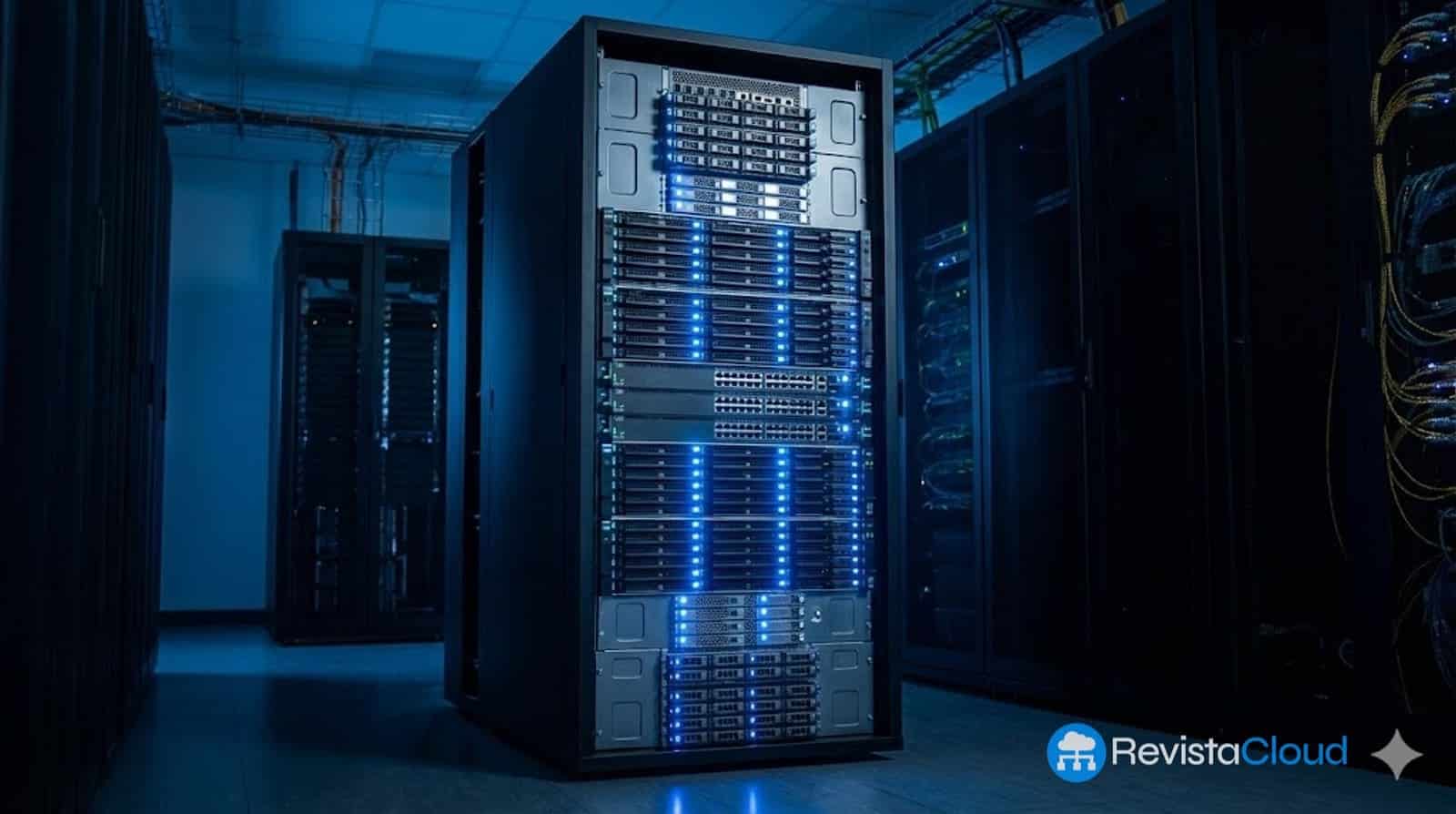
Hewlett Packard Enterprise (HPE) has leveraged its HPE Discover Barcelona 2025 event to unveil one of the most ambitious products in the new wave of AI infrastructure: the first AMD “Helios” rack-ready for training and inference of models with up to trillions of parameters, featuring a scale-up network architecture over standard Ethernet. This solution is targeted at data centers and cloud providers aiming to compete in the large-scale AI league.
The company will be among the first to offer this AMD reference design as a turnkey solution: a single rack capable, according to official figures, of reaching up to 2.9 exaflops of performance in FP4, with 72 AMD Instinct MI455X GPUs per rack and an internal network capable of moving 260 terabytes per second of aggregate bandwidth.
A rack designed for trillion-parameter models
The goal of “Helios” is clear: to provide an open, integrated, and extremely dense platform for training and serving next-generation AI models, including trillions-parameter large language models (LLMs) and massive inference workloads.
Some key data points of the design presented by HPE and AMD:
- 72 AMD Instinct MI455X GPUs per rack
- Up to 2.9 exaflops of FP4 for training and inference of giant models
- 260 TB/s of scale-up bandwidth between accelerators
- 31 TB of HBM4 memory and 1.4 PB/s memory bandwidth to feed the GPUs
- Support for training traffic of “trillion-parameter” models and high-volume inference scenarios
All of this is integrated into a rack architecture based on the Open Rack Wide (ORW) specifications from the Open Compute Project, optimized for power delivery, high density, and direct liquid cooling — an almost essential requirement given the densities and power consumption levels in AI era infrastructures.
Standard Ethernet instead of proprietary networks
One of the most striking elements of the announcement is the central role of networking: HPE introduces a new scale-up switch by HPE Juniper Networking, developed in collaboration with Broadcom based on their Tomahawk 6 chip and the Ultra Accelerator Link over Ethernet (UALoE) standard.
In practice, this means GPU interconnection within the rack is performed over standard Ethernet, but with a hardware and software stack tailored for AI that promises:
- Ultra-low latency
- Lossless internal network
- The ability to support extremely intensive and correlated traffic patterns typical of distributed training of large models
This approach contrasts with other market offerings based on proprietary networks or closed interconnects, reinforcing HPE, AMD, and Broadcom’s commitment to an AI ecosystem built on open standards that can reduce vendor lock-in risks at the networking level.
An open stack: EPYC, Instinct, Pensando, and ROCm
“Helios” isn’t just a box filled with GPUs. The design combines AMD’s entire stack within one system:
- AMD EPYC next-generation CPUs to orchestrate workloads
- AMD Instinct MI455X GPUs as the main engine for training and inference
- Pensando for advanced networking and offload functions
- ROCm, AMD’s open-source software stack for accelerated computing, as the base software layer
HPE contributes its expertise in exascale systems (such as Cray-based supercomputers) and its services team to design, install, and operate these infrastructures with direct liquid cooling and demanding electrical requirements.
The offering clearly positions itself as an alternative to closed GPU systems from other manufacturers, with a message repeated in the industry: “any model, on any hardware,” supported now by open hardware standards (OCP, Ethernet, UALoE) and open software (ROCm).
Designed for CSPs, NeoClouds, and AI data centers
Although the announcement was made in a large-provider environment, the target audience extends beyond traditional hyperscalers: HPE explicitly mentions cloud service providers (CSPs), NeoClouds, and data center operators wanting to offer AI infrastructure as a service, for purposes such as:
- Training large proprietary models
- Fine-tuning platforms and Retrieval-Augmented Generation (RAG) for enterprise clients
- Dedicating clusters to companies seeking sovereignty over their models and data
The concept of a turnkey rack offers a clear advantage: shortening the time from purchase to AI cluster deployment. HPE promises faster deployments, reduced integration risks, and a more straightforward path to scale from a single rack to dozens or hundreds of units, all based on the same reference design.
AI is no longer just about models: it’s about racks and megawatts
The “Helios” announcement arrives at a time when the AI conversation is shifting from models to underlying hardware:
- Energy cost per inference
- Availability of GPUs or accelerators
- Cooling complexity
- Deployment time for new clusters
Tech giants and infrastructure providers are competing to deliver more performance per rack and watt, in a standardized way that enables global scaling.
In this context, HPE’s emphasis on an open architecture based on standard Ethernet and OCP references reflects a long-term strategy: to enable the same rack design to be deployed across multiple data centers, countries, and operators, without dependence on hard-to-source proprietary components.
Availability and next steps
HPE has confirmed that the AMD “Helios” rack will be available worldwide in 2026, primarily targeting cloud providers, large AI data centers, and organizations aiming to build large-scale training and inference infrastructure.
From there, the natural evolution will see this architecture extend to:
- Multi-rack clusters interconnected via scale-out Ethernet networks
- Integration with AI orchestration and MLOps platforms
- “As-a-service” offerings where clients consume training or inference capacity without worrying about the physical rack details
What’s clear is that the AI market’s focus is increasingly shifting towards core infrastructure: who can deliver more performance, faster, and more energy-efficiently, based on open platforms that allow companies and governments to maintain control over their data and models. In that race, the HPE–AMD tandem wants to make it clear they won’t be left behind.
via: hpe