
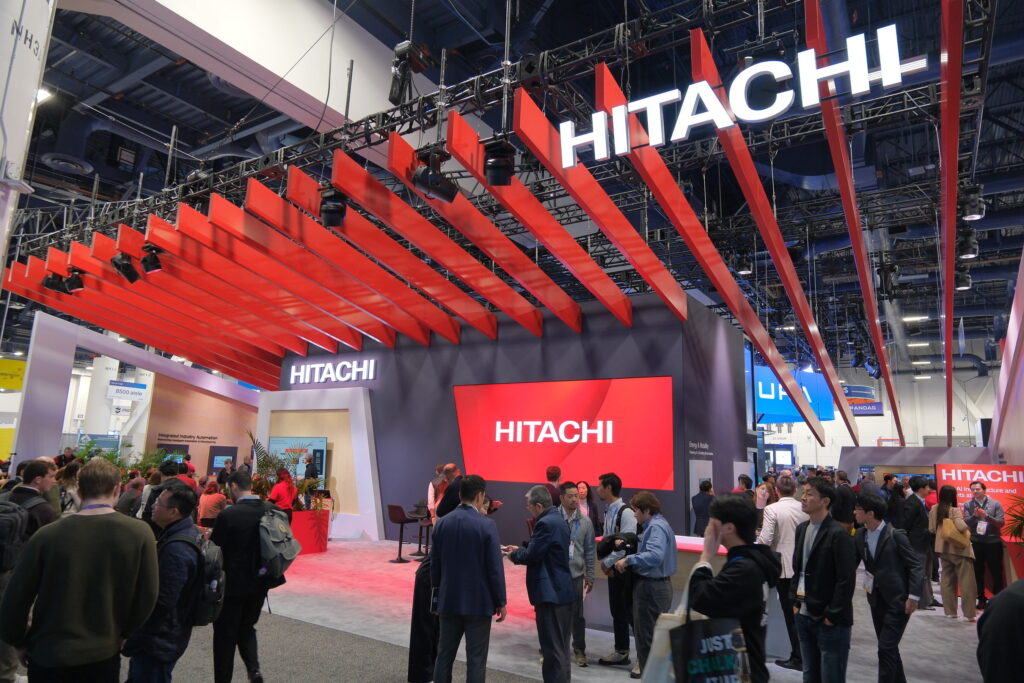
While much of the media buzz at CES 2026 centers around gadgets and consumer experiences, Hitachi has chosen a different narrative: bringing artificial intelligence to the core of the infrastructure supporting the real economy. During its week in Las Vegas, the Japanese group has announced a series of initiatives focused on energy, mobility, and industry, with notable collaborations with NVIDIA, Google Cloud, and Nozomi Networks to accelerate what it calls “Physical AI” applied to critical systems.
The guiding idea is HMAX by Hitachi, a portfolio of solutions aiming to turn operational data (OT) and digital data (IT) into actionable capabilities: from smarter monitoring and control to automation, predictive maintenance, and industrial cybersecurity. The company frames this within its mission to build a “Harmonized Society,” where technology, sustainability, and operational efficiency advance hand in hand.
HMAX: From Sector-Specific Solution to Cross-Industry Platform
According to information shared at CES, HMAX originated in the railway sector and now expands as a cross-industry offering for Mobility, Energy, and Industry. The approach is clear: combine domain knowledge (how electric grids, fleets, factories, or industrial chains work) with modern AI—including generative and agentic capabilities—to operate complex environments with greater visibility and less friction.
At the same time, Hitachi announced a prominent presence at CES Foundry with the session “Pioneering AI Technologies for the Physical World,” featuring executives from Hitachi and NVIDIA to explain how this collaboration aims to accelerate real-world AI applications with safety and validation criteria.
Google Cloud and Hitachi Rail: AI and Cybersecurity for a More Autonomous Railway
In mobility, the most notable announcement was Hitachi Rail’s collaboration with Google Cloud to drive digital transformation in the railway sector. The approach combines advanced AI and cybersecurity capabilities from Google Cloud with engineering expertise from GlobalLogic (a Hitachi group), aiming to improve operational productivity and bring rail closer to a more autonomous and energy-efficient model.
Hitachi emphasizes that in critical infrastructure, AI is not just “co-pilot” assistance but a system that must integrate with the physical world (signaling, operation, maintenance, resilience), with traceability and controls. This alliance seeks to accelerate that integration with a cloud partner specialized in deploying AI at scale, without losing sight of security perimeter.
Nozomi Networks + Hitachi Cyber: OT/IoT Visibility Against Hybrid Threats
If AI “lands” in industrial systems, security ceases to be an add-on and becomes a prerequisite. This is where the collaboration between Hitachi Cyber and Nozomi Networks fits in, focusing on monitoring and visibility of OT and IoT environments to protect ecosystems where industrial networks, sensors, automation, and critical operations converge.
The significance of this move is twofold: first, critical infrastructure already operates under constant pressure (cyber and physical threats); second, adopting AI in industrial operations expands the “impact radius” of incidents. Having visibility and detection capabilities in OT/IoT enables a shift from reaction to prevention.
Use Cases: Batteries, Biopharma, and Healthcare with Explainable AI
Beyond the headlines about alliances, Hitachi has provided examples of how it envisions practical deployment:
- Battery Sector: Solutions to improve performance (yield) and quality through precision analysis and inspection, robotic automation, and OT–IT platforms; plus a lifecycle management approach aimed at circularity and reducing environmental impact.
- Biopharma: Use of cell culture simulation and parameter feedback with AI to cut production timelines by up to a third in certain scenarios.
- Health: Data analysis platforms applying explainable AI to identify biomarkers within complex medical data and support clinical decisions, in addition to end-to-end traceability in regenerative medicine.
This type of examples shifts the conversation from “models” to “operations”: quality, resilience, traceability, cycle times, and safety.
Why CES 2026 Matters for Hitachi: Less Promises, More “Day 2”
Fundamentally, Hitachi is positioning itself in a space that is becoming increasingly strategic: the role of integrator of AI in infrastructure where failures aren’t an option, and where “the hard part” begins after the pilot. In industry, the question is no longer whether a model works in a demo but whether it can sustain a year of operation, load changes, incidents, audits, and compliance.
The idea of “Physical AI” suggests that the next big leap in AI will depend not only on chips and models but on the ability to integrate with OT, processes, and security, demonstrating returns in energy efficiency, reliability, maintenance, and user experience.
Frequently Asked Questions
What is “Physical AI,” and why is it mentioned in critical infrastructures?
It’s an AI approach aimed at acting on the physical world (equipment, sensors, industrial networks, mobility), where AI must perceive, decide, and execute with controls, validation, and safety—not just generate text or images.
What does HMAX bring to energy, mobility, and industry companies?
HMAX is envisioned as a portfolio of solutions to extract value from operational and digital data, automate tasks, improve visibility and control, and accelerate decision-making with AI in complex sectors like energy networks, railways, and industry.
Why is the partnership with Nozomi Networks in OT/IoT critical?
Because it provides monitoring and visibility in industrial and connected environments—key to reducing attack surfaces and detecting anomalies where incidents could impact operational continuity and physical safety.
What does the Hitachi Rail–Google Cloud collaboration mean for the railway sector?
It aims to accelerate digital transformation by combining AI and cybersecurity capabilities in the cloud with specialized engineering, to boost productivity and advance toward more autonomous and energy-efficient operations.