
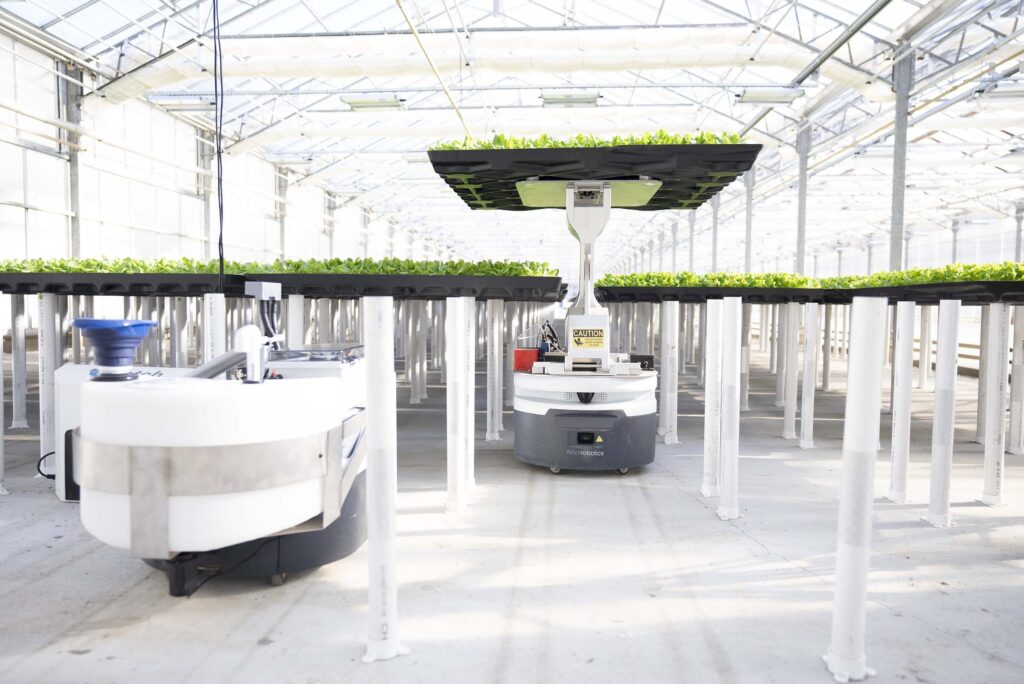
Hippo Harvest has closed a $30 million Series C funding round to multiply its production capacity and bring its robotic cultivation system to a new facility in Hollister, California. The operation was led by Cox Farms, one of North America’s largest greenhouse operators and owner of companies like BrightFarms and Mucci Farms.
The U.S. company aims to expand from its current operation, roughly one acre, to a 30-acre facility which is still in permitting stages. The capital will also fund a new generation of autonomous mobile robots, the commercial launch of greenhouse-grown spinach, and the expansion of its leafy greens along the West Coast of the United States.
The key points about Hippo Harvest in 20 seconds
- Hippo Harvest raised $30 million in a Series C.
- Cox Farms led the investment.
- The company envisions a new 30-acre facility in Hollister.
- Its current productive area is about one acre.
- It uses autonomous mobile robots as small indoor tractors.
- The robots move cultivation modules as plants grow.
- The system combines robotics, sensors, and machine learning.
- The round will fund the commercialization of greenhouse-grown spinach.
- Hippo Harvest launched its butter lettuce in early 2026.
- The company claims its method uses 92% less water and 55% less fertilizer than conventional farming.
Founded in 2019 and based in Pescadero, the company already markets spinach, arugula, salad mixes, butter lettuce, kale, and other leafy greens. Its catalog combines greenhouse-grown products with those from outdoor organic farming—a strategy aimed at maintaining variety and supply year-round.
Robots reorganizing the greenhouse as plants grow
Hippo Harvest’s most distinctive technology is its autonomous mobile robots, known in the industry as AMRs. They function as small indoor tractors adapted to enclosed environments and move underneath cultivation modules where the plants are located.
One of their tasks is to modify the spacing between modules during the crop cycle. Young plants occupy little space and can be placed very close together. As they grow, they require more surface area to receive light, ventilate, and develop leaves without competing with nearby plants.
In a conventional greenhouse, this reorganization might require manual labor or fixed mechanical systems. Hippo Harvest contends that its robots can pick up modules and move them automatically based on software instructions.
The goal is to make the most efficient use of each square meter. The same installation can start with a high density of small plants and gradually open up space without wasting surface during the early growth phases.
The robots also serve as a platform for data collection. Sensors and cameras can observe leaf size, color, and condition, while the system records data on watering, nutrients, temperature, or humidity. Machine learning models use this information to adjust treatment for each plant group.
Additionally, the company describes a closed-loop water and nutrient system that delivers solutions directly to the roots. By controlling the amount and timing of application, it aims to reduce consumption and prevent excess fertilizer from ending outside the cultivation area.
Hippo Harvest claims that its method uses 92% less water, 55% less fertilizer, and generates 61% less food waste. It also states that it has reduced plastic in its packaging by 40% compared to traditional rigid boxes. These figures are published by the company and should be considered as corporate comparisons, as they are not from independent audits or full disclosure of all assumptions used.
What the system automates
| Process | Function of the technology |
|---|---|
| Plant distribution | Robots bring modules closer or space them apart according to growth stage |
| Irrigation | The system delivers water directly to the roots |
| Fertilization | Adjusts nutrient amounts based on plant needs |
| Monitoring | Sensors and cameras oversee crop development |
| Planning | Software estimates space, timing, and production needs |
| Harvesting | Automation helps coordinate harvesting and product movement |
| Cleansing | The environment can be sanitized between cycles |
Automation does not mean the greenhouse operates without workers. The facility still requires agronomists, maintenance technicians, quality specialists, packing operators, and staff to resolve issues. Robots mainly replace repetitive movements, allowing staff to focus more on crop management.
A 30-fold expansion that must prove its costs
The planned increase is significant. Going from one acre to a 30-acre facility involves expanding the potential area by about 30 times, but the new operation will not reach full capacity immediately.
The Hollister project remains in the permitting phase. Afterward, construction, equipment installation, commissioning, and crop cycle adjustments will follow. In controlled agriculture, producing an initial harvest is much easier than maintaining stable yields, competitive costs, and quality throughout the year.
This new funding round will be crucial in assessing whether the technology developed in Pescadero can scale to much larger operations. Managing a small fleet of robots is straightforward; hundreds or thousands of units require systems for charging, preventive maintenance, spare parts, and continued operation when a machine fails.
Software complexity also increases. The system must coordinate different varieties, planting dates, growth rates, and commercial orders. A lettuce that stays longer than planned occupies space reserved for the next cycle, potentially disrupting the entire schedule.
Hippo Harvest believes that the next generation of robots will boost production and reduce the cost per unit. This metric will determine whether the project can compete with outdoor-grown vegetables, especially in California, one of the country’s leading agricultural regions.
The company states it can already offer greenhouse vegetables at prices close to those of conventional agriculture. Its website promotes “greenhouse quality at outdoor prices,” although it does not provide a detailed cost comparison per kilogram.
Indoor farming seeking a less energy-dependent model
Hippo Harvest is part of controlled environment agriculture, but its model should not be confused with a fully closed vertical farm.
Vertical farms typically stack crops at multiple heights and replace sunlight with LED lighting. They can produce near cities and use little water but often entail high electricity consumption and substantial construction costs.
Greenhouses leverage natural light and structure to partially control temperature, humidity, watering, and pest entry. They might require supplemental heating, cooling, or lighting, but their energy costs usually differ significantly from those of enclosed warehouses lit solely with lamps.
This distinction matters since the indoor agriculture sector has faced challenges. Several companies that raised large amounts of capital have struggled to make their production profitable. The costs of facilities, energy, and labor have limited their ability to compete with low-margin agricultural products.
Funding for the sector fell in 2024 to roughly one-fifth of the peak recorded in 2021, according to PitchBook data cited by Reuters. The same analysis noted that high initial costs remain a major obstacle for expanding these operations.
Hippo Harvest aims to address this issue by combining sunlight, organic farming, and relatively small robots. Instead of building a fully isolated plant factory, it automates specific operations within a greenhouse.
Cox Farms’ participation adds an industrial dimension to the round. It is not just a financial investor but an experienced operator in production, distribution, and relationships with major food chains. This involvement can help evaluate the technology from a commercial farming perspective, not solely from a software standpoint.
Participants also include Congruent Ventures, Hawthorne Food Ventures, Collaborative Fund, and Fresh Investment Club. Hippo Harvest previously closed a $21 million Series B in February 2024, led by Standard Investments and supported by, among others, Amazon Climate Pledge Fund and Energy Impact Partners.
Spinach will be a particularly challenging test
Market launch of spinach is a key part of the new plan. Although it may seem straightforward, growing and selling this leafy green at scale involves challenges related to quality, preservation, and food safety.
The leaves must be uniform in size and texture, withstand washing and packaging, and reach supermarkets with enough shelf life. Year-round production also demands that the system maintain consistent results despite seasonal changes in light and temperature.
Hippo Harvest introduced its butter lettuce to retailers in early 2026 and now aims to make spinach another flagship product. The company already features both products alongside arugula, spring mix, kale, romaine lettuce, and crunchy varieties.
Their products are sold in stores in northern California and the Pacific Northwest. Customers include Sprouts, Haggen, and Gus’s Community Markets. The new facility should enable them to serve a larger geographic area and negotiate volume commitments with chains demanding steady supply.
The company maintains a hybrid approach. Some vegetables are from its greenhouses, while others come from traditional organic outdoor farms. This strategy reduces the risk of relying solely on one technology and helps offer products that are not always cost-effective in indoor setups.
The Series C provides funds to grow, but does not automatically solve profitability questions. Construction must clear permitting, robots need to perform reliably, and savings from automation must offset infrastructure costs.
Hippo Harvest has devised an innovative way to turn small robots into greenhouse tractors. The Hollister facility will show whether this system can advance from a one-acre farm to an agricultural platform capable of supplying major chains profitably.
Frequently Asked Questions
What does Hippo Harvest do?
It grows organic leafy greens using greenhouses, mobile robots, sensors, and machine learning systems.
What are its robots for?
They transport and reorganize cultivation modules, collect data, and assist with various tasks during growth and harvest.
Is it a vertical farm?
Not exactly. It uses greenhouses and natural light, whereas a vertical farm usually grows in stacked layers inside a warehouse with artificial lighting.
When will the new facility be operational?
The company has not provided a specific date. The 30-acre project in Hollister is still in the permitting stage.
