
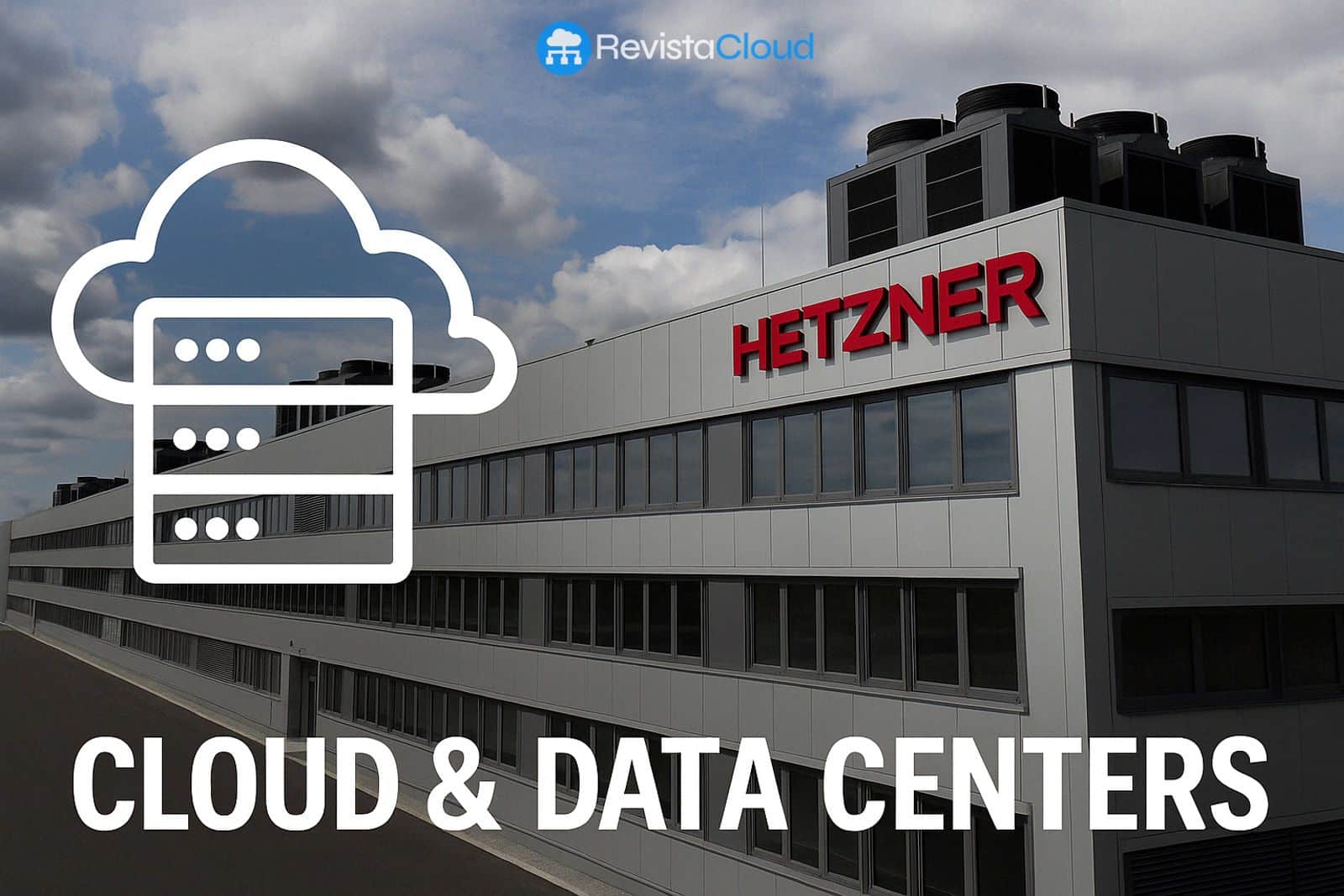
Hetzner is preparing a new price increase in its infrastructure catalog. The German company has announced that on June 15, 2026, it will implement a broad update to its server portfolio, with two main changes: standardization of its dedicated server offerings and an upward adjustment of monthly fees for new orders. The measure will affect dedicated servers and cloud plans across all locations, although it will not alter existing contracts.
The company describes the move as a combination of commercial simplification and a response to rising hardware costs. But for customers placing new infrastructure orders or rescaling, the practical effect will be clear: new servers and cloud plans will cost more in monthly fees, although Hetzner claims it will significantly reduce setup fees for most dedicated servers.
A price hike wrapped in standardization
Hetzner will reorganize its dedicated server range around fixed configurations. With the change, models will be structured with “-1”, “-2”, and “-3” designations, instead of depending on individual RAM and storage configurations. Additionally, a “limited” category, identified as “-1-Ltd”, will appear for servers available in limited quantities and based on components Hetzner can acquire at lower costs.
The official explanation is that this standardization will make product comparisons easier, accelerate deployment, and simplify provisioning and maintenance. In practice, it reduces some of the flexibility many clients associated with Hetzner, especially in dedicated servers configured with specific combinations of memory, disks, or storage.
Hetzner’s own FAQ clarifies that freeform configurations will not disappear completely immediately, but they will be reduced. Initially, Hetzner will offer up to three fixed configurations per model, based on the most requested options, representing around 90% of orders. Custom configurations will still be available through Custom Solutions, albeit within a more standardized framework.
| Announced Change | Implication for the Customer |
|---|---|
| Models “-1”, “-2”, and “-3” | Fewer flexible configurations and a more comparable catalog |
| “-1-Ltd” servers | Limited offers with hardware purchased at lower costs |
| Increase in monthly fees | Affects new orders and rescalings |
| Reduction in setup fees | Lower initial costs for most dedicated servers |
| Existing contracts unchanged | Already contracted servers retain their conditions |
| Affected cloud plans | Adjustments will also apply to cloud plans, not just dedicated servers |
| Prices not yet published | Hetzner will announce them during the rollout on June 15 |
The most sensitive point is that there is no finalized public list of new prices yet. Hetzner justifies this absence by pointing to the market volatility of hardware components, especially RAM, SSD, and GPUs, whose prices can fluctuate in just a few days. This leaves customers in an awkward position: they know a price increase is coming but cannot precisely estimate the impact until the change takes effect.
RAM, SSD, and GPU explain part of the issue
Hetzner has been warning about hardware market pressures for months. In February, it announced a price adjustment effective from April 1, 2026, affecting both new orders and existing products. In April, it issued another note about increased setup fees for dedicated servers, citing continued rises in RAM and NVMe SSD prices, and the unpredictability of supply commitments.
The new measure on June 15 fits into this sequence. The company speaks of a “massive increase” in acquisition costs and describes the situation as particularly tense regarding key components. The FAQ also explains why some cloud plans based on already deployed hardware will be affected: even if the server exists, operating it involves replacing failing parts during its lifespan, such as CPUs, RAM, or disks.
This argument is not unique to Hetzner. Demand for memory, fast storage, and GPUs for AI applications has disrupted supply chains and increased prices for components that were previously more predictable. Infrastructure providers with low margins and highly competitive pricing models are especially sensitive to these changes because their business depends on efficient hardware procurement and amortization over the years.
| Product or Resource | Situation Described by Hetzner |
| RAM | High prices and tensioned market |
| NVMe SSD | Cost increases and reduced predictability |
| GPU | Significant fluctuations and limited availability |
| New dedicated servers | Higher monthly costs starting June 15 |
| Cost Optimized Cloud | Also affected by hardware replacement costs |
| Setup fees | Reduced in most cases, despite previous adjustments |
| Custom Solutions | Will continue to exist but with more standardization |
The market message is clear: hardware again influences the price of cloud and dedicated servers. Over the years, many customers got used to a nearly constant decline in costs per vCPU, gigabyte of RAM, or terabyte of storage. The surge in AI demand and component shortages are breaking that inertia.
Which products are exempt from the adjustment
The increase does not affect the entire catalog. Hetzner has specified that web hosting products, managed servers, Server Auction servers, IP addresses, storage products, Load Balancers, Volumes, Snapshots, and Object Storage are excluded.
This is important because the company maintains a clear separation between its core infrastructure and other ancillary services. The Server Auction, for instance, will continue to be a route for purchasing refurbished or variable-availability servers at decreasing prices. For cost-sensitive clients, this could be more attractive than the new standard dedicated server rates.
| Affected by the adjustment | Not affected by the adjustment |
| Dedicated servers | Web hosting |
| Cloud plans | Managed servers |
| New orders | Server Auction |
| Rescaling existing servers | IP addresses |
| Future products with a new structure | Storage products |
| Load Balancers | |
| Volumes | |
| Snapshots | |
| Object Storage |
Current contracts, according to Hetzner, will remain under their current terms and conditions. This minimizes the immediate impact for clients with active servers, but creates a distinction between existing infrastructure and new capacity. Those needing to expand, add nodes, or resize will need to accept the new scheme.
This distinction may influence planning decisions. Companies expecting growth after June 15 will need to recalculate budgets. Others might accelerate orders before the change if availability allows. And some may reconsider whether to maintain current infrastructure, utilize Server Auction, switch to another cloud provider, or redesign workloads to reduce resource consumption.
Less flexibility, more internal efficiency
Standardization makes operational sense. Managing thousands of servers with many RAM, disk, NIC, and storage combinations complicates procurement, inventory, support, replacement, and maintenance. Reducing variants allows for better purchasing, inventory forecasting, configuration validation, faster delivery times, and simplified data center processes.
For customers, the experience may be twofold. There will be fewer rare options and more clarity in the catalog. But also less room to tailor servers to very specific needs. In certain environments, flexibility matters: virtualization, databases, storage, Kubernetes clusters, backups, lightweight AI, streaming, or workloads with specific I/O requirements.
Hetzner aims to bridge this gap with Custom Solutions and network add-ons. According to its FAQ, options like 10G uplinks or Dual-25G cards will still be available via sales or Custom Solutions when technically feasible and will be billed separately. It will also continue to offer Dell servers with custom configurations above 512 GB RAM upon request.
In standard models, the maximum RAM will be 512 GB until further notice, with 64 GB as the minimum configuration. Hetzner also states it will continue offering ECC memory options on all servers except for EX44, GEX44, AX41, and AX42. For EPYC and Xeon-based models, this will be registered ECC memory.
A warning for cloud and dedicated clients
The change matters because Hetzner has established itself as one of Europe’s major infrastructure providers in terms of price-performance. Its dedicated servers, cloud, and presence in Germany, Finland, the US, and Singapore make it a common choice for companies, developers, SaaS projects, technical communities, and cost-conscious deployments.
Therefore, any price increase extends beyond its current customer base. Hetzner is often used as a reference price in Europe. If even a provider known for margin adjustments needs to raise fees, the market message is that cost pressures are no longer limited to hyperscalers or large GPU-buying entities. They now also affect providers purchasing general-purpose servers, RAM, SSD, and replacement components.
This transition also challenges the common belief that cloud prices always decline over time. In reality, infrastructure costs depend on hardware cycles, energy, component availability, AI demand, logistics, and exchange rates. When several of these factors tighten simultaneously, providers can optimize processes but cannot always fully absorb the increase.
Hetzner argues that standardization will mitigate some of the impact but admits it does not eliminate hardware procurement cost increases. It’s an elegant way of saying that internal efficiency alone is insufficient to offset rising component prices.
What clients should review before June 15
For current clients, the priority is to identify which parts of their infrastructure might require new orders or rescaling after June 15. Already contracted servers will not change in price due to this measure, but any expansion may adopt the new scheme.
It’s also advisable to review dependencies on RAM, NVMe storage, and Cost Optimized cloud plans, especially in architectures that grow by nodes: virtualization, Kubernetes, replicated databases, distributed storage, queues, workers, and CI/CD environments. A small monthly price change could have a significant impact when multiplied by dozens or hundreds of instances.
The reduction in setup fees may facilitate starting some projects, but the monthly increase weighs more for long-term workloads. In infrastructure, the total cost over 12, 24, or 36 months is usually more relevant than the initial month.
Hetzner remains committed to dedicated servers and is not shifting solely to cloud, as explicitly clarified in its FAQ. However, it is changing how it packages and sells infrastructure. For customers used to configuring servers with great flexibility, June 15 will mark a more closed, standardized, and, for new contracts, more expensive stage.
Frequently Asked Questions
When does Hetzner’s price increase take effect?
The portfolio update and price adjustments are effective from June 15, 2026.
Does this affect existing servers?
Not due to this measure. Hetzner states that existing contracts remain under their current terms. The change applies to new orders, rescaling, and future products under the new structure.
Which products will see price rises?
The adjustment affects dedicated servers and cloud plans across all locations. It does not impact web hosting, managed servers, Server Auction, IP addresses, storage products, Load Balancers, Volumes, Snapshots, or Object Storage.
Why is Hetzner raising prices?
The company attributes this to the sharp increase in procurement and replacement costs for hardware, especially RAM, SSD, and GPUs, along with supply volatility.
