
Mechanical hard drives (HDDs) have now posted price increases for six straight quarters, with reference 1 TB models costing up to 15% more during the July-to-September 2026 quarter. The pressure is no longer limited to SSDs and NAND memory: growing data center storage demand is also straining the HDD market, where manufacturers are prioritizing high-capacity nearline drives.
HDD price increases: the key facts in 30 seconds
- 3.5-inch, 1 TB HDDs are reaching $66.70 in large commercial deals, up 15% from the previous quarter.
- 2.5-inch, 1 TB models are up 10%, to $61.20.
- These are wholesale reference prices, not direct retail prices.
- Morgan Stanley estimates HDD demand is growing 40% to 50% a year, versus 30%-35% for supply.
- Its analysts expect supply constraints to persist at least through 2028.
The situation breaks with an idea that has been fairly widespread in recent years: that mechanical storage would keep getting cheaper as SSDs gradually took its place. That shift has indeed happened in personal computers and other devices, but HDDs still hold an advantage that’s hard to ignore when dozens of terabytes are needed: cost per unit of capacity.
Data centers need precisely this ever-growing amount of storage. Artificial intelligence adds new workloads, but it isn’t the only factor. Cloud services, backups, archives, video, video surveillance, and large data repositories keep using mechanical drives when an SSD’s speed doesn’t justify its higher cost.
The combination is narrowing the available margin between supply and demand.
A 1 TB HDD Hits $66.70 in the Wholesale Market
Data originally published by Nikkei for the July-to-September quarter show a significant increase in two products used as benchmarks in commercial deals.
| Reference HDD | Previous quarter | July-September 2026 | Change |
|---|---|---|---|
| 3.5-inch, 1 TB | $58.00 | $66.70 | +15% |
| 2.5-inch, 1 TB | $55.64 | $61.20 | +10% |
The 3.5-inch model has thus gained $8.70 in a single quarter. The 2.5-inch model is up $5.56.
These figures need to be read correctly. They don’t mean that every 1 TB HDD will cost $66.70, or that every drive has risen by exactly 15%.
They are reference prices used in large commercial transactions, and it can take time for them to filter through to the retail channel. The final price also depends on the manufacturer, capacity, distributor, available inventory, promotions, taxes, and the segment the drive belongs to.
What’s more, 1 TB drives are no longer necessarily the best benchmark for measuring the real cost of high-capacity storage. Data centers use nearline drives with far higher capacities, where cost per terabyte tends to be the more useful metric.
The real significance lies elsewhere: prices keep trending upward even in mature segments of the HDD market.
AI Needs Fast SSDs, But Also Huge Amounts of HDDs
The expansion of AI infrastructure is usually associated with GPUs, HBM memory, and high-performance SSDs. However, data centers need to store far larger amounts of data than what they keep permanently in their fastest tiers.
SSDs are well suited to workloads where latency and the number of input/output operations per second matter most. HDDs remain competitive for mass storage when capacity is the priority and data doesn’t need to respond with the same latency.
This split helps explain why AI growth can end up affecting both technologies.
The NAND flash memory shortage that has driven up enterprise SSD prices can make SSDs less attractive at certain storage tiers. At the same time, the growth of cloud services and inference workloads is increasing the total amount of data that needs to be kept.
In June, Morgan Stanley calculated that HDD demand was growing roughly 40% to 50% a year, while supply capacity was advancing 30% to 35%. Its checks in Asia led the firm to forecast a shortage that could last at least through 2028.
That’s an analyst forecast, not a guarantee that every segment will face shortages over the next two years. The distinction matters because the HDD market includes very different products, from small drives for consumer electronics to nearline disks of more than 20 or 30 TB destined for large data centers.
Morgan Stanley also noted that nearline drive prices stood below $15 per terabyte in June, while manufacturers such as Seagate and Western Digital are reportedly targeting levels of $25 to $30 per terabyte over the next two to three years.
If that scenario plays out, the increase would hit exactly the segment where HDDs retain the greatest economic importance: mass storage.
Manufacturers Are Concentrating Resources on High-Capacity Drives
Industrial capacity can’t grow from one quarter to the next at the same pace as demand, either.
The global HDD market is concentrated mainly around Seagate, Western Digital, and Toshiba. Manufacturers have devoted much of their development work to increasing the capacity of each drive, especially for data center customers.
The goal isn’t just to produce more drives, but to store more terabytes using a similar number of drives, bays, servers, and data centers.
Technologies such as HAMR (Heat-Assisted Magnetic Recording) increase storage density by heating the magnetic surface in an extremely localized way during writing. Seagate is already selling its Mozaic platform based on HAMR, while Western Digital — which sold out its entire 2026 hard-drive capacity — is developing its own technology transition alongside other density-boosting techniques.
Demand for these high-capacity drives is also reshaping production priorities. If large operators are willing to commit to buying large volumes of nearline storage, keeping a broad supply of smaller, lower-margin drives becomes less attractive for manufacturers.
That may partly explain why the pressure ends up reaching conventional drives even though large data centers aren’t buying millions of 1 TB HDDs.
There’s no direct equivalence between the two markets, but they share manufacturers, components, industrial capacity, and investment decisions.
Video surveillance adds another source of demand. Higher camera resolutions and longer recording retention periods are increasing storage needs, a market where mechanical drives still have a substantial presence.
Switching Back From SSD to HDD No Longer Guarantees Cheap Storage
The situation is particularly unusual because the pressure is hitting different technologies at the same time.
For years, a user who found a multi-terabyte SSD too expensive could combine a small SSD for the system and applications with a large HDD for data. That setup is still technically valid, but the economic gap can narrow if both technologies get more expensive.
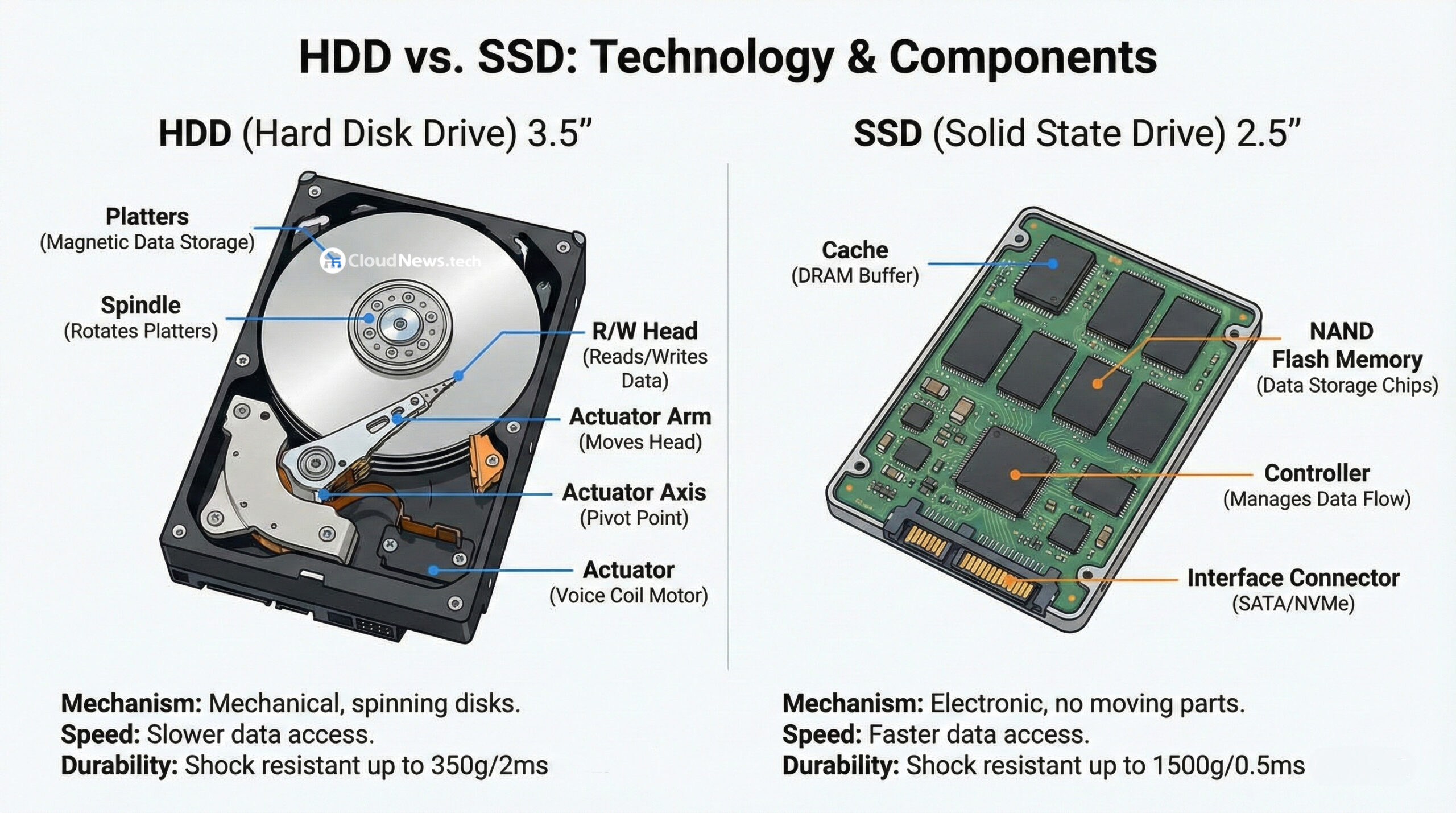
That doesn’t mean HDDs and SSDs are converging toward the same price per terabyte. High-capacity mechanical drives still offer economic advantages for certain uses, and SSDs retain huge differences in latency, power draw during certain operations, noise, mechanical resilience, and random performance.
The choice increasingly depends on the workload.
| Need | Usually best-suited technology |
|---|---|
| Operating system and applications | SSD |
| Games and read-heavy applications | SSD |
| Virtual machines and active databases | SSD |
| Large-volume archiving | HDD |
| Local backups | HDD |
| High-capacity NAS | HDD |
| Nearline storage in data centers | HDD |
| Data requiring minimal latency | SSD |
For companies with large storage needs, this trend matters far more than it does for someone buying a single drive. A difference of a few dollars per terabyte can add up to a substantial amount when sizing petabytes of capacity.
And it’s precisely in that market where order visibility is greatest.
Large operators negotiate contracts well in advance, and manufacturers can adjust their investments based on those forecasts. Morgan Stanley believes the combination of rising demand and slower supply expansion could keep the market tight through 2028.
That doesn’t mean prices have to rise every quarter until then. There could be periods of stabilization, inventory shifts, capacity increases, or demand fluctuations.
Nor does it guarantee that any specific HDD will cost more in two years than it does now.
What the current data shows is more limited but still significant: mechanical storage has stopped acting as a complete refuge from the pressures affecting the rest of the memory and storage industry.
Data center demand is shifting toward ever-larger amounts of capacity, and manufacturers are concentrating much of their resources on meeting it. As long as supply grows more slowly than that demand, finding cheap storage — whether SSD or HDD — could keep being harder than it was just a few quarters ago.
