
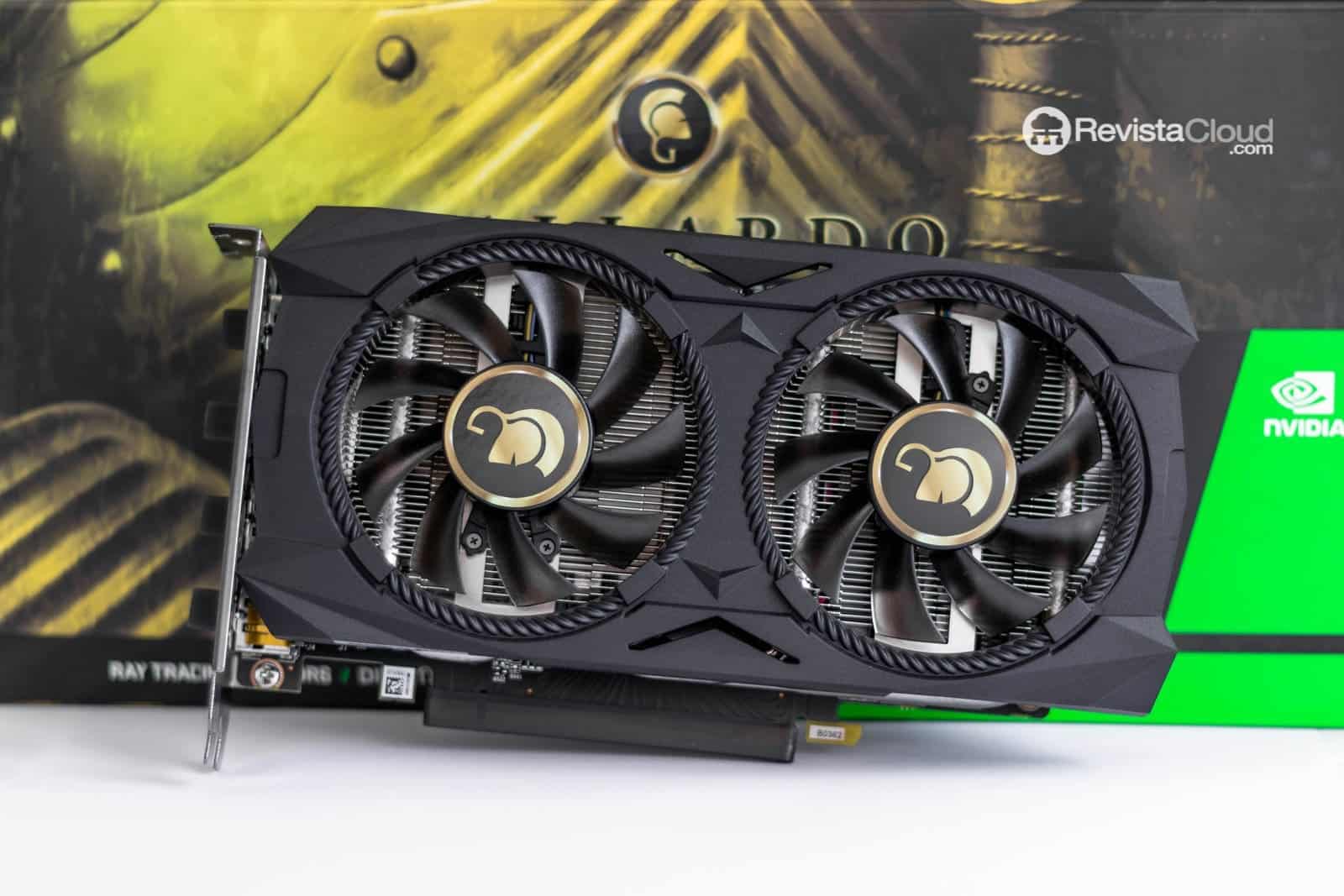
For a long time, GPUs were seen almost exclusively as the piece that enabled better graphics for gaming or smoother 3D scene rendering. Its full name, Graphics Processing Unit, helps to understand its origin: it was created to accelerate operations related to images, video, geometry, and pixels. But this specialization eventually became an advantage for many other workloads.
The reason is simple. A GPU is not designed to solve a few very complex tasks one after another like a CPU. It is built to execute thousands of small operations in parallel. This difference in approach explains why GPUs have become so vital in artificial intelligence, scientific computing, data analytics, simulations, rendering, video processing, supercomputing, and model training.
The CPU remains necessary. It coordinates the system, runs the operating system, manages processes, makes overall decisions, and moves work between components. The GPU accelerates specific parts where parallelism makes a difference. It doesn’t replace the CPU; it complements it.
CPU and GPU: two different ways of processing information
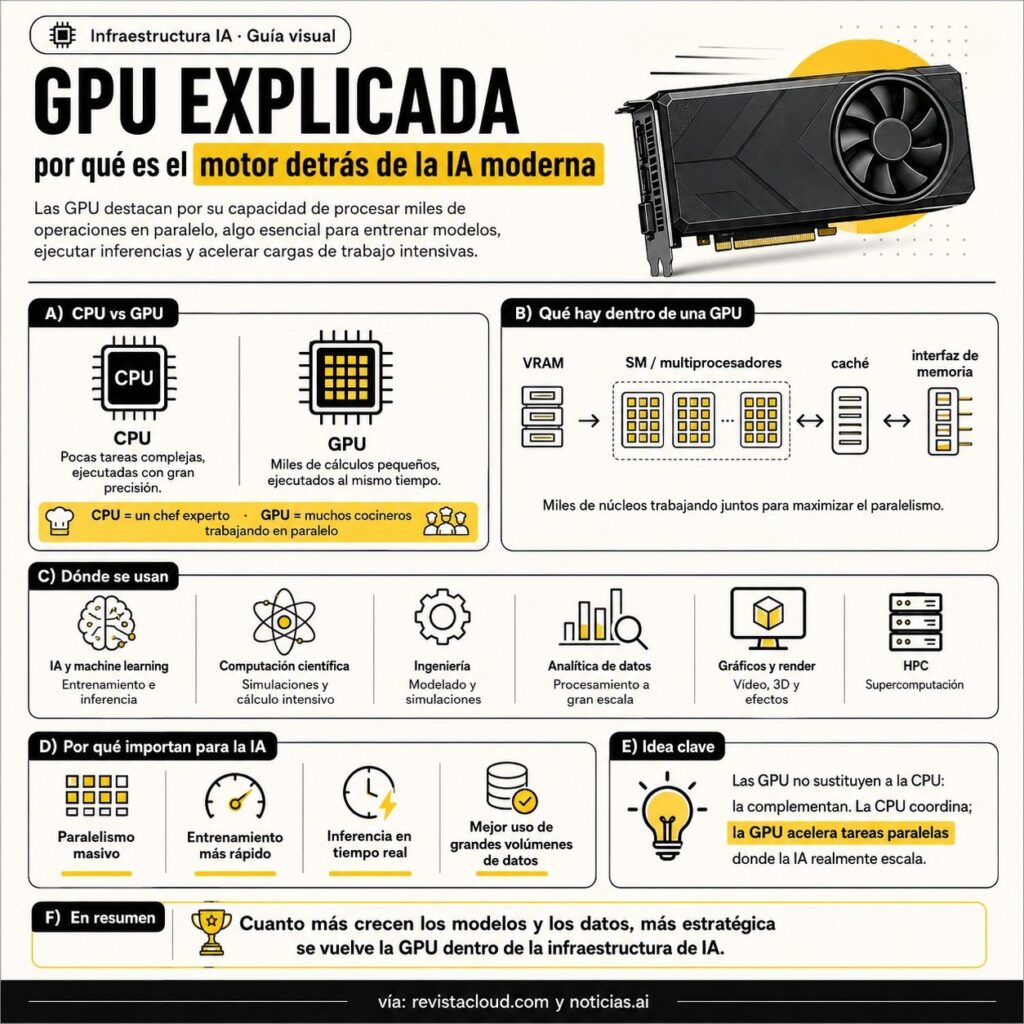
A CPU can be compared to a master chef capable of preparing complex dishes with high precision. It has few cores, but each is highly versatile. It can switch between tasks, execute conditional logic, respond to interrupts, manage memory, coordinate peripherals, and handle general system processes.
A GPU is more like a kitchen with many cooks performing similar tasks simultaneously. It isn’t as flexible for individual operations, but it can repeat simple calculations on a massive scale. This capability fits well with problems that can be divided into thousands or millions of small, independent operations.
In graphics, for example, a 3D scene consists of many vertices, textures, pixels, lights, and effects that can be processed in parallel. In artificial intelligence, something similar happens. Training a neural network involves performing large quantities of matrix multiplications, additions, transformations, and weight adjustments. These are repetitive, massive, and highly parallelizable operations.
This is why a GPU can accelerate both training and inference. During training, it helps process large batches of data and adjust model parameters. During inference, it enables faster responses when a trained model generates text, classifies images, recognizes speech, translates, recommends content, or analyzes patterns.
What’s inside a GPU
A modern GPU is not just “many cores.” It’s a set of components designed to move and process data at high speed.
The first key component is the VRAM, the dedicated memory of the graphics card. It loads models, textures, intermediate data, training batches, and temporary results. In AI, VRAM heavily influences what can be executed. A large model requires more memory to load its parameters and work with broad contexts. If it doesn’t fit in memory, it must be split across multiple GPUs, reduced in precision, use quantization techniques, or offloaded parts of the workload to system memory, with a performance penalty.
Next are the internal multiprocessors, known by different names depending on the manufacturer. NVIDIA calls them SM, streaming multiprocessors. AMD uses terms like compute units. These blocks contain many execution cores working together on parallel data. Not all cores are the same: some are designed for general operations, others for matrix math, graphics, video, or specialized tasks.
The cache also matters, acting as an intermediate, fast memory to reduce VRAM accesses. Better cache utilization means less waiting time for data. In AI workloads, where models move enormous amounts of data, the memory hierarchy is almost as important as raw computational power.
The memory interface and bandwidth determine how much information can enter and exit the GPU per second. A GPU may have many cores, but if data doesn’t arrive fast enough, it becomes idle waiting for data. That’s why in AI and HPC, it’s not just about TFLOPS. Bandwidth, memory size, interconnection quality, latency, power consumption, and efficiency are crucial too.
Additionally, many modern GPUs include specialized units for AI, like tensor cores or equivalents. These are optimized for matrix operations and lower-precision formats like FP16, BF16, INT8, or FP8, depending on architecture and software support. They enable much faster deep learning operations with higher efficiency than traditional cores.
Why they matter so much for AI
Modern AI relies heavily on two aspects that align perfectly with GPUs: vast amounts of data and repeated calculations. Training a language model, vision model, or multimodal system involves processing enormous datasets and tuning millions or billions of parameters. Without parallelism, this process would be painfully slow or even impossible.
GPUs reduce training times by processing large batches simultaneously. They also speed up real-time inference, which is essential when a service must respond to thousands of users, analyze images in seconds, or run models within interactive applications.
But GPUs don’t work alone. They require a full stack: drivers, libraries, frameworks, fast storage, low-latency network, sufficient CPU, memory, cooling, and optimized software. In AI, the infrastructure matters as much as the chip itself. A GPU poorly fed with data, poorly connected, or badly programmed can perform far below its potential.
It’s also important to distinguish between training and inference. Training generally demands more memory, time, and sustained computation. Inference aims for low latency, cost efficiency per request, and stability. Some GPUs are designed for large data centers and intensive training; others are better suited for inference, workstations, or mixed workloads.
In business, choosing a GPU should not be based solely on technical specs. It’s essential to consider what models will be run, required precision, memory demands, number of users, expected latency, software ecosystem, and operational costs over months or years.
Beyond AI: science, data, video, and simulation
While AI gets most of the spotlight, GPUs remain vital in many other fields. In scientific computing, they accelerate physical simulations, computational chemistry, biology, climatology, astronomy, and engineering. In data analytics, they handle large volumes of data when operations can be parallelized. In video processing, they assist with encoding, decoding, effects, resolution scaling, and real-time streaming.
In rendering and graphics, GPUs are still fundamental. Film, gaming, architecture, industrial design, virtual reality, digital twins, and 3D creation rely on powerful GPUs to generate complex images. In HPC, GPUs work alongside CPUs and high-speed networks to build supercomputers capable of solving enormous scientific and technical problems.
The central idea remains: when a problem can be broken into many similar calculations, the GPU usually has the advantage.
GPU is not magic: limits and challenges
Not everything improves just by moving it to a GPU. Sequential tasks, complex logic, tightly dependent operations, or workloads with low parallelism are better suited for CPUs. Also, programming effectively for GPU requires understanding memory architecture, concurrency, data transfer, and specialized tools.
Power consumption is another concern. Modern GPUs can deliver high performance but need power, cooling, and planning. In data centers, this affects rack density, cooling systems, electrical capacity, and operational costs. In workstations, it influences noise levels, temperature, and stability.
Availability is also a factor. The demand for GPUs for AI has strained the market, leading many companies to consider alternatives: model optimization, CPU inference when sufficient, specialized chips, private cloud with GPUs, shared resources, training queues, quantization, or smaller models.
GPU’s strategic value lies not just in being a component but as the convergence point of computation, data, software, and infrastructure. As models and data volumes grow, choosing where and how to accelerate each workload becomes increasingly critical.
Understanding a GPU as a massive parallel processing accelerator—rather than just a graphics card—is key. That distinction matters profoundly for modern AI.
Frequently Asked Questions
What is a GPU?
It’s a processing unit designed to execute many operations in parallel. Created for graphics, today it accelerates AI, science, data, video, and simulations.
How does a GPU differ from a CPU?
The CPU is more general-purpose, capable of executing complex tasks with high flexibility. The GPU is optimized for processing thousands of small operations simultaneously.
Why are GPUs so widely used in artificial intelligence?
Because training and inference of models require many repetitive mathematical operations, especially matrix calculations, which are highly parallelizable.
How important is VRAM?
Very. VRAM determines how much data, models, and intermediate results the GPU can handle without resorting to slower external memory.
Does a GPU replace a CPU?
No. The CPU handles coordination and general tasks. The GPU accelerates parallel loads. In practice, they work together.
