
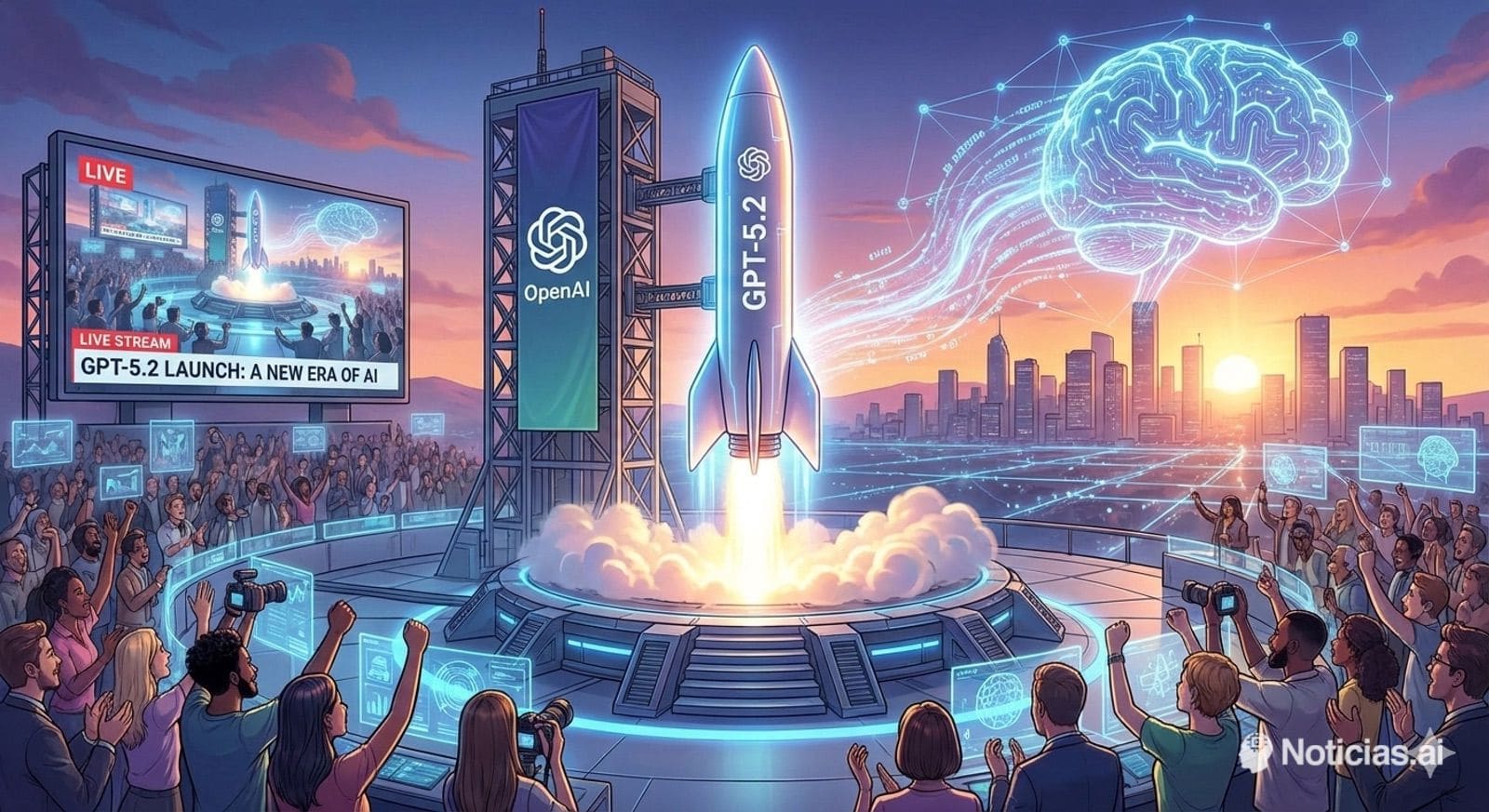
OpenAI has announced GPT-5.2, its new family of artificial intelligence models, with a clear message to the tech market: the company wants AI to move beyond being just a conversational assistant and become a central component of professional work, especially in areas involving complex spreadsheets, production code, lengthy documents, and chained workflows across multiple tools.
The new generation arrives in three variants — Instant, Thinking, and Pro — initially deployed in paid ChatGPT plans (Plus, Pro, Business, and Enterprise), and is already available via API for developers under the references gpt-5.2, gpt-5.2-chat-latest, and gpt-5.2-pro.
From Chatbot to “AI-Augmented Knowledge Worker”
For months, OpenAI has been relying on GDPval, a comprehensive testing suite designed to simulate real-world tasks across 44 knowledge-based occupations: from investment banking to marketing, including law, HR, and business analysis.
Within this framework, GPT-5.2 Thinking becomes the first model from the company that, according to OpenAI, consistently matches or surpasses human professionals in most comparisons. Approximately 70.9% of the time, the model ties or beats evaluated experts, producing complete artifacts such as presentations, spreadsheets, structured reports, or project plans.
Beyond the percentage, OpenAI emphasizes efficiency: for these same tasks, GPT-5.2 Thinking produces results over eleven times faster and at less than 1% of the cost of a professional, always assuming human supervision before the final output.
In an internal testing setup focused on typical junior analyst financial models — like assembling a company’s three financial statements or building a leveraged buyout model — the leap over GPT-5.1 is about 9 percentage points, reaching an average accuracy of 68.4%.
Code Engine: Improved Performance on SWE-Bench and Front-End
Software engineering is another front where GPT-5.2 aims to stand out. In SWE-Bench Pro, a real-world incident evaluation across repositories in various programming languages, GPT-5.2 Thinking resolves over half of the cases and hits a new internal maximum. In the Python-focused Verified version of SWE-Bench, accuracy hits 80%.
In everyday use, this translates into a more reliable model for:
- debugging errors in large codebases,
- implementing small features from tickets,
- refactoring existing modules,
- and proposing reasonable pull requests with less manual intervention.
OpenAI also highlights improvements in front-end development: complex interfaces, unconventional designs, and even 3D components are managed more effectively than with GPT-5.1, suggesting a more prominent role for GPT-5.2 as a full-stack engineer copilot.
Another relevant metric for the industry is the reduction in “hallucinations”: in a set of anonymized real ChatGPT queries, the rate of incorrect answers decreased by about 38% relatively compared to the previous generation. Errors still exist, but they are fewer than before.
Massive Context and More Robust Vision
One of the main practical barriers of current models is context: how much text they can process simultaneously without losing information or becoming confused. GPT-5.2 Thinking significantly improves on internal MRCRv2 tests, where OpenAI measures the model’s ability to locate and combine “needles” of scattered information in very large documents.
In scenarios involving hundreds of thousands of tokens, the model maintains high accuracy and, in some specific variants, approaches 100% correctness, enabling applications such as:
- comprehensive analysis of corporate reports, contracts, technical memos, or lengthy scientific papers,
- synthesis of projects with many files and versions,
- and professional workflows that combine multiple data sources within a single session.
To go beyond the standard window, GPT-5.2 Thinking integrates with a new API endpoint (Responses /compact) that effectively extends manageable context through compression techniques and tool usage.
In vision, improvements are twofold: fewer errors in graphics, dashboards, and interfaces, and better spatial understanding of elements. The model is more accurate in identifying and labeling regions in technical images (like a motherboard) or complex software screens, which is relevant for visual debugging, user support, product analysis, or interactive documentation.
Tools, Agents, and Multi-Step Workflows
GPT-5.2 also introduces specific enhancements in the use of external tools—a key step towards AI agents executing end-to-end tasks.
In tests such as Tau2-Bench or BrowseComp, designed for multi-turn scenarios involving API calls, the model manages step sequences better, maintains context between interactions, and reduces coordination errors. OpenAI showcases examples where GPT-5.2 handles a complex customer service case (delayed flights, missed connections, special medical needs), managing rebookings, seat assignments, and compensations more comprehensively than GPT-5.1.
For enterprise applications, this points to:
- assistants capable of orchestrating multiple internal systems,
- automation of back-office processes,
- and agents collaborating on long workflows without losing track.
GPT-5.2 Thinking and GPT-5.2 Pro also support a new xhigh reasoning level in the API, designed for tasks where quality takes precedence over cost or latency.
Science, Mathematics, and Abstract Reasoning
In the academic realm, GPT-5.2 reinforces AI as a tool for accelerating research:
- In GPQA Diamond, an evaluation of graduate-level scientific questions, GPT-5.2 Pro exceeds 93% accuracy, with GPT-5.2 Thinking very close behind.
- In FrontierMath, a set of advanced math problems, GPT-5.2 Thinking sets a new company maximum at levels 1-3.
- In ARC-AGI, designed to measure abstract reasoning and generalization, results significantly surpass GPT-5.1, especially in the second, more demanding version that is better isolated from training contamination.
OpenAI already mentions specific cases where GPT-5.2 Pro contributed to formulating tests in statistical learning theory, subsequently reviewed and validated by human researchers—an example of close collaboration between models and scientists.
Safety, Mental Health, and Child Protection
Alongside enhanced capabilities, the company emphasizes strengthened safeguards. GPT-5.2 builds on the “safe completion” approach introduced in GPT-5, designed to maximize usefulness while respecting predefined safety boundaries.
According to published data, the new models:
- respond more effectively in contexts involving mental health, suicide, and self-harm,
- reduce the risk of fostering emotional dependency on the system,
- and apply more filters to sensitive content.
OpenAI is beginning to deploy an age prediction system to impose additional protections for users under 18, aiming to limit exposure to certain content types within a parental control framework.
The company acknowledges, however, that GPT-5.2 is still imperfect and recommends independently verifying any critical information before making important decisions.
Pricing, Availability, and Market Position
For ChatGPT users, access to GPT-5.2 does not entail any price changes: subscription plans remain the same, but model availability will be gradually rolled out. GPT-5.1 will stay accessible for a few months before being phased out of paid plans.
In the API, the generational upgrade does come with a pricing increase:
- GPT-5.2 Thinking / Chat-latest is billed at $1.75 per 1 million tokens input and $14 per 1 million output, with substantial discounts for cached inputs.
- GPT-5.2 Pro costs $21 per 1 million input tokens and $168 per 1 million output tokens.
GPT-5.1, GPT-5, and GPT-4.1 will continue to be available via API without immediate changes, allowing companies and developers to choose based on cost, performance, and latency needs.
A Message to the Industry: Less Demo, More Production
With GPT-5.2, OpenAI sends a clear message to the tech ecosystem: the major models are no longer just showcased with impressive demos but are backed by metrics designed to convince IT departments, data teams, and business leaders.
The combination of improved performance on professional tasks, increased context handling, better tool integration, and enhanced security positions GPT-5.2 as a prime candidate for advanced automation projects, specialized copilots, and enterprise assistants.
The real challenge remains outside the models: how companies integrate AI into their systems, what data they feed it, the boundaries they set, and how much they trust the AI versus human judgment in decision-making. GPT-5.2 broadens the horizon of what technology can achieve; responsible use will determine whether this represents a genuine productivity leap or just a version number increment.