
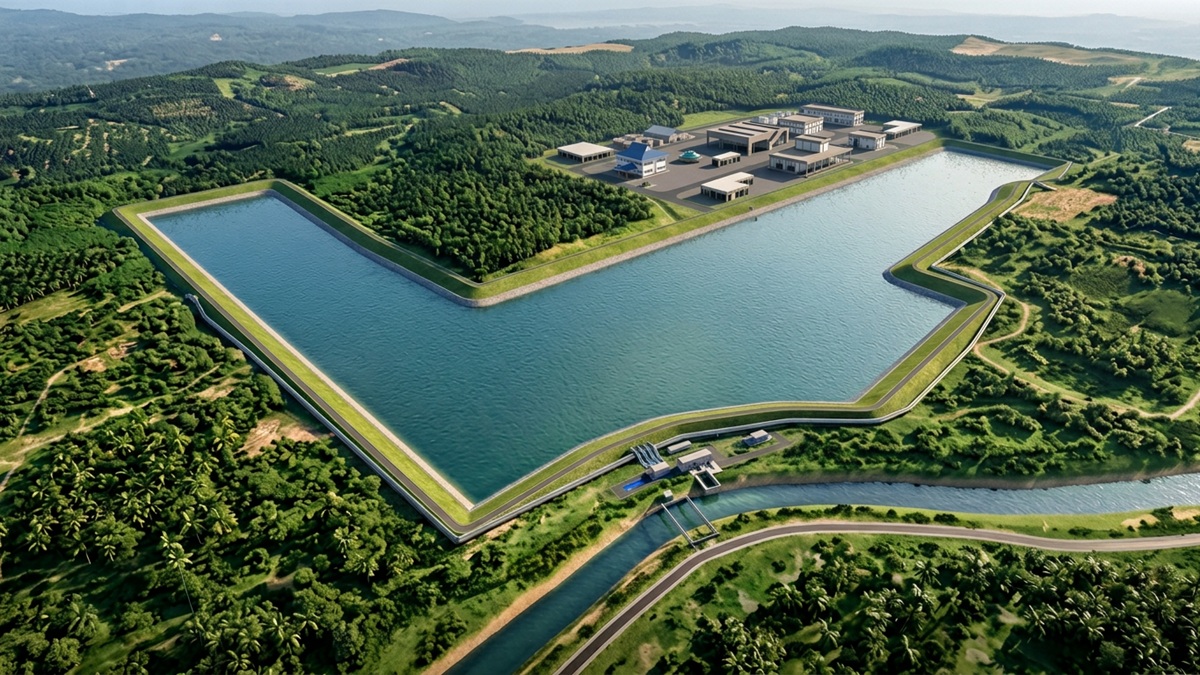
Google has announced it will contribute $160 million to build an off-river reservoir and a water treatment plant in the Malaysian state of Negeri Sembilan, with capacity to supply 65 million liters of drinking water per day. The infrastructure will serve its future data center campus at the Springhill industrial park in Port Dickson, and will also expand the state’s public water supply. The company announced it on November 2, 2026, alongside two clean-energy training programs.
Google’s water investment in Negeri Sembilan in 30 seconds
- Google is funding a $160 million off-river reservoir next to the Linggi River and a treatment plant.
- The plant will produce 65 million liters per day for the Port Dickson campus and for the public network.
- Gamuda is building the works, and the facilities will pass into state government hands.
- Google says it will pay for all of the campus’s electricity and its grid connection, and is launching two solar training programs starting in 2027.
The announcement comes as data centers’ water and electricity consumption has become a political issue in many countries, and Malaysia, which has attracted a wave of investment in the southern part of the peninsula, is no exception. Google’s approach is to fund the infrastructure its campus will need up front and hand it over to public ownership, so the plant doesn’t serve the data center alone.
A reservoir next to the Linggi River that will pass to the state
According to Google’s announcement, the company has commissioned the works from Malaysian builder Gamuda Berhad, coordinating with the Negeri Sembilan state government and the state water company Syarikat Air Negeri Sembilan (SAINS). Once complete, the facilities will be owned by Menteri Besar Negeri Sembilan (Incorporated), known as MBINS, the public body that manages the state’s assets.
The reservoir will be built off the main channel of the Linggi River. Its job is to capture excess flow and rainwater during periods of higher input, which Google says will help reduce flood risk in nearby areas. That raw water will then go to the plant to be made potable. During dry periods, the plant will be able to draw on the reservoir’s reserves without altering the river’s natural flow, according to the company’s description.
The state water utility backs the project. Its CEO, Dato’ Ir. Haji Mohd Yazid bin Ahmad, says in the announcement that the 65-million-liter daily capacity “will strengthen the local supply system for residents and commercial users alike.” The announcement doesn’t specify, however, how much of that volume the Google campus will consume and how much will remain available for the public network, a key detail for judging the real benefit to the local population.
It also gives no timeline. Malaysian press, drawing on Gamuda’s filings with Bursa Malaysia, had already reported in 2025 that the 65-million-liter plant was planned for the second quarter of 2027 and the reservoir for the fourth quarter of 2028. Those are earlier estimates and don’t appear in the current announcement, so they should be read as projections rather than confirmed dates.
The Port Dickson campus and Google’s bet on Malaysia
The Springhill campus is part of a Google presence in Malaysia that took off in May 2024, when the company announced a $2 billion (RM9.4 billion) investment to build its first data center and its first Google Cloud region in the country, at Elmina Business Park in the Kuala Lumpur metro area. According to Malaysian investment agency MIDA, that investment would have an economic impact of more than $3.2 billion and support 26,500 jobs by 2030.
Port Dickson is the second site. In 2025, Pearl Computing Malaysia, a Google subsidiary, bought 389 acres of land there from Gamuda for RM455.23 million, according to reporting at the time based on stock-exchange filings. In April 2026, Gamuda announced an RM1.72 billion (roughly $430 million) contract to build a hyperscale data center in Port Dickson for a major U.S. tech company it did not identify, with construction running from the second quarter of 2026 to the first quarter of 2028. Google hasn’t detailed the campus’s power capacity, though some outlets reported figures between 500 MW and 1 GW in 2025, a number the company has not confirmed.
Gamuda knows its client well. In the announcement, its engineering director general, Justin Chin, notes that the builder is also delivering the Elmina campus, which Google describes as nearing operation. The concentration of projects in the southern peninsula, including hyperscale campuses like Vantage’s in Johor, explains why Malaysian states compete to attract this investment and, at the same time, why they’re watching its effect on water and the power grid.
Google commits to paying 100% of the electricity the campus consumes and the direct costs of connecting it to the grid. It also claims the site is designed to be among the most efficient in the world, a claim the company does not back with energy-efficiency or water-consumption figures.
The 120% replenishment goal and the water-risk assessment
Drew Byrnes, Google’s director of global infrastructure and energy for Asia-Pacific, frames the investment within the company’s global goal of replenishing 120% of the freshwater it consumes. He adds that they’re doing it “even as our water risk assessment showed that local water sources were not at high risk of scarcity or depletion.” The announcement doesn’t publish that assessment or say who carried it out.
From the state government, Invest Negeri Sembilan CEO Dato’ Haji Najmuddin Sharif bin Sarimon argues the project “demonstrates how private investment and public interests can be aligned from the outset,” and that for the state, attracting investment isn’t measured by committed capital alone, but by its quality and long-term contribution. The debate over the resources these facilities consume isn’t exclusive to Asia: Spain’s data centers are also under scrutiny for their water and energy consumption.
Solar power and school training starting in 2027
The announcement also has an energy component. Google notes it has power purchase agreements (PPAs) with consortiums led by Shizen Energy-Solarvest and TotalEnergies to add new clean generation to Malaysia’s national grid. These contracts guarantee future revenue to developers and let them finance the construction of plants, such as large-scale solar farms.
With the SOLS Foundation, the company is launching two initiatives. Solar Explorers and Solar Futures will install a lab with 2.56 kWp panels and a 5.4 kWh battery at each participating public school, to be used in class and also to help cut the school’s electricity bill and provide backup during outages. The second, Digital Skills for the Renewable Energy Workforce, is a 36-hour track within the SOLS Solar Academy that trains young people from lower-income families and Indigenous communities in trades such as solar installation or EV charging-point maintenance. Both will start in Negeri Sembilan in early 2027. The announcement doesn’t say how many schools or students will take part.
Frequently Asked Questions
How much is Google investing in water in Negeri Sembilan?
$160 million for an off-river reservoir next to the Linggi River and a treatment plant with capacity for 65 million liters of drinking water per day.
Who will own the water plant?
Menteri Besar Negeri Sembilan (Incorporated), the public body that manages the state’s assets. Google is funding it and Gamuda is building it.
Where will Google’s Negeri Sembilan data center be?
At the Springhill industrial park in Port Dickson. It’s Google’s second site in Malaysia, after the Elmina Business Park campus in the Kuala Lumpur area.
When will the treatment plant be ready?
Google gives no dates. 2025 reporting based on Gamuda’s filings placed the plant in the second quarter of 2027 and the reservoir in the fourth quarter of 2028.
Sources:
- Google Cloud Press Corner: Google Funds US$160 Million in Shared Water Infrastructure in Negeri Sembilan
- Google: $2 Billion Investment in Malaysia (05/30/2024)
- MIDA: Google to invest RM9.4 bln in Malaysia
- Lowyat.NET: Google Port Dickson data centre project
- W.Media: Gamuda scores US$430 million hyperscale buildout in Port Dickson
This article is also available in Spanish: “Google pagará 160 millones en agua para su centro de datos de Negeri Sembilan”, on revistacloud.com.
