
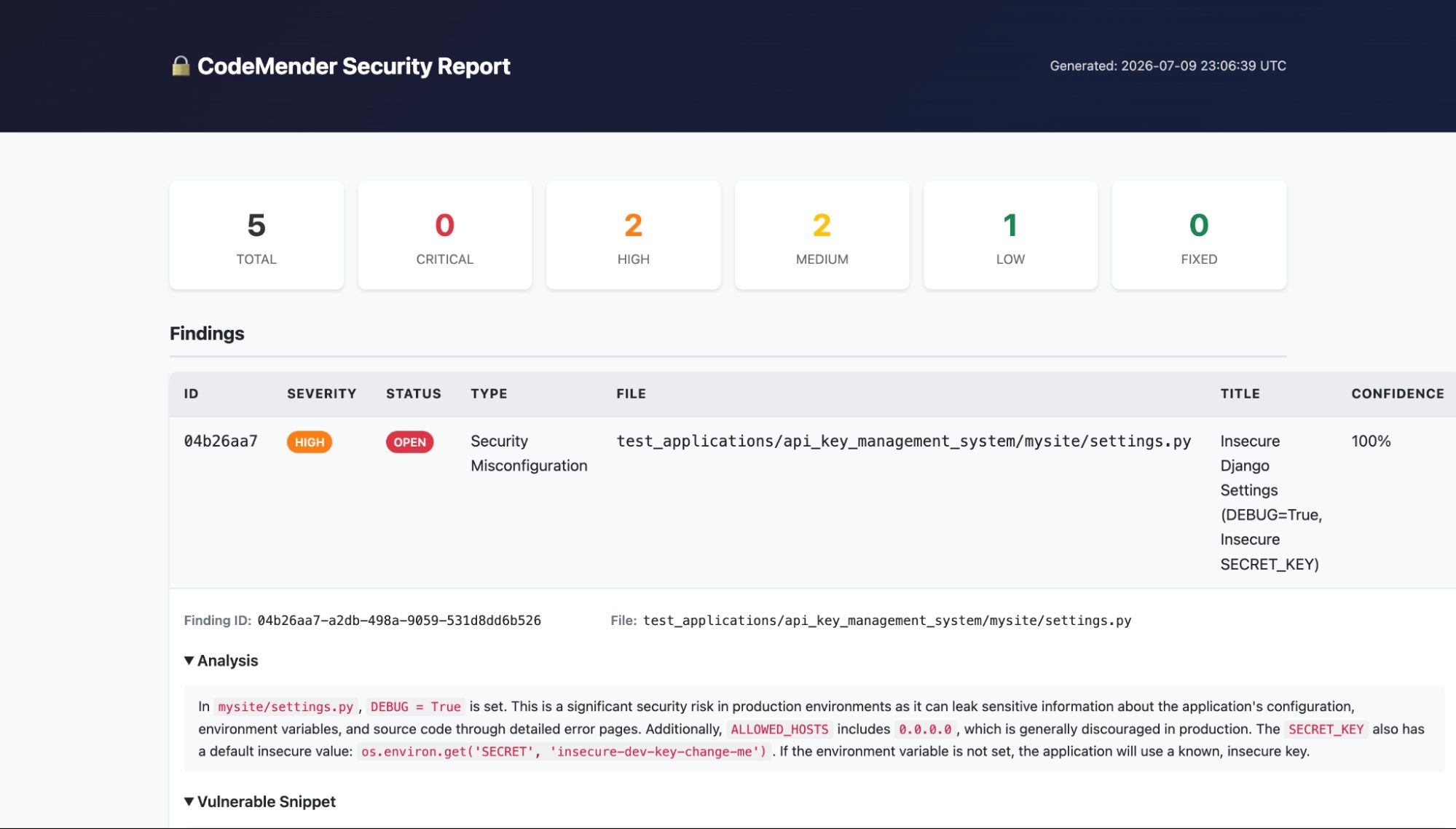
Google Cloud has announced CodeMender, a new AI-powered agent designed to automate much of the vulnerability management process in software development. Currently available in preview phase, this tool not only analyzes code for security flaws but also attempts to verify whether these flaws are actually exploitable and generates correction proposals for developers to review before integrating them into the project.
Key Highlights of CodeMender in 20 Seconds
- Google Cloud introduces CodeMender as an AI agent to analyze and fix software vulnerabilities.
- The platform combines code analysis, attack simulation, and automatic patch generation.
- It can integrate into development tools and CI/CD pipelines or run from the command line.
- Google claims it helps prioritize truly exploitable vulnerabilities, reducing false positives.
- The solution is available in preview within the Gemini Enterprise Agent Platform and AI Threat Defense.
The emergence of assistants capable of generating code has also transformed the cybersecurity landscape. While AI accelerates software development, it also enables attackers to discover vulnerabilities or develop new exploitation techniques at a much faster rate.
Google believes responding to these challenges requires deploying AI in defensive tasks as well. CodeMender is created with this purpose: reducing the gap between vulnerability detection and remediation without removing developer oversight.
The tool integrates into Gemini Enterprise Agent Platform but can also be used as a component of AI Threat Defense, Google Cloud’s platform aimed at protecting applications and workloads via AI agents.
From Identifying a Vulnerability to Confirming Its Exploitability
One common issue with traditional static analysis tools is the high number of false positives. They detect patterns that may indicate a risk, but don’t always mean the application is actually vulnerable in real-world conditions.
CodeMender aims to add an extra validation step.
After locating a potential flaw, the agent generates a proof of concept (PoC) to attempt to exploit that vulnerability within an isolated, controlled environment managed by the client.
If it successfully reproduces the attack, the incident gains higher priority because there’s a practical demonstration that the risk is real. If it cannot be exploited, security teams may choose to allocate their resources to other vulnerabilities with greater impact.
This approach seeks to reduce the so-called “alert fatigue,” a common problem in large organizations where security teams receive thousands of alerts daily from various tools.
Google states that the system can detect vulnerabilities related to memory corruption, code injection, cryptographic errors, web security issues, or unsafe data handling, among other scenarios.
Currently, it supports several popular languages used in enterprise development, including C, C++, Go, Java, Python, Ruby, Rust, and TypeScript.
Proposing Fixes While Keeping Developer Control
Once a vulnerability is confirmed, CodeMender automatically generates a correction proposal.
This solution does not directly modify the client’s repository. Instead, it produces a diff with suggested changes for the developer to review before accepting.
Google notes that the agent uses a LLM-as-a-judge system, where another model evaluates whether the patch fixes the problem without altering the application’s expected behavior.
Organizations can also provide input regarding coding standards, development styles, or internal policies to ensure the generated code aligns with their criteria.
The goal is to facilitate integrating the patch into the usual development workflow rather than producing completely unrelated code.
Nonetheless, Google emphasizes that the final decision always rests with the development team. No changes are automatically committed to the repository without human review.
Integration with CI/CD, VS Code, and Local Environments
CodeMender is designed to integrate seamlessly with existing development processes.
It can run as part of CI/CD pipelines, analyze corporate repositories, or operate from a command-line interface installed on the developer’s machine.
It is also compatible with tools like Visual Studio Code and other supported development environments mentioned by Google.
For dynamic analysis, it uses a sandbox managed by the client, where exploitation tests are carried out without impacting the production environment.
Google further indicates that traffic can stay within the client’s private network (VPC) and that source code remains isolated and encrypted during the process. The company also states that it does not retain the source code used during analyses.
Part of a Broader AI-Driven Threat Defense Strategy
CodeMender is also part of AI Threat Defense, a platform recently announced by Google Cloud in collaboration with Wiz.
In this setup, Wiz acts as the central security platform coordinating various specialized agents.
When a possible vulnerability is detected, Wiz can request CodeMender to analyze the code, incorporate context from Wiz’s Security Graph, and generate a correction proposal.
Subsequently, other security agents in the platform can run additional AI-driven penetration tests to reassess exploitability before closing the incident.
This integration reflects a rising trend in cybersecurity: leveraging multiple specialized agents working collaboratively rather than relying on a single monolithic tool.
Google’s Vision of a ‘Self-Healing’ Development Cycle
Google describes CodeMender as a step toward a development cycle where AI continuously detects, validates, and fixes vulnerabilities.
However, the company does not yet envision a fully autonomous process.
Developers will continue reviewing and approving fixes, ultimately deciding which changes go into production.
This supervision is especially vital in critical applications, where an incorrect patch could disrupt business processes or introduce subtle issues that are hard to detect automatically.
The current version is in preview stage, meaning some features will evolve before general availability. Google has also announced that CodeMender will adopt a multimodel strategy, leveraging different models based on trade-offs between cost, speed, and analysis depth. Support for third-party models is expected by the end of the year.
Additionally, a variant based on Gemini 3.5 Flash Cyber will initially be available only to select government agencies and trusted partners.
With CodeMender, Google enters a competitive market involving static analysis platforms, DevSecOps security tools, and code review assistants. Its main differentiator is the integration of three traditionally separate phases: vulnerability detection, exploitability validation, and vetted patch generation — all before the developer makes a final decision.
FAQs
What is Google CodeMender?
An AI agent developed by Google Cloud to identify vulnerabilities, verify their exploitability, and automatically generate code correction proposals.
Does it automatically modify the source code?
No. CodeMender produces a patch that must be reviewed and approved by developers prior to integration into the repository.
Which programming languages does it support?
Currently, Google indicates support for C, C++, Go, Java, Python, Ruby, Rust, and TypeScript.
When will it be generally available?
CodeMender is currently in preview within the Gemini Enterprise Agent Platform and as part of AI Threat Defense. Google has not yet announced a release date for general availability.
