
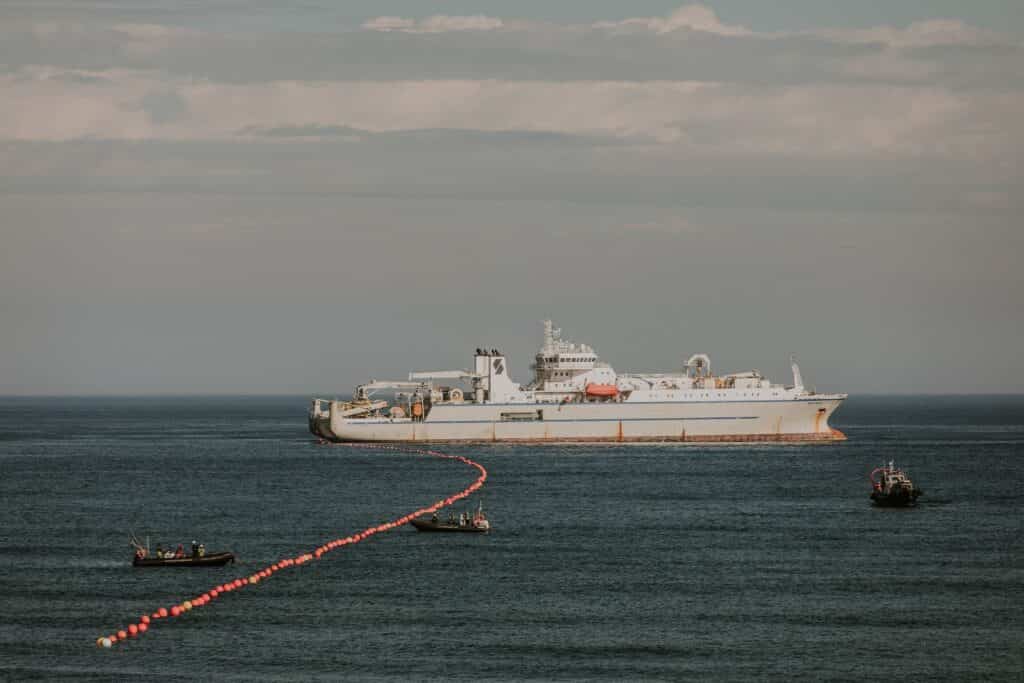
Google has acquired a parcel in Cantabria’s Scientific and Technological Park (PCTCAN) to build a data transmission center linked to the transatlantic submarine cable Sol. The project enhances Santander’s role as an entry point for digital infrastructure between Europe and the United States, positioning Cantabria more prominently on the global connectivity map.
The operation, announced by the Cantabria Government, pertains to a 5,907.72 m² plot within PCTCAN. There, an interconnection station associated with the Sol cable will be installed—a submarine fiber optic system announced by Google Cloud in 2025 to connect Spain with the United States, Bermuda, and the Azores. This is not a typical large data center but a critical facility to connect the submarine cable with terrestrial networks and transmission services.
Cantabria Gains Clout in Transatlantic Connectivity
The Sol cable will connect Europe with Florida via Santander, Bermuda, and the Azores. According to Google Cloud, it will be a new transatlantic system that complements other company submarine infrastructures like Nuvem, Firmina, and Equiano, as part of a strategy to increase resilience and capacity of their global networks.
While often overlooked by the average user, these cables are fundamental physical components of the Internet. They carry data for cloud services, video calls, enterprise platforms, AI applications, digital commerce, and international communications. Greater capacity and lower latency mean better responses for users and companies relying on distributed services across continents.
The Sol project is especially noteworthy: Google described it as the second submarine cable connecting Spain to the United States, after Grace Hopper, designed to bolster the direct link between Europe and Florida. The company also explained that Sol and Nuvem will interconnect on land in the U.S., Iberian Peninsula, Bermuda, and the Azores, providing alternative routes and increased fault tolerance.
For Cantabria, this installation offers more than just a real estate transaction within a tech park. An interconnection station of this nature integrates the region into an international high-capacity network. While it does not alone create a large cloud hub, it can attract activity in telecommunications, engineering, network operations, digital services, and attract companies valuing proximity to strategic infrastructure.
Spanish regional leader María José Sáenz de Buruaga highlighted that the project will strengthen EU-USA connectivity, generate skilled employment, and position the community as a strategic node within the global digital ecosystem. It is an ambitious yet reasonable outlook, considering the project as part of a broader technological strategy.
PCTCAN Nears Full Occupancy
The sale of the parcel to Google comes at a time when Cantabria’s Scientific and Technological Park is nearing maximum occupancy. According to data released by the regional government and reported by local media, PCTCAN now operates at approximately 99% of its total 240,000 m² area. The park currently hosts over 5,000 workers and 84 companies across sectors such as ICT, engineering, health, electronics, energy, environment, aerospace, and automotive.
This data underscores that Google’s project does not land in an empty space but within an established business environment. Cantabria’s challenge will be to turn this presence into a tangible boost: more technology suppliers, specialized jobs, collaboration with universities and training centers, and the ability to attract higher-value digital projects.
The associated Sol cable station aligns with the growing interest among European regions to establish themselves within global digital infrastructure. Historically, major hubs like London, Amsterdam, Frankfurt, Paris, Dublin, and Madrid dominated this space. Now, the deployment of submarine cables, regional data centers, edge nodes, and low-latency networks is opening opportunities for territories with favorable locations, connectivity, specialized land, and institutional support.
Santander had already appeared on the Sol project map since Google Cloud’s initial announcement. In July 2025, Telxius announced a collaboration with Google to provide the necessary infrastructure for the cable’s landing in Santander, adding to previous collaborations on cables such as Firmina, Grace Hopper, Dunant, Junior, and Tannat.
AI Drives Higher Network Demands
The strategic importance of the project becomes clearer when considering the pressures from cloud computing and artificial intelligence. AI models, enterprise applications, inference services, distributed storage, and data platforms demand faster, more reliable international networks with lower latency. Simply building more data centers is not enough; better interconnection is essential.
Google Cloud continues expanding its global network and associates Sol with the need to address the rising demand for cloud and AI services. This demand isn’t limited to hyperscalers; companies of all sizes are migrating workloads to the cloud, using AI models, replicating data across regions, and demanding continuous service. In this scenario, submarine cables become a vital yet invisible infrastructure.
For Spain, these projects reinforce its role as the digital gateway of the Atlantic. The Iberian Peninsula’s strategic geographic position facilitates connections between Europe, America, Africa, and beyond. Madrid has gained prominence as a data center and interconnection hub, Lisbon has attracted significant projects, and regions like Cantabria, Basque Country, and Andalusia are increasingly recognized for their cable landing points and associated terrestrial networks.
The key will be leveraging this infrastructure beyond just traffic transmission. If Cantabria can link the Sol cable to technological training, startups, cloud services, cybersecurity, research, digital industry, and talent attraction, the impact can be sustained. Merely hosting a technical installation limits its broader potential.
Google’s announcement confirms a broader trend: major tech companies are investing directly in the physical infrastructure behind their services. Submarine cables, landing stations, connectivity hubs, cloud regions, and operator partnerships are part of a unified strategy. Cloud’s infrastructure is tangible—cables, buildings, energy, land, permits, terrestrial routes, and technical equipment.
Cantabria now joins this network with a specific piece of the Sol cable. It might seem like a modest installation within a nearly full tech park, but its function will be to connect territory, data, and digital services across the Atlantic. In an economy increasingly reliant on AI and cloud via robust global networks, such infrastructure weighs more than its physical size suggests.
Frequently Asked Questions
What has Google purchased in Cantabria?
Google has acquired a 5,907.72 m² parcel in Cantabria’s Scientific and Technological Park to build a data transmission center connected to the Sol submarine cable.
What is the Sol submarine cable?
Sol is a Google Cloud transatlantic submarine cable that will connect Spain with the United States, Bermuda, and the Azores, enhancing the capacity and resilience of Google’s global network.
Will it be a large data center in Cantabria?
Available information indicates it will be an interconnection or transmission station, not a massive compute data center. Its primary function is to link the submarine cable with terrestrial networks.
Why is this important for Cantabria?
Because it places the region within an international digital infrastructure, can attract skilled employment, and reinforces PCTCAN’s status as a nearly fully occupied tech space.
