
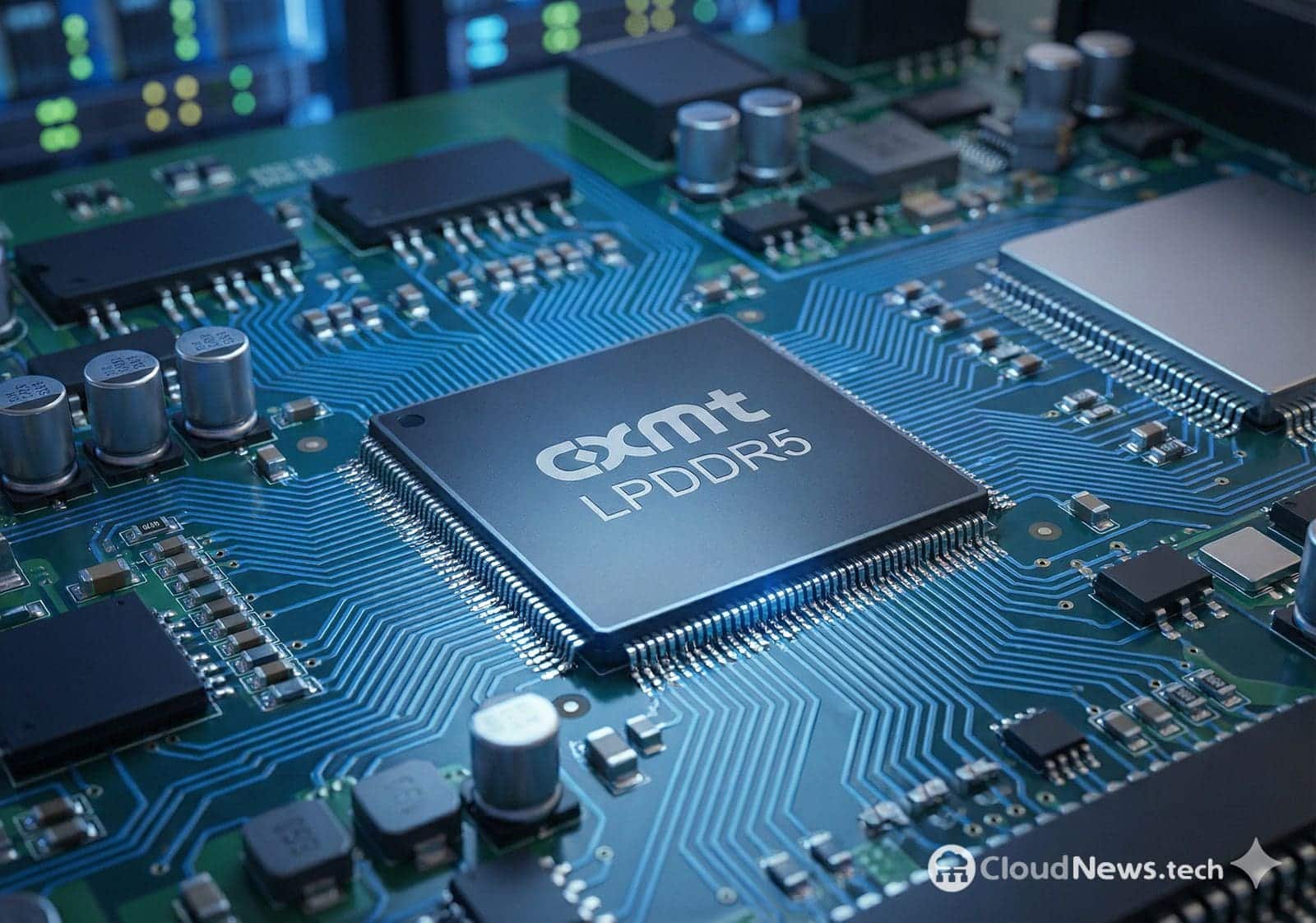
Google is reportedly evaluating the purchase of DRAM memory from Chinese suppliers, with ChangXin Memory Technologies, better known as CXMT, being the most prominent name. This information is currently based on a rumor posted on X and reported by specialized media, so it should be approached with caution: there has been no official confirmation from Google, CXMT, or Alphabet regarding formal negotiations, a signed contract, or specific usage of these chips.
Though unconfirmed, this news comes at a particularly sensitive time for the semiconductor market. The demand driven by Artificial Intelligence has put pressure on memory supplies to levels that seemed unlikely just a few years ago. HBM for accelerators, server DDR5, LPDDR for mobile devices, and NAND for storage are competing for investment, manufacturing capacity, and commercial priority among Samsung, SK Hynix, Micron, and other manufacturers.
This context explains why a major U.S. tech company might be exploring options that until recently would have been hard to imagine. Chinese memory no longer appears solely as a low-cost alternative. It is starting to be viewed as a pressure valve in a market where availability has become as critical as price.
A rumor with significant industrial context behind it
Google’s alleged interest in CXMT should not be treated as a confirmed fact. The public lead is weak: an X account, SouthernValue, claimed that Google was considering purchasing Chinese DRAM, and when asked for a source, they responded with the name Sundar Pichai. This does not constitute official corporate confirmation nor verifiable document leakage.
What’s notable is that the rumor coincides with several actual movements. The U.S. government has postponed adding CXMT and over a hundred other Chinese companies to the Department of Commerce’s Entity List, despite some having been considered national security risks. The Entity List is not the same as other lists from the Department of Defense, but in practice, it affects the ability of U.S. companies to operate with certain foreign suppliers.
| Element | Current Situation |
|---|---|
| Alleged interest from Google | Unconfirmed rumor |
| Supplied cited | CXMT, leading Chinese DRAM manufacturer |
| Market context | Global memory shortage driven by AI |
| Regulatory context | US has postponed new additions to the Entity List |
| Main risk | Security, compliance, and supply chain trust |
| Most probable use if confirmed | Devices, testing, or specific markets before critical cloud applications |
The absence of a direct ban does not eliminate the risk. For a company like Google, using Chinese memory in consumer devices doesn’t have the same implications as integrating it into cloud infrastructure, TPUs, AI servers, or systems handling sensitive enterprise data. While the technical feasibility exists, regulatory and reputational risks weigh heavily.
Why Google might consider CXMT
Google’s memory needs span multiple areas. Its data centers and TPUs rely on a highly demanding supply chain. Google Cloud competes in enterprise AI and requires capacity to train, serve, and accelerate models. Additionally, the company sells hardware like Pixel phones, tablets, home devices, and other products that use DRAM and NAND memory.
If Google is indeed evaluating Chinese memory, the most logical target probably wouldn’t be its core infrastructure. It could start with consumer devices, non-U.S. markets, qualification testing, or less sensitive components. This approach would allow increased supply margins without immediately creating a complex dependency on high-trust cloud environments.
| Google Area | Potential Memory Use | Sensitivity Level |
| Pixel and Mobile Devices | LPDDR and NAND | Medium |
| Consumer Hardware | DRAM/NAND in specific products | Medium |
| Internal Servers | Server DRAM | High |
| Google Cloud | Infrastructure for clients | Very high |
| TPUs and Accelerators | High-performance memory | Very high |
| Labs and Validation | Supply testing | Low to medium |
The economic motivation is clear. In a market where memory prices are rising and allocation prioritizes certain segments, relying solely on Samsung, SK Hynix, and Micron narrows flexibility. If CXMT can supply sufficient DRAM—even if not matching all segments—it becomes an alternative that major buyers cannot ignore.
CXMT is no longer a marginal player
ChangXin Memory Technologies represents China’s key bet on DRAM. Founded in 2016 and headquartered in Hefei, it has made progress in DDR5, LPDDR5X, and other memory products despite Western restrictions on advanced manufacturing equipment. Its public catalog includes DDR5 with capacities of 16 Gb and 24 Gb, speeds up to 8,000 Mbps, and LPDDR5X with 12 Gb and 16 Gb capacities.
Financially, the company is experiencing an exceptional period. Based on its IPO disclosures and financial media reports, CXMT expects revenues between 110 billion and 120 billion yuan in the first half of 2026, driven by soaring memory prices. In Q1, its revenue reportedly grew over 700% year-over-year.
| CXMT Metrics | Industry Perspective | ||
| Headquarters | Hefei, China | ||
| Main Business | DRAM | ||
| Highlighted Products | DDR5 and LPDDR5X | ||
| Potential Customers | PC, mobile, consumer electronics, and less critical servers | ||
| Recent Drivers | Global shortage and rising prices | ||
| Risks | Restrictions, reputation, and technical validation | ||
| Strategic Value for China | Reducing dependence on Samsung, SK Hynix, and Micron |
CXMT has yet to compete on equal footing across all segments. In advanced HBM, Samsung, SK Hynix, and Micron still lead. But in conventional DRAM, LPDDR, and DDR5, its presence is already enough to prompt global manufacturers to consider it, especially given the current market tensions.
PC manufacturers have already opened the door
Google wouldn’t be the first Western company to look toward Chinese memory. In February, reports indicated that HP, Dell, Acer, and ASUS were evaluating or qualifying Chinese memory chips due to global supply shortages. HP reportedly began assessing CXMT products for markets outside the U.S., while Dell is testing its DRAM amid fears of continued price increases through 2026.
This trend with PC manufacturers highlights how procurement logic shifts during shortages. For years, OEMs favored established suppliers for reliability, certifications, scale, and compatibility. But during price spikes and risky product launches, availability becomes a priority.
| Manufacturer or Segment | Observed Action |
| HP | Evaluating CXMT chips for outside U.S. markets |
| Dell | Testing CXMT’s DRAM |
| Acer | Opening to Chinese memory via contract manufacturer |
| ASUS | Seeking supply through Chinese partners |
| Memory Module Brands | First DDR5 kits with Chinese chips |
| Rumored evaluation, no official confirmation |
Additionally, consumer DDR5 modules with CXMT chips have appeared in the market, helping to normalize its presence outside China. For a major tech company, the question isn’t just whether the chips work, but if they pass quality, compatibility, traceability, security, and compliance tests.
AI has broken the memory market equilibrium
At the core of all this is Artificial Intelligence. Data centers are absorbing an increasing share of available memory. HBM has become a critical component for GPUs and accelerators, but its manufacturing consumes capacity, investment, and priority that used to be allocated to other products.
TrendForce warns of a highly aggressive pricing cycle for DRAM in 2026, while IDC expects supply growth in DRAM and NAND to lag behind historical patterns. The market has shifted into a seller’s environment: memory manufacturers can raise prices, select customers, and prioritize higher-margin products.
| Market Power | Consequence |
| Increased HBM demand | Less capacity for conventional memory |
| More AI servers | More DDR5 and enterprise storage |
| Greater hyperscaler pressure | Large, prioritized contracts |
| Supply elasticity diminishes | Sustained price increases |
| Impacts on PC and mobile manufacturers | Higher costs and potential delays |
| Chinese suppliers gain visibility | Supply alternatives in some segments |
Memory has become a strategic resource. Once it was about GPU shortages; now it’s about everything needed to feed those GPUs. Without sufficient memory, training, inference, local AI devices, and profitable data centers are impossible.
Cloud and security: the most sensitive point
If Google were to buy CXMT memory for Pixel devices, the debate would be intense but manageable. Using it in Google Cloud or critical AI infrastructure, however, would invite much greater scrutiny. Cloud customers don’t just buy performance—they seek trust, auditability, compliance, and an acceptable supply chain for regulated sectors.
DRAM memory does not run persistent code like firmware, but it’s part of systems that process sensitive data. Hardware security considerations include provenance, traceability, validation, manipulation risks, and adherence to internal or governmental policies. The discussion would extend beyond price and availability, touching on trust and security.
| Potential Use | Technical Risk | Political/Regulatory Risk |
| Pixel or other devices | Moderate | Medium |
| Non-U.S. products | Moderate | Medium |
| Internal non-critical servers | Medium | High | Google Cloud | High | Very high |
| TPUs and AI platforms | High | Very high |
| Laboratory testing | Low | Low to medium |
Therefore, if the rumor is confirmed, the most critical aspect will be the chips’ end use. Limited procurement for consumer hardware differs greatly from deployment in data centers. The headline might be the same, but the industrial significance varies completely.
China gains leverage amid supply crisis
The potential interest from Google also exposes an uncomfortable reality for Washington. Tech restrictions aim to curb Chinese advances in semiconductors, but the global shortage could make Chinese suppliers valuable for U.S. companies. If CXMT helps ease DRAM shortages, outright exclusion might drive up costs, delay product launches, and limit supply options.
China has pursued for years to reduce reliance on foreign memory. CXMT in DRAM and YMTC in NAND are central to that strategy. Although they don’t dominate the most advanced segments, they can gain market share where volume, price, and availability are critical. The memory crisis provides a window of opportunity.
| For China | For Western Companies |
| Validates domestic memory industry | Provides an alternative source |
| Reduces dependence on foreign suppliers | Improves bargaining leverage |
| Gains revenue and scale | Alleviates supply pressure |
| Strengthens technological autonomy | Introduces regulatory risks |
| Enhances industrial reputation | Requires strict validation |
The balance is delicate. Purchasing Chinese memory might be a rational procurement move but a complex geopolitical decision. For a company like Google, any such decision will be carefully analyzed from both angles.
A sign that the memory shortage crisis is serious
The most significant aspect of all this is not whether Google will sign tomorrow with CXMT. It’s that the possibility no longer seems far-fetched. A few years ago, a major U.S. tech firm using Chinese DRAM in significant products would have been a remote hypothesis. Now, it’s an option the market is starting to consider out of necessity.
This reflects the scale of the shortage. AI has reordered industrial priorities, driven up prices, and forced buyers to explore alternative suppliers. PC manufacturers are already taking steps. Apple has acknowledged cost pressures related to memory. If the rumor is accurate, Google is viewing the same reality from a different perspective.
Chinese memory will not resolve the global bottleneck on its own. CXMT cannot suddenly replace Samsung, SK Hynix, and Micron, nor meet the entire demand for advanced HBM needed by large accelerators. But it can be a partial relief, especially if the traditional market cannot provide enough capacity at affordable prices.
The question now is not just who makes the most advanced memory, but who can supply enough in a world where AI is consuming available capacity. CXMT has stopped being just a footnote—it’s now a name that Google, HP, Dell, and others cannot ignore.
Frequently Asked Questions
Has Google confirmed it will purchase memory from CXMT?
No. The information comes from a rumor posted on X and reported by specialized media. There has been no official confirmation from Google, CXMT, or Alphabet regarding a contract.
What is CXMT?
CXMT, or ChangXin Memory Technologies, is China’s leading DRAM manufacturer. Founded in 2016 and based in Hefei, it has developed in DDR5, LPDDR5X, and other memory products despite Western restrictions on advanced manufacturing equipment. Its public catalog includes DDR5 modules with 16 Gb and 24 Gb capacities, speeds up to 8,000 Mbps, and LPDDR5X with 12 Gb and 16 Gb capacities.
Why might Google consider Chinese memory?
Due to the global memory shortage and rising prices driven by AI demand. Having multiple suppliers could help secure supply and strengthen negotiation power.
Could CXMT memory be used in Google Cloud?
Technically possible, but this would be the most sensitive scenario due to security, compliance, and trust concerns among enterprise clients. If a purchase is made, explicit details on its application would be necessary beforehand.
Have other Western manufacturers evaluated Chinese memory?
Yes, HP, Dell, Acer, and ASUS have studied or qualified Chinese memory chips due to global shortages, particularly for products or markets where regulatory risks are lower.
