
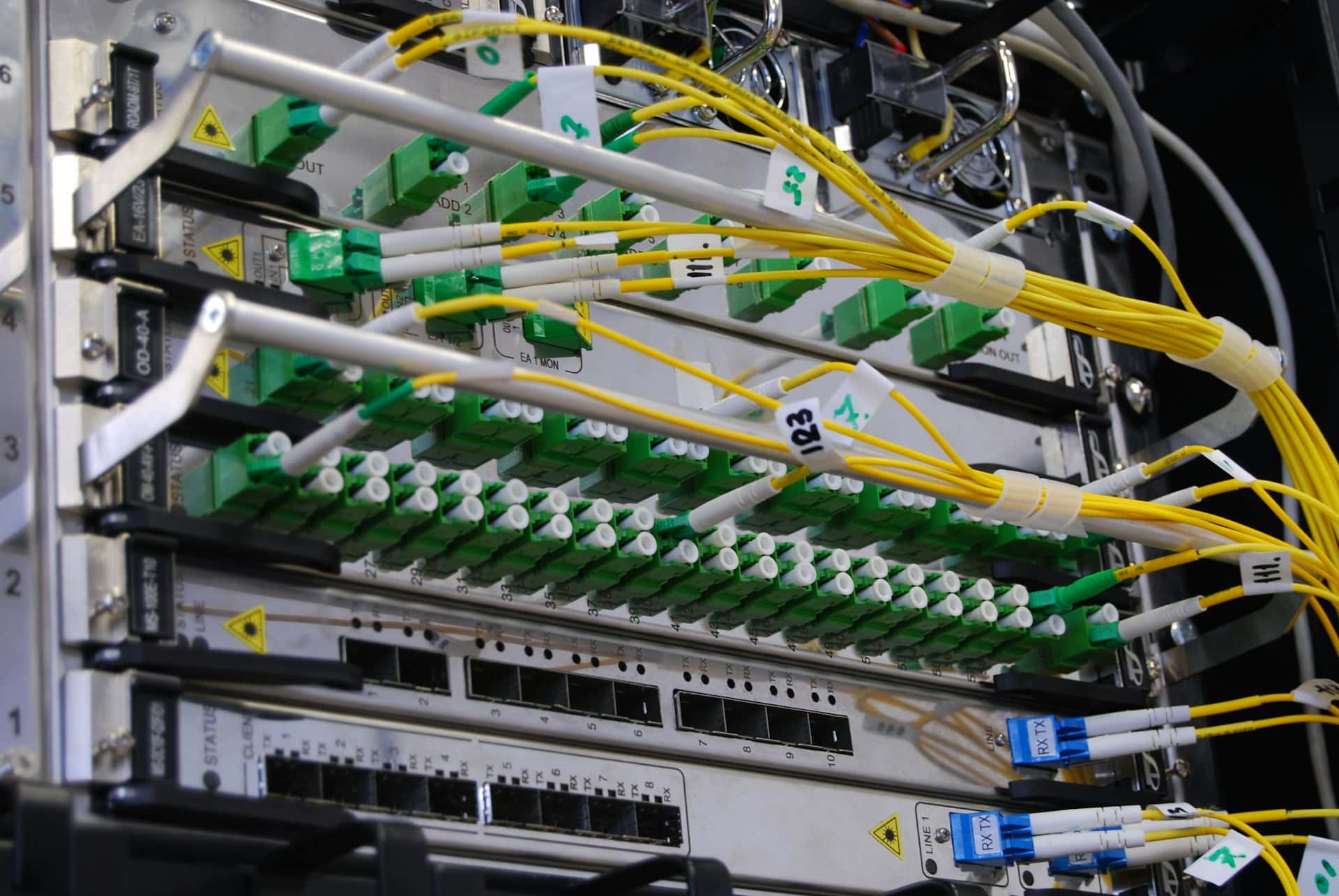
The race to build artificial intelligence data centers is no longer just about GPUs, HBM memory, energy, or liquid cooling. It’s also increasingly dependent on much less visible but essential components that enable high-speed data transfer within and between racks. One such component is indium phosphide substrate, known as InP, a key foundation for optical devices used in high-speed communications.
Google and other major cloud providers are pushing to diversify their supply of these substrates outside China, according to supply chain sources in the semiconductor industry. The priority is no longer solely securing the lowest price, but ensuring stable availability for an AI industry that cannot afford bottlenecks in optical networks as clusters grow to hundreds of thousands of accelerators.
This movement follows months of tension. China began imposing export controls on InP substrates in February 2025, a measure industry analysts see as part of Beijing’s response to U.S. restrictions on advanced chips. Though some controls have recently been eased and a new shipment started in late May 2026, sector companies do not consider the fundamental issue resolved.
Why InP Matters for AI
Indium phosphide is a compound semiconductor used in high-performance optoelectronic components. In optical communications, it enables the manufacturing of devices capable of operating at high speeds with characteristics suited for increasingly demanding data links. In AI data centers, where accelerators need to continuously exchange information, this capability is becoming even more critical.
Pressure stems from multiple fronts. Cloud providers are already increasing their transmission needs from 400G to 800G between racks, according to industry sources. Inside the rack, copper is still widely used, but the trend points toward a growing use of optical links and, in the medium term, co-packaged photonics (CPO), where optics are integrated closer to silicon to reduce latency, power consumption, and interconnection limitations.
| Element | Role in AI Infrastructure |
|---|---|
| InP substrates | Foundation for high-speed optical components |
| 400G / 800G | Increasing speeds for rack-to-rack transmission |
| CPO | Co-packaged photonics to integrate optics and compute |
| Copper | Still common inside racks but with physical limits |
| Cloud providers | Require faster, more stable networks for AI clusters |
| Japan, Europe, and the U.S. | Seeking alternative sources due to Chinese risks |
The problem is that the InP substrate market is highly concentrated. Supply chain sources indicate that AXT and Sumitomo each control around 40%, collectively accounting for nearly 80% of global capacity. JX Advanced Metals also plays a relevant role. When such a small, specialized market intersects with export controls, the ability to respond is limited.
This is not merely theoretical concern. Industry fears that product schedules tied to CPO could face delays if substrate availability is insufficient. Optical communications demand may peak in 2027 and 2028, precisely when new generations of AI data centers will require more bandwidth, greater energy efficiency, and lower latency.
Google and Hyperscalers Seek Suppliers Outside China
According to industry sources, representatives from Google and other cloud providers have personally visited manufacturers outside China to send a clear message: demand exists, is real, and can support capacity investments. This direct engagement is significant, as manufacturers are cautious about expanding production blindly.
Expanding capacity in compound semiconductors takes time, investment, and a reasonable confidence in future demand. If European or Japanese suppliers fear that China might resume mass exports at low prices, they may hesitate to invest in new lines. This uncertainty is one of the most delicate issues currently faced.
| Region or Company | Supply Chain Insights |
| AXT | Dominant player with strong historic presence in InP |
| Sumitomo | Japanese supplier holding nearly 40% of the market |
| JX Advanced Metals | Other relevant supplier of compound substrates |
| Freiberg Compound Materials | German manufacturer focusing on GaAs, with small InP volumes |
| Yunnan Germanium | Chinese producer expanding capacity |
| VPEC and GCS | Taiwanese suppliers benefiting from eased shipments |
Some sources aim for non-Chinese supply to eventually surpass 50% of the total sourcing. It’s not just about replacing China; it’s about avoiding excessive dependency on any single geopolitically sensitive source.
This shift aligns with a broader industry trend. Major buyers no longer focus solely on unit cost per component. In critical areas like AI, cloud, and telecom, supply security is now a top priority. A cheaper component is of little use if it can be blocked by export controls, diplomatic tensions, or regulatory changes.
China’s Relaxation Does Not Remove the Risk
China’s decision to release some batches of substrates has provided temporary relief. Following a shipment in August 2025, the first batch of 2026 began shipping at the end of May, which may help sustain operations during the second half of the year for Taiwanese compound semiconductor companies such as Visual Photonics Epitaxy and GCS.
However, industry sources emphasize that this does not solve the structural problem. If Chinese exports depend on specific authorizations, supply remains vulnerable. Companies planning capacity expansions under the assumption that restrictions will always be lifted on time risk facing blockages at the worst possible moment in the demand cycle.
The issue also affects non-Chinese manufacturers. Inventory build-up in China due to export restrictions, combined with local capacity expansion and price competition, could lead to a flood of low-cost inventory entering the international market once exports fully reopen, discouraging investments elsewhere.
| Scenario | Possible Effect |
| China maintains controls | Risk of shortages and delays in advanced optics |
| Partial relaxation | Temporary relief but no long-term security |
| Massive export reopening | Price pressures on non-Chinese suppliers |
| Hyperscalers commit long-term | Increased confidence to expand alternative capacity |
| Scaling CPO in 2027-2028 | Greater pressure on InP substrates and optical supply chain |
Therefore, visits from Google and other buyers are strategic. Suppliers need more than informal discussions to gauge demand. Purchase commitments, long-term agreements, or direct support from major clients can justify investments that might otherwise seem risky.
Optical Networks Become Strategic Infrastructure
For years, AI data center focus centered on accelerators, memory, storage, and energy. But now, the network is gaining equal importance. Training and deploying large models require moving vast volumes of data between nodes. As clusters expand, optical links cease to be secondary and start to define overall performance.
The move from 400G to 800G between racks is just one step. Future steps include increasing density, reducing power per transmitted bit, and bringing optics closer to compute. Co-packaged photonics is seen by many as a way to surpass the limits of traditional optical modules and copper in large-scale AI architectures.
As a result, specialized materials like InP gain a new industrial importance that was previously less apparent. They are not consumer products or mainstream chips, but shortages can delay entire timelines. Similar concerns are evident with HBM, advanced packaging substrates, power transformers, cooling equipment, and high-speed interconnects.
For Google and other hyperscalers, paying more for reliable sources of substrates may be more rational than squeezing prices in a vulnerable supply chain. In an AI data center, the cost of delays can easily surpass the savings from a cheaper component. Bottlenecks in racks, optics, or deployment speed impact computing capacity, cloud revenue, and customer schedules.
Europe and Japan Have an Opportunity, But it’s Not Guaranteed
The push for non-Chinese suppliers opens a window for European and Japanese manufacturers. Germany’s Freiberg Compound Materials has a long history with GaAs, though its InP volumes remain small. Japan has more established suppliers, but sources note they are cautious about ramping capacity too rapidly.
Such prudence is logical. In specialized markets, overbuilding capacity too fast risks oversupply if demand cools or if China resumes mass exports. However, AI infrastructure is changing the market scale. If optical demand peaks in 2027 and 2028, those who delay investments risk missing a significant opportunity.
For buyers, balancing price, security, and availability will be key. For governments, it’s an industrial matter: without materials and compound semiconductors, real sovereignty over critical digital infrastructure parts is impossible. Dependence often exists deep in the supply chain, far from public view but with a direct impact on competitiveness.
The InP case illustrates how AI is reshaping entire supply chains. It’s no longer enough to just have compute chips. Memory, energy, networks, optics, materials, and scalable suppliers—free from geopolitical tensions—are equally vital. Google and other cloud providers are already acting as if this security is more important than price. In the next phase of AI development, that could be as crucial as having the best accelerators.
Frequently Asked Questions
What is indium phosphide?
Indium phosphide, or InP, is a compound semiconductor used in high-performance optoelectronic components, especially in high-speed optical communications.
Why does Google and other cloud providers care?
Because AI data centers need increasingly faster optical links between racks. If InP substrates are in short supply, critical components for 800G networks and future photonic architectures could be delayed.
What did China do with InP substrates?
China began export controls in February 2025. While some batches have been released, supply chain sources remain concerned about long-term security.
Why isn’t cheaper to buy from China?
Because the risk isn’t just price—cheap, restricted supply can cause delays in AI data centers, advanced optics, and strategic cloud deployments.
via: Jukan on X
