
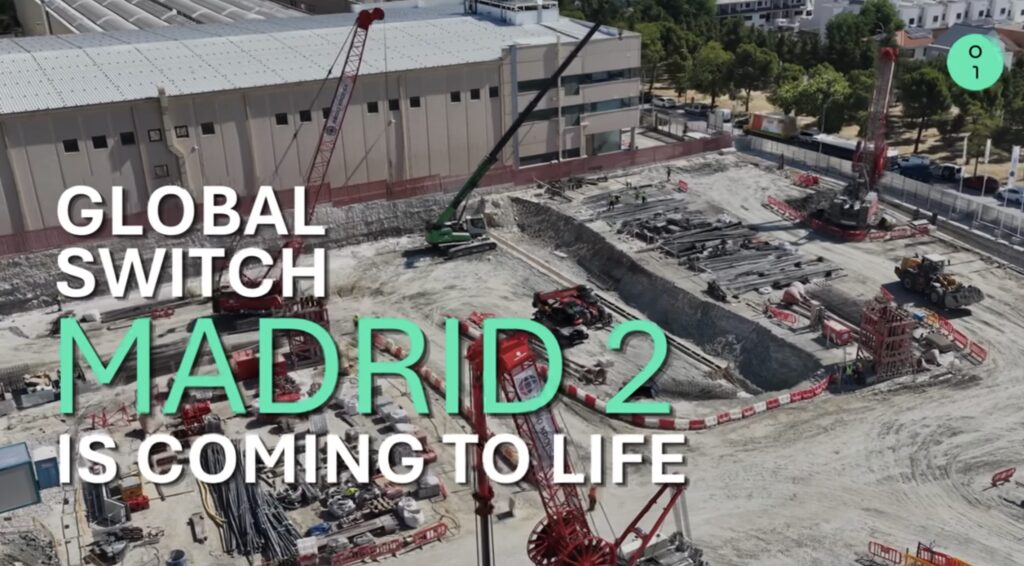
Global Switch has begun construction on Madrid 2, its second data center in the Spanish capital, an installation that the company plans to put into service in 2029 and complete by 2032. The project significantly expands its presence in Madrid: the latest information from the operator assigns 56 MW of capacity to Madrid 2, compared to the 14 MW currently listed for Madrid 1.
The key points of Global Switch Madrid 2 in 20 seconds
- Global Switch has announced the start of work on Madrid 2, with EIGO Construcciones serving as the general contractor.
- The data center is expected to begin operations in 2029 and reach full capacity by 2032.
- Global Switch currently reports a capacity of 56 MW for Madrid 2.
- The facility will be prepared for AI, cloud, and high-performance computing (HPC) workloads.
- Madrid 1 and Madrid 2 will share a location on Calle Yécora.
The announcement also updates the known dimensions of the project. Previously, in corporate documentation, Global Switch described a new building of approximately 24,000 square meters and 36 MW of IT capacity adjacent to its existing facilities. The company’s current profile raises Madrid 2’s capacity to 56 MW, although Global Switch does not detail in this latest announcement how those megawatts are exactly distributed or the construction phases that explain the difference.
Construction is underway by EIGO Construcciones, which is already working on site. Global Switch has shared initial images of the progress and situates the project within its expansion efforts to meet the growing demand for digital infrastructure in Madrid.
A campus that will go from 14 to 70 MW
Madrid 2 will not be an isolated data center. It is being built at Calle Yécora, 4, the same address as Madrid 1, so both buildings will form part of the same campus.
The scale difference is significant.
The Global Switch website currently assigns 14 MW to Madrid 1 and 56 MW to Madrid 2. Using these figures published by the operator, the Madrid campus will reach a total capacity of 70 MW once the new installation is completed.
Madrid 1 currently covers a gross area of 21,922 square meters across three technical floors. Its electrical infrastructure includes a 15 kV supply with N+N redundancy, a network capacity of 2 x 18 MVA, UPS systems with 2N redundancy, and mechanical systems backed by N+1 generators.
The site also features one of the increasingly rare characteristics in major data center expansions: it is within Madrid’s urban area and relatively close to key business and connectivity hubs.
Global Switch situates the campus approximately 12 kilometers from the financial district and city center, near the A-2 highway, and about ten minutes by car from Barajas Airport. It also hosts numerous operators and cloud providers and has a remote access point to DE-CIX.
This existing connectivity is precisely one of the advantages of expanding an already operational campus compared to developing a completely new site from scratch.
AI and HPC are also changing how data centers are built
Global Switch explicitly states that Madrid 2 will be designed to support growth in artificial intelligence, cloud services, and high-performance computing (HPC).
This is a noteworthy point. The infrastructure required to host large GPU clusters imposes different demands than traditional enterprise cloud, especially regarding electrical and thermal densities that new systems can reach.
Global Switch already offers liquid cooling in its data centers and presents this technology as an option to support high-power AI and HPC systems.
New AI servers also prompt operators to reconsider rack power density, electrical distribution, cooling, and internal connectivity. Building a center scheduled to go online in 2029 requires planning infrastructure around hardware that is not yet commercially available.
Madrid 2 will arrive precisely during a period when NVIDIA, AMD, and other manufacturers expect to continue scaling their platforms for data centers.
Global Switch has previously linked Madrid’s expansion to the rising demand for artificial intelligence. Their corporate documentation explained that the new facility could handle such workloads and that it would operate in conjunction with the existing center as a single campus.
Madrid continues to increase its data center capacity
The start of construction marks another large-scale project moving from planning to physical development in Madrid.
Energy availability will remain a key factor in determining how much the market can really grow in the coming years. AI projects significantly increase the electrical needs of campuses, making land availability only part of the equation.
For Global Switch, this expansionalso benefits from being located in an area with existing telecommunications infrastructure and a community of operators.
The company describes its Madrid installation as one of its points of connection with other European markets and North and South America, highlighting the high concentration of fiber networks available in the area.
The announced timeline still leaves considerable scope for development. According to Global Switch, Madrid 2 will start serving in 2029, with the full capacity not reached until 2032.
This three-year gap indicates a phased deployment, common in data centers of this scale, though the company has not publicly detailed the capacities of each phase.
Once Madrid 2 is complete, the current figures place the campus in Madrid at 70 MW between its two facilities. Rather than simply doubling its presence, the company would multiply by five the capacity it currently attributes to Madrid 1.
Frequently Asked Questions
When will Global Switch Madrid 2 open?
Global Switch expects Madrid 2 to be operational in 2029. The company plans to reach full capacity by 2032.
What capacity will Madrid 2 have?
The current Global Switch website attributes 56 MW to Madrid 2. Previous corporate documentation described a project with 36 MW of IT capacity, indicating figures have evolved during development.
Where will the new data center be located?
Madrid 2 will be at Calle Yécora, 4, Madrid, adjacent to Madrid 1. Both centers will form part of the Madrid campus operated by Global Switch.
Will it be suitable for AI servers?
Global Switch states that Madrid 2 is designed to support AI, cloud, and HPC workloads. The company also offers liquid cooling solutions in its data centers to support high-density systems.
