
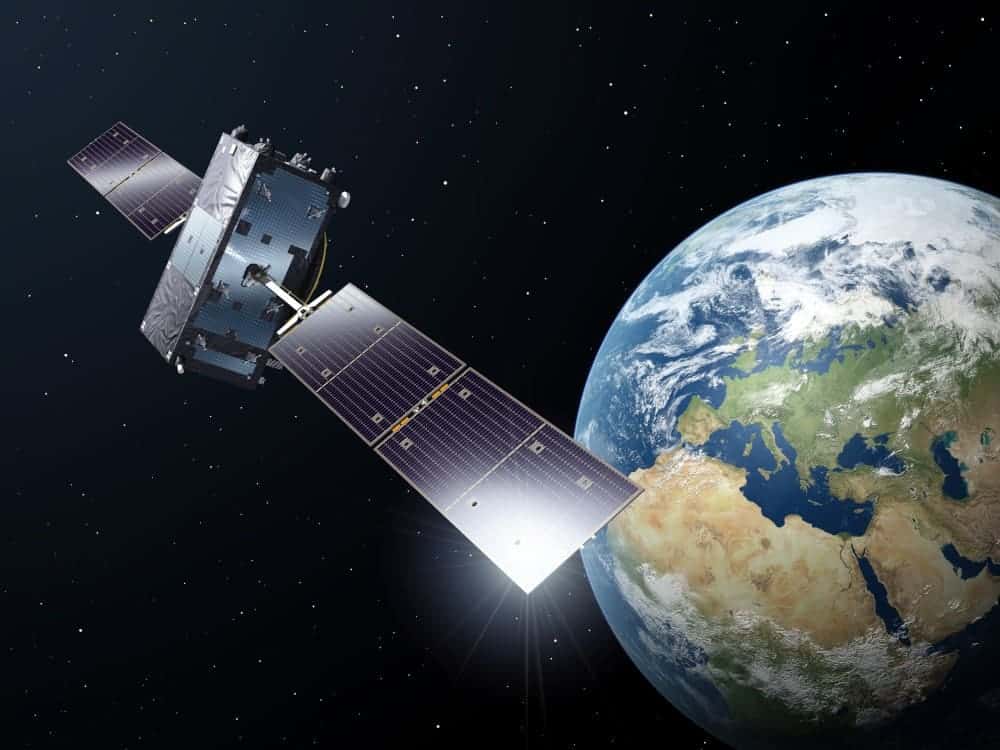
Canada’s GHGSat has commissioned Toronto-based SFL Missions to develop GHGSat-D2, a demonstration satellite designed to measure greenhouse gas emissions more precisely and more often than its current fleet. The spacecraft will weigh around 100 kg at launch, compared with the roughly 15 kg average of the satellites the Montreal company currently has in orbit. SFL Missions announced the contract on September 28, 2026, without disclosing its value or a planned launch date.
GHGSat-D2’s key facts in 30 seconds
- SFL Missions will build a demonstration satellite of just under 100 kg for GHGSat, based on its DEFIANT-XL platform.
- The larger, more precise sensor is built by ABB Canada.
- According to the companies, it will detect leaks as small as 50 kg per hour and cover 20,000 km² a day, double the current rate.
- It will have propulsion, two star trackers, and deployable solar panels.
- Neither the contract value nor the launch date has been disclosed.
GHGSat sells emissions data, mainly on methane, to governments and companies in oil and gas, power generation, mining, waste management, and agriculture. Its business depends on two things: spotting ever-smaller leaks and passing over a facility often enough to check whether it has been fixed. GHGSat-D2 aims to improve both.
GHGSat-D2 is, for now, a single demonstration satellite. Stephane Germain, GHGSat’s CEO, frames it as preparation for the second generation of its constellation: “Now, with our second-generation constellation, we’re building on that success to achieve a substantial leap in performance.” The release doesn’t specify how many satellites that second generation will include or when deployment would begin.
From 15 kg to nearly 100 kg to carry a bigger sensor
The size jump is the most striking part of the project. Since the pioneering “Claire” mission, launched in 2016, SFL has built eleven commercial emissions-monitoring satellites for GHGSat on its NEMO microsatellite platform, averaging 15 kg each. It also has two more units of that same family under construction in Toronto, GHGSat-C18 and C19, contracted in November 2025.
GHGSat-D2 jumps to DEFIANT-XL, an enlarged version of another SFL platform, because the new sensor doesn’t fit on the previous one. That instrument is built by ABB Canada, the Canadian subsidiary of the Swiss industrial group, which had already supplied some of GHGSat’s earlier payloads.
The extra space is also used for other systems. The satellite will carry two star trackers instead of one, to maintain precise orientation from any position, and deployable solar panels to power a more demanding sensor. It will also include a propulsion system, which SFL justifies on two grounds: avoiding possible collisions with other satellites and offsetting atmospheric drag, which increases with solar activity. Both should extend its operating life, though the release does not give a specific figure for years of operation.
Smaller leaks, more frequent passes over the same spot
The improvement that matters most to GHGSat’s customers is sensitivity. According to the companies, the new satellite will be able to detect emissions of as little as 50 kg per hour from space. To achieve that, SFL will install the latest version of its attitude determination and control system (ADCS), which combines software and hardware to keep the satellite stable and point the sensor precisely at a target on the ground.
Coverage is also increasing. Each satellite will be able to observe 20,000 km² a day, double the current rate, according to the release. And it will be more agile: it will be able to tilt up to 45 degrees both along its orbital track and perpendicular to it. That reorientation capability makes it possible to re-image the same spot more often, known in the industry as the revisit rate. For an operator trying to pinpoint an intermittent leak in a pipeline or a landfill, passing overhead more often can matter as much as sensor resolution.
Robert E. Zee, CEO of SFL Missions, described the contract as “a significant technological advance” in GHGSat’s ability to monitor greenhouse gases from space. All the specs cited are design targets for a satellite that has not yet been built, so they will need to be confirmed once it reaches orbit.
A relationship dating back to 2016
GHGSat was, in 2016, one of the first companies to measure methane emissions from specific industrial facilities from a satellite at around 500 km altitude. The company says it has since helped mitigate more than 21 million tonnes of CO₂-equivalent in methane, which it compares with the annual emissions of more than 4.9 million cars. That figure comes from the company itself and has grown with each announcement: in November 2025 it cited more than 20 million tonnes and 4.6 million cars.
SFL Missions, for its part, says it has racked up 98 operationally successful missions and more than 470 combined years of in-orbit operation. It builds satellites of between 3 and 500 kg and currently has 33 in development at its Toronto plant for commercial, government, and research customers. The contract lands in the middle of a race for low Earth orbit, where, as CloudNews has reported, China has reserved more than 200,000 satellites, though GHGSat plays in a very different niche: a small number of highly specialized spacecraft whose end product is the data.
Frequently asked questions
What is GHGSat-D2?
It’s a demonstration satellite that SFL Missions is developing for GHGSat to measure greenhouse gas emissions, mainly methane, with more precision and frequency. It will weigh just under 100 kg at launch.
What methane leaks will it be able to detect?
According to the companies, emissions as small as 50 kg per hour, with daily coverage of 20,000 km² per satellite, double the current fleet’s rate.
Who makes the sensor?
ABB Canada, which had already supplied some of the payloads for GHGSat’s earlier satellites.
When will it launch?
Neither SFL Missions nor GHGSat has announced a launch date or the contract’s value.
Sources:
