
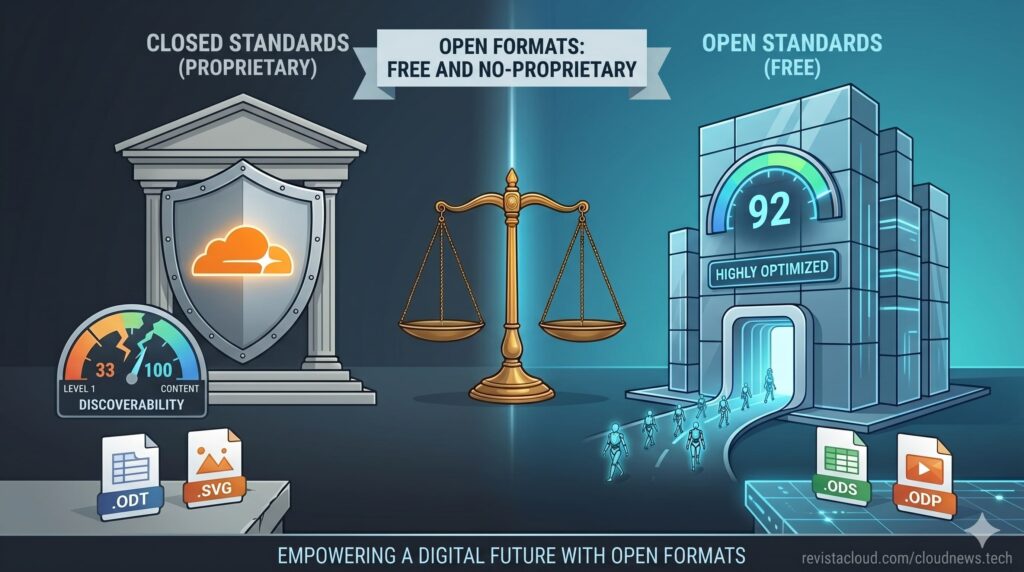
The decision made by Germany within the framework of the Deutschland-Stack doesn’t seem to be an ideological gesture or a technical extravagance. Viewed with some perspective, it appears more like a delayed correction of a debate that Europe already had nearly two decades ago and handled poorly. The German government has established, within its technical framework, ODF and PDF/UA as official document formats under the category of “semantic technologies,” while presenting the Deutschland-Stack as a sovereign, interoperable digital infrastructure connected with Europe and supported by open standards. Furthermore, the official portal sets 2028 as the target date to offer concrete solutions for federal, state, and municipal levels.
This move matters on a fundamental level: formats are not a minor detail. They are the State’s memory. If public documentation remains tied for years to a provider’s logic, interoperability ceases to be a promise and becomes a dependency. Germany has not announced a symbolic crusade against Microsoft, but it has made clear which standards it wants to base its administrative documentation on. In practice, this reopens a debate that Europe never fully closed when it accepted OOXML as an ISO standard.
A debate Europe prematurely considered settled
OOXML was approved as ISO/IEC 29500 in 2008. The ISO’s description defines it as a set of XML vocabularies for text documents, spreadsheets, and presentations “based on Microsoft Office 2008 applications.” This formulation, often overlooked in political debate, already revealed the core problem: the standard was born attached to a specific product, rather than as a neutral language created from scratch to be implemented equally by anyone.
Additionally, the standardization process was highly controversial. ISO acknowledged in 2008 that the process gathered 3,500 comments before final approval, and media outlets like Wired documented the intense political and technical clashes surrounding the vote. This was not an academic discussion; there was an underlying industrial power issue: if the dominant office document format became an international standard, governments could continue depending on it under a new guise of institutional legitimacy.
Over time, some of those criticisms remain. Today, Microsoft maintains specific documentation explaining how Office implements ISO/IEC 29500, including points where the product “varies” or “extends” the standard. This does not automatically invalidate OOXML, but it does dismantle the idea of a completely transparent, self-sufficient, and homogeneous standard. If the main provider needs a parallel document to describe how their software departs from or extends the norm, the promise of full interoperability is at least nuanced.
In contrast, ODF maintains another position. OASIS defines it as an open, international standard for text documents, spreadsheets, presentations, and graphics, also published as ISO/IEC 26300. It is not owned by a single company, and its governance is not dependent on the commercial roadmap of any specific manufacturer. Even Microsoft has gradually expanded ODF support in Microsoft 365, now announcing compatibility with ODF 1.4. Because of this, the question is no longer whether Word can open an .odt file, but rather which format a public administration should use by default when considering long-term preservation, neutrality, and sovereignty.
What Germany has understood
Germany’s Deutschland-Stack emphasizes reducing lock-in effects, prioritizing open standards, and when possible, favoring open-source solutions and European products. Its official portal establishes principles such as “Made in EU first,” the prioritized use of standards and open APIs, and local data storage. Within this same document, ODF and PDF/UA are explicitly named as document formats in the semantic layer—not as casual details, but as clear political and technical signals about the direction the German administration intends to take.
The choice of PDF/UA is also significant. Germany has not simply chosen PDF as an output format but has opted for the variant aligned with universal accessibility. The PDF Association reminds us that PDF/UA is the ISO 14289 standard for accessible PDFs and highlights that the Deutschland-Stack adopts it for final documents. This links digital sovereignty with real accessibility, two topics often addressed separately, yet here united in a single decision.
In essence, Germany seems to have embraced something Europe chose to overlook in the OOXML debate: that interoperability isn’t guaranteed just by declaring a format “open” in a catalog, but by unequivocally selecting a standard as the public reference. It’s not about preventing an official from opening a .docx file if received; it’s about ensuring the State’s documentary memory isn’t fundamentally written in a format whose core remains tied to a single provider. That distinction is far more significant than it might appear.
Spain also faces this debate
In theory, Spain has been advocating a similar approach for years. The National Interoperability Framework (Esquema Nacional de Interoperabilidad) requires public administrations to use open standards and, additionally, standards commonly used by citizens, with the explicit goal of guaranteeing independence in the technological choices. However, the Spanish catalog admits both ODF and Strict Open XML, meaning both a truly neutral format and the one that has historically reinforced Office’s dominance coexist within the same list.
This highlights the difference between Germany and Spain. The Spanish framework clearly states the principle but leaves room for daily practice to remain reliant on the dominant format. Germany, on the other hand, has chosen to reduce ambiguity in its official stack. While implementation challenges, internal resistance, and slow migrations can be debated, the core message remains clear: if the State wants digital sovereignty, it cannot keep storing administrative records primarily in a format whose center of gravity still lies with Redmond.
Ultimately, this isn’t just about office suites or software communities; it’s a discussion about institutional control, long-term preservation, and the capacity for change. Europe missed a key opportunity when it made OOXML an ISO standard that was openly debated, complex, and permanently accompanied by vendor-specific implementation notes. Germany has decided, at least in its new framework, not to repeat that path exactly. That makes its movement about more than just a matter of format preference; it’s a stance on sovereignty.
Frequently Asked Questions
Has Germany banned Microsoft Office in its administration?
There is no official announcement within the Deutschland-Stack that bans Microsoft Office as an application. However, the official framework sets ODF and PDF/UA as the official document formats within its technical architecture, prioritizing open standards, open APIs, and reducing lock-in.
What’s the difference between ODF and OOXML for a public administration?
ODF is an open standard managed by OASIS and published as ISO/IEC 26300, while OOXML was approved as ISO/IEC 29500 but described by ISO itself as based on Microsoft Office, with Microsoft providing additional documentation to detail variations and extensions of their implementation.
What is PDF/UA and why did Germany choose it?
PDF/UA is the ISO 14289 standard for accessible PDFs. Germany included it alongside ODF in the Deutschland-Stack, signaling a desire to combine document interoperability with universal accessibility requirements in final documents.
Does Spain still allow DOCX in public administration?
Yes. The Esquema Nacional de Interoperabilidad (ENI) establishes a preference for open standards, but its catalog of standards admits both ODF and Strict Open XML (.docx, .xlsx, .pptx), meaning both formats are officially recognized within the Spanish framework.
References: LinkedIn and Deutschland-Stack
