

Google DeepMind has introduced Gemini 3.5 Flash with a very clear message for the tech market: the next phase of artificial intelligence will be decided by agents. No longer is it enough to respond accurately in a chat, summarize documents, or generate code in an isolated window. New models need to act, connect tools, query data, execute workflows, and complete long tasks at the lowest possible cost.
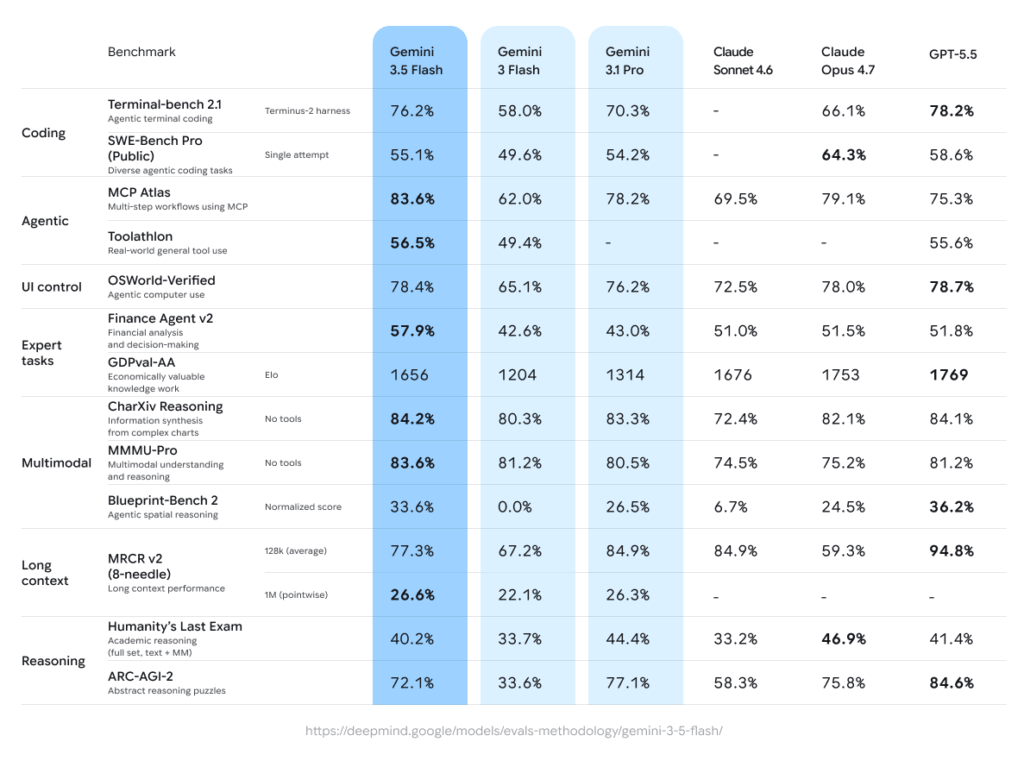
This shift explains why the most noteworthy data in the benchmark table isn’t necessarily in general reasoning tests but in MCP Atlas. Gemini 3.5 Flash scores 83.6% on this multi-step flow benchmark using the Model Context Protocol, surpassing Gemini 3.1 Pro, Claude Opus 4.7, and GPT-5.5 in the comparison shared by Google. For a Flash model designed for speed and scale to achieve this result in an agent test is a significant signal for developers, platforms, and companies.
Flash no longer means “lightweight model”
For quite some time, Flash versions of models have been understood as faster, cheaper options suitable for everyday tasks, but not necessarily contenders against flagship models in complex workflows. Gemini 3.5 Flash aims to change that perception. Google presents it as its most robust model to date for agents and programming, with the capacity to execute long and complex tasks with useful results in real-world environments.
According to Google DeepMind, Gemini 3.5 Flash outperforms Gemini 3.1 Pro in tests like Terminal-Bench 2.1, GDPval-AA, and MCP Atlas. It also scores 84.2% in CharXiv Reasoning, a multimodal comprehension and reasoning test, and claims to reach response speeds up to four times faster than other state-of-the-art models in tokens per second.
The combination of these features is crucial because agents don’t operate like traditional chatbots. An agent can break down a task, open tools, consult documentation, read files, run code, review errors, replan, and deliver a final result. Each step adds latency and cost. Therefore, a model that is “sufficiently intelligent,” but much faster and cheaper, can be more useful in production than a slightly better reasoning model that’s less efficient.
| Benchmark | Gemini 3.5 Flash | Gemini 3.1 Pro | Claude Opus 4.7 | GPT-5.5 |
|---|---|---|---|---|
| MCP Atlas | 83.6% | 78.2% | 79.1% | 75.3% |
| Terminal-Bench 2.1 | 76.2% | 70.3% | 66.1% | 78.2% |
| SWE-Bench Pro | 55.1% | 54.2% | 64.3% | 58.6% |
| OSWorld-Verified | 78.4% | 76.2% | 78.0% | 78.7% |
| CharXiv Reasoning | 84.2% | 83.3% | 82.1% | 84.1% |
| ARC-AGI-2 | 72.1% | 77.1% | 75.8% | 84.6% |
The table clearly shows there’s no absolute winner. GPT-5.5 remains ahead in several reasoning and long-context tests. Claude Opus 4.7 maintains an advantage in SWE-Bench Pro and Humanity’s Last Exam. Gemini 3.5 Flash stands out primarily in areas where Google now aims to compete: agents, tool usage, practical programming, and large-scale deployment.
MCP becomes a competitive territory
MCP Atlas is significant because it targets one of the core aspects of agent-based AI: connecting with external systems. MCP, the Model Context Protocol, has become a pathway for models to interact more systematically with tools, databases, repositories, development environments, and enterprise applications.
The symbolic interpretation is powerful. Anthropic promoted MCP as a key component for connecting Claude with tools and data, but now Google shows Gemini 3.5 Flash can perform better in a test built around that protocol. This doesn’t undermine Anthropic’s experience in developer tools or its role in popularizing MCP. It confirms, however, that open protocols can quickly turn into battlegrounds among large models.
For technical teams, this point is more relevant than a tenth of a point in an academic test. A model that manages MCP flows better can be more effectively integrated into internal tools, automation workflows, development agents, documentation analysis, financial processes, or multi-step enterprise procedures.
The race will no longer be just “which model reasons better,” but “which model completes a connected task more effectively.” This shifts how we evaluate AI. An agent benchmark resembles a real workday more: tools, errors, partial context, dependencies, and intermediate decisions are involved. In that scenario, consistency is as valuable as raw intelligence.
Google aims for mass distribution of its agents
Gemini 3.5 Flash also benefits from a distribution advantage that’s hard to match. Google has announced its availability via the Gemini app, in Search’s AI Mode, in Google Antigravity, in the Gemini API through Google AI Studio and Android Studio, and in Gemini Enterprise Agent Platform and Gemini Enterprise.
This means the model isn’t just an API for advanced developers. It’s integrated into consumer products, development environments, enterprise platforms, and search functions. If it performs well in daily use, this can significantly accelerate adoption.
Google Antigravity plays a prominent role in this strategy. The company describes it as a platform for developing agents where sub-agents collaborate to solve complex problems. In examples shared by Google, Gemini 3.5 Flash can coordinate multiple agents to synthesize technical documents, create interfaces, or work on programming tasks for hours with human oversight.
This aligns with a broader sector trend: agents won’t be a standalone feature but a cross-cutting layer. They’ll be embedded in IDEs, browsers, search engines, office suites, customer service platforms, financial analysis tools, security operations, and business applications. For this to succeed, models must be fast, affordable, integrable, and capable of handling long workflows efficiently.
Cost per task will become the new metric
The AI debate has historically focused on token cost, but agents demand taking a step further: cost per completed task. A cheap model that fails often can be expensive overall. A costly model that solves problems in a few steps may be competitive. A fast model enabling more iterations and stable tool use might become the top choice for production environments.
Gemini 3.5 Flash aims to fill this niche. Google claims it can complete tasks previously requiring hours of a developer’s time or days of an auditor’s work in a fraction of that time, often at less than half the cost of other cutting-edge models. This is a claim that will need validation through real-world cases, but it points to where competition is headed: not just output quality but overall productivity.
For companies, this can be a game-changer. Generative AI pilots are quick to set up. The real challenge is turning them into stable, governed, and profitable processes. If an agent must work over codebases, financial documents, catalogs, internal systems, or data analysis, the model must be fast, inexpensive, reliable, and easy to integrate.
Gemini 3.5 Flash doesn’t eliminate the need for human oversight. Google emphasizes this when discussing agent and sub-agent workflows. Oversight will still be necessary to define permissions, review outputs, limit actions, and prevent systems from making decisions out of context. The difference is that, with more capable and faster models, oversight can shift from micro-managing every step to validating objectives and outcomes.
Google’s presentation of Gemini 3.5 Flash shows their intention to compete on three fronts: the model, the platform, and distribution. The MCP Atlas figure is just a number but encapsulates the core shift. AI is no longer judged solely by how well it responds — now it’s also about how effectively it works.
Frequently Asked Questions
What is Gemini 3.5 Flash?
It’s Google’s new DeepMind model focused on speed, programming, agents, multimodality, and executing complex workflows.
Why is MCP Atlas so important?
Because it assesses multi-step workflows using the Model Context Protocol, a key element for connecting AI models with tools, data, and external systems.
Does Gemini 3.5 Flash outperform Claude in MCP Atlas?
According to Google’s published table, Gemini 3.5 Flash scores 83.6% on MCP Atlas, compared to 79.1% for Claude Opus 4.7.
Is Gemini 3.5 Flash better than GPT-5.5 or Claude Opus 4.7?
It depends on the task. Gemini 3.5 Flash excels in agents, speed, and MCP Atlas, but GPT-5.5 and Claude Opus 4.7 still lead in other tests. The most useful comparison will increasingly be based on specific use cases.
