
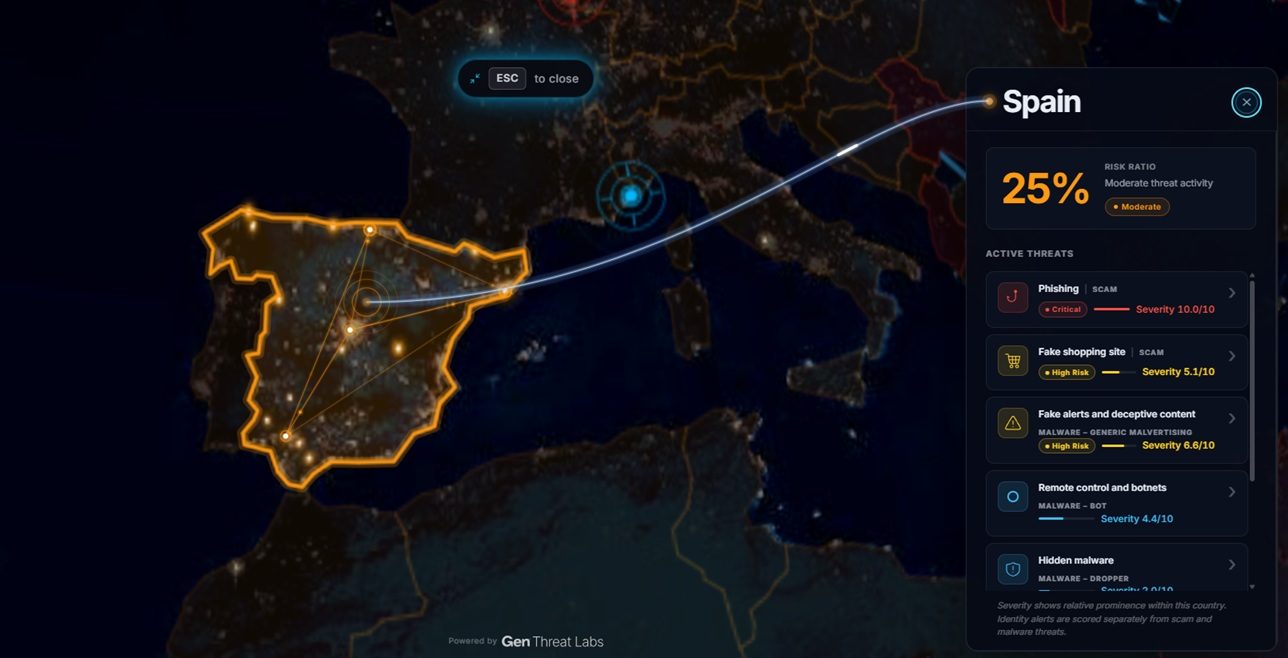
Gen, the company behind brands like Norton, Avast, and LifeLock, has introduced Fearless Planet Index (FPI), a new platform that allows real-time monitoring of the main digital threats across 245 countries and territories. The tool transforms millions of signals collected by the company’s research labs into an interactive map showing which scams and cyberattacks are gaining strength in each region.
The key points of the Fearless Planet Index in 20 seconds
- Gen presents an interactive map that monitors digital threats in 245 countries and territories.
- The platform identifies which scams and attacks are increasing or decreasing daily.
- Phishing remains the most widespread threat worldwide.
- In Spain, online shopping scams and those related to dating apps stand out.
The initiative aims to bring threat intelligence closer to end users through a representation similar to a weather map. Instead of just consulting periodic cybersecurity reports, anyone can check which digital risks are dominant in their country and access specific recommendations to reduce exposure to these threats.
A ‘Weather Radar’ for Digital Threats
The operation of the Fearless Planet Index is inspired by weather forecasting applications. Just as a radar tracks a storm’s development, the platform reflects how scams, phishing, malware, or identity theft campaigns evolve almost in real time.
According to Gen, the system is powered by telemetry collected by Gen Threat Labs, which processes billions of security events from its installed user base worldwide.
Each country shows the predominant threats and whether they have increased, decreased, or remained stable compared to the previous day. Additionally, users can access more information about each attack type and receive recommendations to minimize risk.
Spain: Online Shopping Scams Among the Main Targets
One notable data point from the launch directly concerns Spain. The index places online shopping scams among the most active threats detected in July.
Cybercriminals continue to use familiar techniques, such as:
- Fake online stores.
- Fraudulent sponsored ads on social media.
- Counterfeit promotional emails.
- Manipulated search engine results.
- Websites imitating legitimate businesses.
Their goal is usually to obtain banking data, login credentials, or payments for products that are never delivered.
Europe Shows Rise in Romance Scams
Another clear trend identified by the map is the growth of romance or online dating scams across several European countries.
According to Gen, Spain, along with Germany, Sweden, Norway, Belgium, and the Czech Republic, is among the markets where this type of fraud maintains a significant presence.
In these cases, attackers establish trusting relationships with victims over weeks or even months before requesting money or personal information.
As preventive measures, the company recommends:
- Be skeptical of profiles avoiding video calls or in-person meetings.
- Do not send money via bank transfers, cryptocurrencies, or gift cards.
- Avoid sharing financial information or personal documents during initial conversations.
Phishing Continues to Dominate the Global Landscape
Initial data published by the Fearless Planet Index shows that phishing remains the most widespread digital threat worldwide.
Key figures include:
| Indicator | Data |
|---|---|
| Countries and territories monitored | 245 |
| Phishing attacks detected (30 days) | Over 120 million |
| Threats classified as scams or malicious advertising | Over 80% |
| Region with highest average risk | North America (29.6%) |
| Region with lowest average risk | Latin America (22.0%) |
The analysis also shows that the nature of threats varies by region. While some areas experience more financial fraud activity, others focus on e-commerce scams, fake tech support, or identity theft campaigns.
Threat Intelligence Accessible to Every User
Traditionally, this type of information was reserved for security operations centers (SOCs) or large organizations. With this initiative, Gen aims to bring some of that intelligence to individual users through a visual and straightforward interface.
The Fearless Planet Index allows daily checks on the digital risk status in each country and identifies which threats are most likely to affect citizens and businesses based on their location.
The platform is now publicly available and will continuously update its data as the campaigns detected by Gen’s monitoring systems evolve.
Frequently Asked Questions
What is the Fearless Planet Index?
It is a platform developed by Gen that displays real-time data on the main digital threats detected across 245 countries and territories.
What information does it provide?
It allows users to explore the most relevant scams, phishing campaigns, malware, and identity alerts in each country, as well as whether these threats are growing or declining.
What is currently the most widespread threat?
According to initial data from Gen, phishing remains the leading digital threat worldwide.
What risks are prominent in Spain?
The index specifically highlights scams related to online shopping and fraudulent campaigns linked to dating platforms.
