
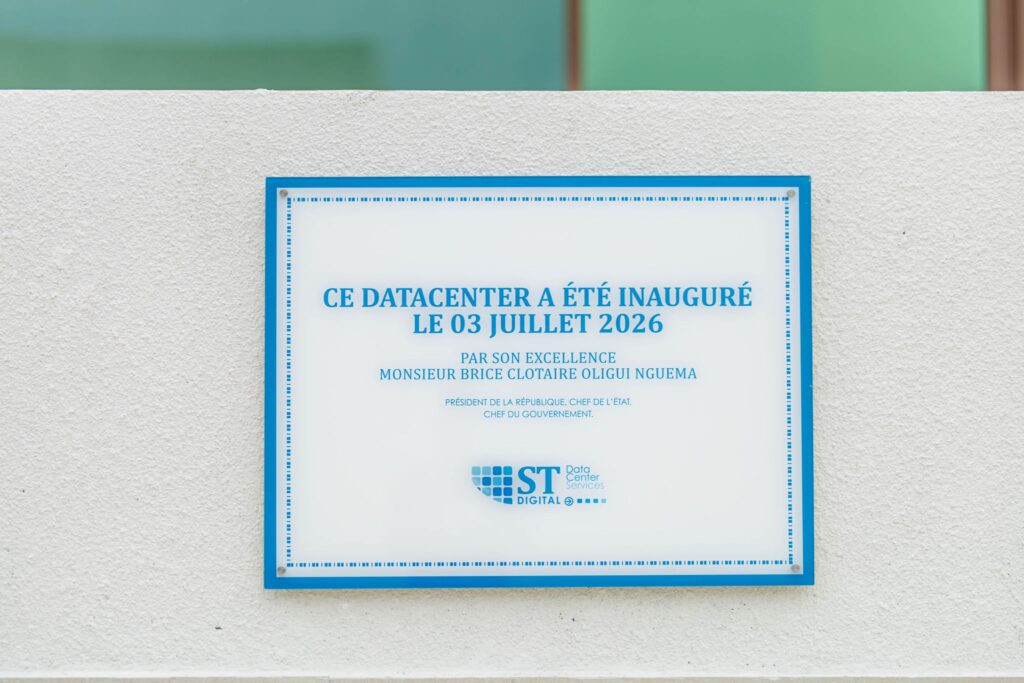
Gabon has taken an important step in its digitalization strategy with the inauguration of the ST DIGITAL DATA CENTER SERVICES data center, an infrastructure located in the Nkok Special Investment Zone, presented as a central piece to host data, cloud services, and digital capabilities within the country itself.
The ceremony took place on Friday, 07/03/2026, with the presence of the President of the Republic, Brice Clotaire Oligui Nguema, along with government representatives, local authorities, tech partners, and private sector guests. ST DIGITAL described the inauguration as a significant date in the country’s digital history and connected the project to strengthening Gabon’s digital sovereignty.
The infrastructure had been announced weeks earlier as an eco-friendly Tier III Standard Cloud AI Data Center, developed by ST DIGITAL in Nkok, aimed at businesses, administrations, and digital services that require local hosting and processing capacity.
Why Hosting Data Locally Matters
Digital sovereignty may sound like a political concept, but it has a very concrete meaning: where data is stored, who operates the infrastructure, under what legal framework it’s managed, and a country’s ability to maintain critical services without relying entirely on overseas data centers.
For a state, a local data center enables progress in administrative digitization, improves the availability of public services, enhances cybersecurity, and reduces dependence on external entities. For companies, it can facilitate hosting applications, backups, e-commerce platforms, financial services, sensitive data, or AI projects with less physical distance and greater operational control.
The Gabonese government presented the data center as a tool to improve national cybersecurity, attract investment, promote the digital sector, and create new qualified jobs for young Gabonese professionals.
The location in Nkok is no coincidence. The Special Investment Zone has become one of the hubs from which Gabon aims to attract industry, services, and projects linked to its economic transformation. A data center fits this vision because it not only serves the administration or tech companies; it can also support banking, logistics, healthcare, education, commerce, telecommunications, and public services.
An Infrastructure for African Administration, Business, and Cloud
ST DIGITAL has stated that the project is part of a broader vision: building African infrastructure for African needs, with international standards and local operational capacity. The company has already positioned itself as a cloud provider and digital services provider in the region, operating in several French-speaking African countries.
In 2025, the group also inaugurated a data center in Ivory Coast, a facility with 160 racks according to Data Center Dynamics, demonstrating that its strategy extends beyond a single national market.
In the Gabonese context, the idea of a “sovereign cloud” has particular importance because many African countries have historically depended on infrastructure hosted outside their borders. This dependence can lead to higher latency, increased costs, complicated data governance, and less control over critical services for local businesses.
A national data center doesn’t solve all these issues alone, but it provides a foundation. It allows digital workloads to stay close to users, enables public administration to adopt stricter hosting policies, and helps local providers build services on infrastructure located within the country.
It can also enhance resilience. Digital administrations that manage records, payments, identity, tax services, or citizen procedures need operational continuity, power, connectivity, physical security, backups, monitoring, and technical personnel. This layer isn’t improvised; it requires prepared facilities and capable operators to maintain them.
The Challenge Starts After the Ribbon-Cutting
The inauguration is significant, but the success of a data center is measured afterward. Real availability, quality of connectivity, cost to clients, security, support, energy efficiency, certification, the ability to handle critical loads, and trust from companies and government agencies all matter.
In countries building their digital infrastructure, technology is often only part of the challenge. Data protection frameworks, skilled professionals, operational cybersecurity, continuity policies, agreements with telecom operators, and cloud services that truly meet local market needs are also crucial.
Laïka Mba, CEO of ST DIGITAL Gabon, highlights this ambition. According to a statement released by the company, she described the project as proof that no aspiration is too big for Gabon. Beyond the formal tone, this reflects an important idea: Africa does not want to just consume digital services built elsewhere but to actively participate in the infrastructure that supports them.
Gabon’s digital transformation will not rely solely on this data center. It will also require national connectivity, fiber networks, technical talent, regulation, business adoption, and an administration capable of migrating services smoothly. However, having local infrastructure shifts the starting point.
The new ST DIGITAL center positions Gabon in an increasingly important regional dialogue: among African countries seeking better control over their data, reduce technological dependence, and offer nearby digital services to businesses and citizens. If the operation meets expectations, Nkok could become more than an industrial zone—it could emerge as a hub for the digital economy of Central Africa.
Frequently Asked Questions
What has ST DIGITAL inaugurated in Gabon?
ST DIGITAL DATA CENTER SERVICES has opened a data center in Gabon, located in the Nkok Special Investment Zone, focused on cloud services, data hosting, and supporting digital transformation.
Why is digital sovereignty important?
Because hosting critical data and services within the country allows for greater legal, operational, and strategic control over the digital infrastructure.
What does it mean that it’s built to Tier III standards?
Tier III is associated with data centers designed with redundancy and higher operational availability. In this case, ST DIGITAL has presented the infrastructure as a Tier III standard data center.
Who can benefit from this infrastructure?
Public administrations, businesses, digital operators, cloud providers, financial entities, health services, educational institutions, and organizations that need to host data or applications within Gabon.
via: LinkedIn
