
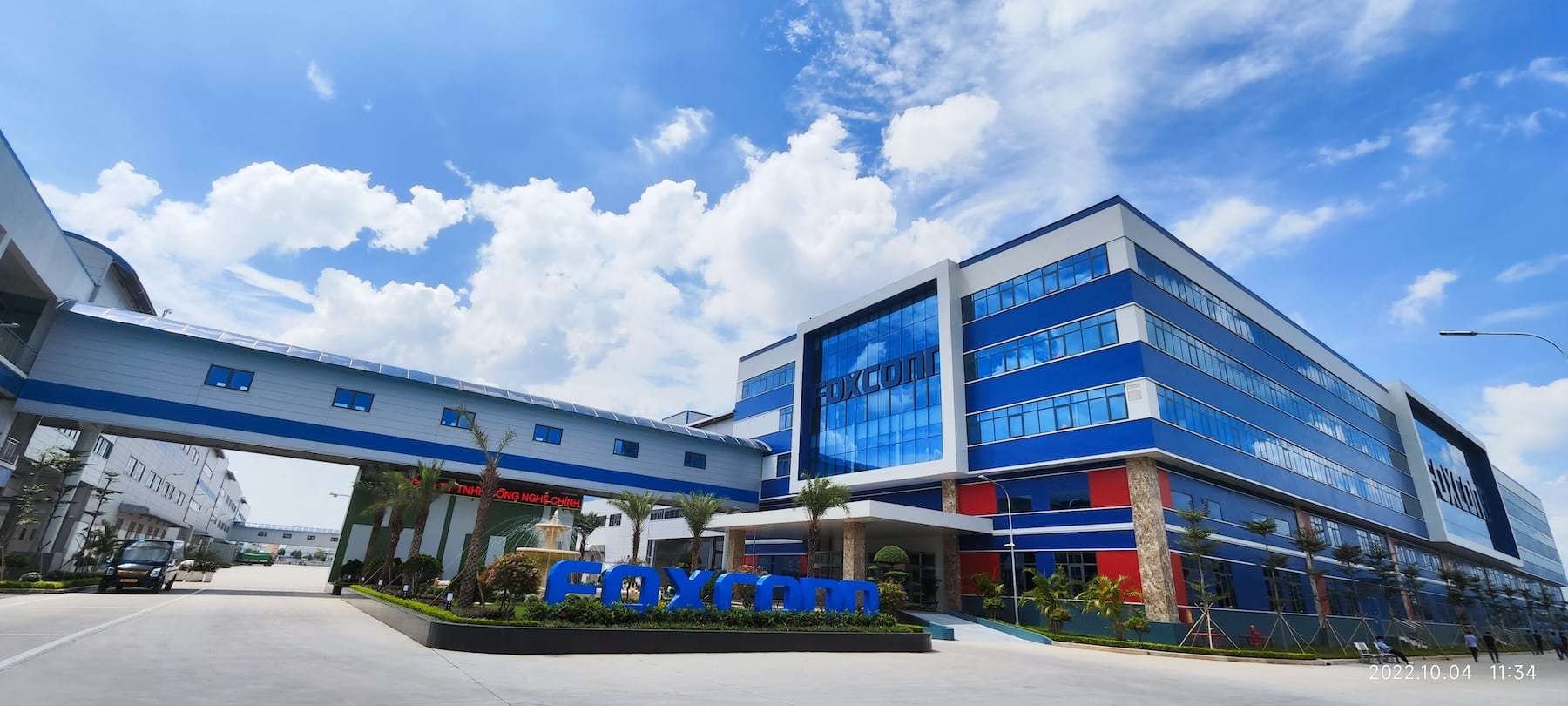
The hardware industry is experiencing a silent but profound reshuffle: the focus is no longer solely on the end device but increasingly on the infrastructure that makes it possible. In this landscape, Foxconn Industrial Internet (FII)—the mainland subsidiary of Foxconn/Hon Hai—is pushing its growth toward high-performance computing (HPC) with a growing emphasis on cloud and, above all, artificial intelligence servers.
The latest snapshot comes from China. In early December 2025, FII announced to the market a planned investment of CNY 2 billion (about $282.8 million) in its FII Cloud Computing Tianjin branch, aimed at strengthening AI computing infrastructure and expanding R&D efforts within the country. The announcement immediately impacted the stock: the share price closed up 1.9%, reaching CNY 60.96, after intraday gains of up to 4.8%, according to reported data. Beyond the financial headline, this move signals a strategic shift: moving beyond just manufacturing “boxes” and gaining influence in the infrastructure layer that supports deployment, training, and increasingly, large-scale inference models.
The figures accompanying this shift are equally compelling. In the first three quarters of 2025, FII reported revenues of CNY 604 billion, a 38% year-over-year increase. In the same period, the cloud computing segment grew strongly: over 65% in total and over 75% in Q3. Net profit rose by 49% to CNY 22.5 billion. During its earnings call, the company expressed being “optimistic” about demand for AI server racks in the coming year—a key signal of where it expects to create value.
This approach is not happening in isolation. Simultaneously, Foxconn itself has emphasized that demand for high-performance computing power is now a structural trend. In its Q2 2025 results, the conglomerate highlighted the surge in AI servers, with over 60% annual growth in that segment, and projected accelerating growth for Q3: AI server revenue expected to increase more than 170% YoY, with rack shipments tripling quarter-over-quarter. Additionally, Foxconn indicated that annual revenue related to AI servers could surpass one trillion Taiwanese dollars—a figure that underscores the scale of this phenomenon.
The key point is that the market no longer rewards volume manufacturing alone; it values integration. In the AI universe, a “server” is not an isolated unit but a component within rack-based systems with demanding requirements for power, cooling, and density. That’s where the manufacturer who masters industrialization, supply chain, and advanced assembly can turn complexity into a barrier to entry. FII is aiming to position itself at that point: building capabilities to serve cloud clients—the major providers building data centers for AI—in a context where each hardware generation pushes the limits of consumption and thermal management.
However, the strategy also involves balancing acts. The same December report noted that FII continues investments in traditional lines: for example, the company announced months earlier a CNY 726 million investment to build a R&D center for next-generation precision smartphone components, with completion expected by late 2026. The implicit message is that the transition is not about shutting down traditional businesses but rather preventing them from being the sole engine. “Premium” computing—advanced servers, cloud infrastructure, and AI systems—is emerging as the most visible new growth vector.
There’s also a geopolitical factor shaping the narrative. The expansion of cloud and AI is intersecting with industrial policies, tariffs, and technological sovereignty plans. Foxconn, as a major global player, has consistently noted that it monitors the impact of tariffs and international trade changes, while boosting capacity for cloud and networking products across various markets. Practically speaking, for companies like FII, the challenge isn’t just producing more but producing where the client needs it, within deployment schedules for increasingly aggressive data center rollouts.
In this context, FII’s push to strengthen its Tianjin subsidiary appears to be a preparation for a decade where AI infrastructure will not be a short-term “peak,” but a sustained market driven by multi-year investments. The lingering question is whether the industry can scale smoothly: with sufficient electrical capacity, cooling, availability of critical components, and fierce competition that won’t stand still. For now, FII seems intent on playing in the league of those who not only assemble hardware but also design and maintain the industrial continuity of the new computing economy.
Frequently Asked Questions
What is Foxconn Industrial Internet (FII) and what does it do?
FII is a subsidiary within the Foxconn ecosystem focused on designing, manufacturing, and selling equipment related to communications, cloud computing, and digital industrialization, with a growing focus on data center infrastructure and AI servers.
Why have “AI racks” become a strategic business?
Because they carry much of the value addition in the AI era: integration of accelerators, networking, storage, power, and cooling. Those who master this assembly and supply chain can ensure volume, timing, and quality in large-scale deployments.
What are the risks facing the AI server market in 2026?
主要瓶颈通常在制造能力、关键组件的供应、电力和数据中心的冷却,以及监管和商贸不确定性(如关税或出口限制)方面。
How does this trend impact companies that use cloud services or deploy their own AI?
Increasing infrastructure demand can strain timelines and prices, especially for high-end configurations. At the same time, industrial expansion can improve supply and accelerate AI adoption in sectors that previously lacked access to this power.