
Intel added a symbolic but timely recognition this week at a pivotal moment for its industry story. The company has been named by Fortune as one of the most innovative companies in the United States, a ranking that includes 300 firms, dominated in its 2026 edition by technology, healthcare, and finance. Collectively, these companies have generated over $12.5 trillion in revenue over the past twelve months, according to Fortune’s methodology.
For Intel, the recognition comes amid a phase of rebuilding its image. The company aims to reposition itself not just as a historic processor manufacturer but as a player capable of competing in the new era of Artificial Intelligence, advanced chip design, and cutting-edge semiconductor manufacturing in the U.S. Therefore, Fortune’s accolade functions more as a reputational validation than as a technical comparison demonstrating superiority over rivals.
An Award That Looks Both to the Past and the Future
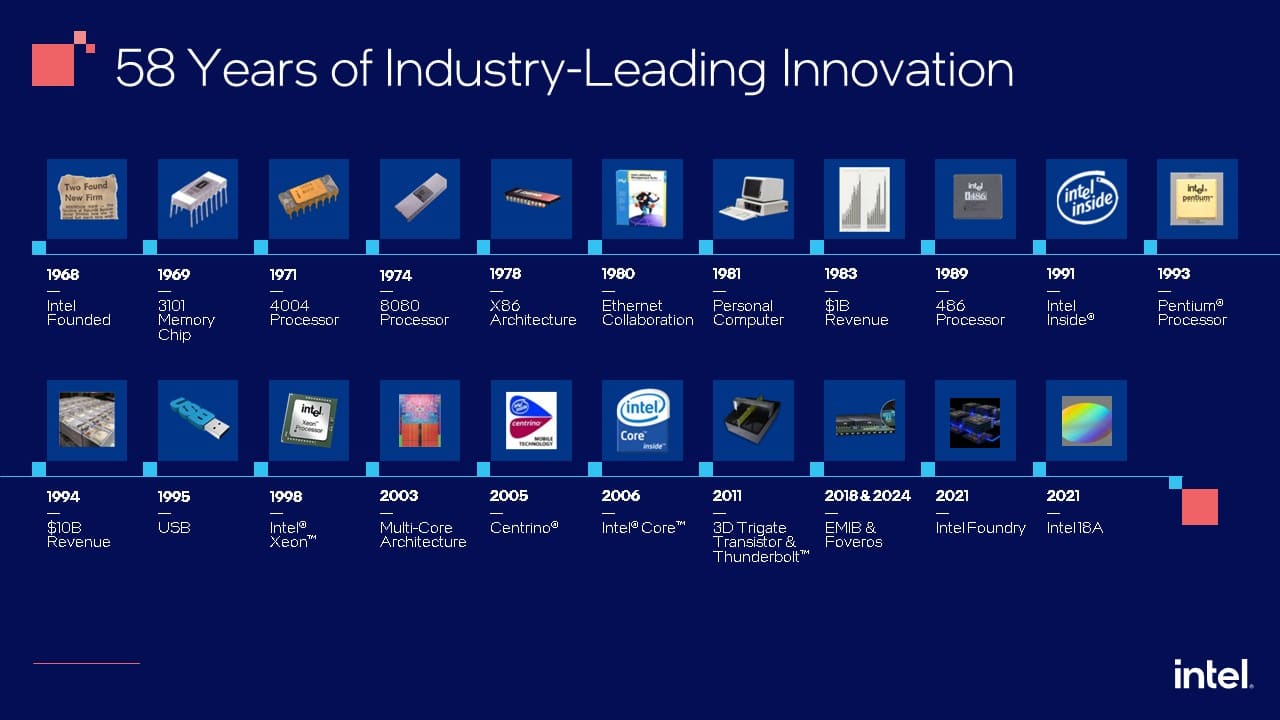
Intel itself emphasized this inclusion in the list by highlighting a clear vision: innovation as the guiding thread throughout its history. In its statement, it notes that it has been driving semiconductor advancements for 58 years, holds more than 64,000 patents worldwide, and estimates that its technologies power roughly 70% of the desktop and laptop microprocessor market. These figures reinforce a narrative that blends legacy with renewal efforts.
This approach is deliberate. Intel recognizes that its historical prominence remains one of its key assets in an industry obsessed with the near future. It recalls milestones such as the 1971 Intel 4004—the first commercial microprocessor— the x86 architecture established in 1978, the Intel Core family introduced in 2006, and recent breakthroughs in advanced packaging like EMIB and Foveros. While these are not all new for 2026, they form part of a broader story: Intel wants the market to view it not only as a leader in hardware revolutions of the past but also as an active participant in shaping the next wave.
The Real Test Is in 18A, AI, and Foundry
The key area where Intel most stakes its narrative is its 18A process technology. The company presents it as its major process leap, centered on two innovations: RibbonFET, its gate-all-around transistor architecture, and PowerVia, its backside power delivery system. According to Intel, this technology is already ready for customer projects, offering up to 15% more performance per watt and up to 30% higher density than Intel 3, along with additional improvements related to PowerVia.
The significance of 18A extends beyond just technical specs. Intel has made it a symbol of its effort to regain manufacturing leadership and bolster its foundry business. In October 2025, it announced that Panther Lake, its first AI PC platform built on 18A, entered production, and that Fab 52 in Arizona was prepared for high-volume manufacturing with this technology. In January 2026, the company reaffirmed that 18A was in high-volume production in Arizona and Oregon, framing this as proof of its ability to design, develop, and manufacture advanced semiconductors within the U.S.
This context lends more seriousness to Fortune’s recognition. It’s not awarded amid financial euphoria but during a complex transformation. Intel closed 2025 with annual revenues of $52.9 billion—roughly flat compared to the previous year. Within that total, its Data Center and AI business grew 5% to $16.9 billion, while Intel Foundry increased 3% to $17.8 billion. These figures show momentum, albeit not yet a definitive recovery scenario.
Innovation Yes, but Under Competitive Pressure
The challenge for Intel is that today, historical reputation alone is insufficient. The chip market now measures innovation almost in real-time amid fierce competition. NVIDIA leads the narrative in AI acceleration, AMD has gained ground in servers and data centers, TSMC continues to set the pace in advanced manufacturing, and hyperscalers are strengthening their own designs. In this landscape, Intel must convert its innovation discourse into products, contracts, and industrial capacity executed with precision. While Fortune’s recognition boosts its brand, it does not alone resolve this strategic challenge.
Nevertheless, the company has arguments to remain a central piece of the ecosystem. Lip-Bu Tan, who became CEO in March 2025, has emphasized that the CPU’s role remains vital in the AI era and that the priority is to refine execution, strengthen engineering excellence, and capitalize on the opportunities AI presents across all divisions. This message aligns with Intel’s strategic roadmap: an open, heterogeneous AI platform; reinforcing x86 as the architecture for control and large-scale computing; and cutting-edge foundry services based in the U.S.
In this light, inclusion in Fortune’s list can be seen more as a sign of endorsement for Intel’s strategic direction than a definitive proof of success. The company retains a vast legacy, a solid technological foundation, and an industrial capacity few can match. Yet it also faces a period where every promise related to AI, manufacturing, or advanced packaging will face much more scrutiny than a decade ago. That’s why this recognition matters—it serves as a reminder that Intel still has influence in the innovation conversation. The key question now is whether it can regain clear leadership in that space.
Frequently Asked Questions
What does it mean that Intel was included by Fortune among the most innovative companies in the U.S.?
It means Fortune has listed it in its annual ranking of the 300 most innovative companies nationwide, with sectors like technology, healthcare, and finance dominating in 2026.
What technological milestones does Intel highlight to justify this recognition?
Intel emphasizes the 4004 microprocessor, the x86 architecture, the Intel Core family, advanced packaging with EMIB and Foveros, and its new Intel 18A process technology.
What is Intel 18A, and why is it so important for the company?
It’s the advanced node Intel aims to strengthen its foundry business and technological stature. It includes RibbonFET and PowerVia, positioning itself as a key technology for high-performance chips and AI workloads.
Is this recognition happening at a good time for Intel?
It comes at a critical yet demanding moment. Despite flat 2025 revenues of $52.9 billion, growth in Data Center and AI (up 5%) and in foundry (up 3%) are signs that the company’s transformation continues to move forward.
via: newsroom.intel