
Cache management in Cloudflare is rarely considered a critical task until it stops working as expected. An unreflected change, a homepage that still serves an outdated version, or a URL that requires immediate refresh are enough to remind us that purging cache remains a routine operation for developers, agencies, and system administrators. On that front, FlarePurge, a new native app for Apple devices, aims to minimize that friction: open the app, select the zone, and purge—with no need to go through Cloudflare’s web panel.
The proposal isn’t trying to compete with the official dashboard or full management clients. Its value lies precisely in the opposite: specializing in a single function and executing it quickly. FlarePurge acts as a client for the Cloudflare public API to list zones and launch full or selective purges from iPhone and iPad. It features an interface designed for recurring use, with a strong focus on privacy, security, and no own backend infrastructure.
A niche app with a very clear logic
From a technical standpoint, FlarePurge is built around a very concrete need that many more generalist tools address clumsily. The app allows adding multiple accounts, grouping zones by account, marking favorites, and executing cache purges without navigating through several layers of the Cloudflare panel on a mobile browser.
This approach is especially relevant now, as many web management utilities have become overly loaded frontends or services packed with unnecessary functions. FlarePurge, instead, opts for a utility pattern focused on direct usefulness: multi-account, full or selective purge, synchronized favorites, and quick access to basic info of each zone.
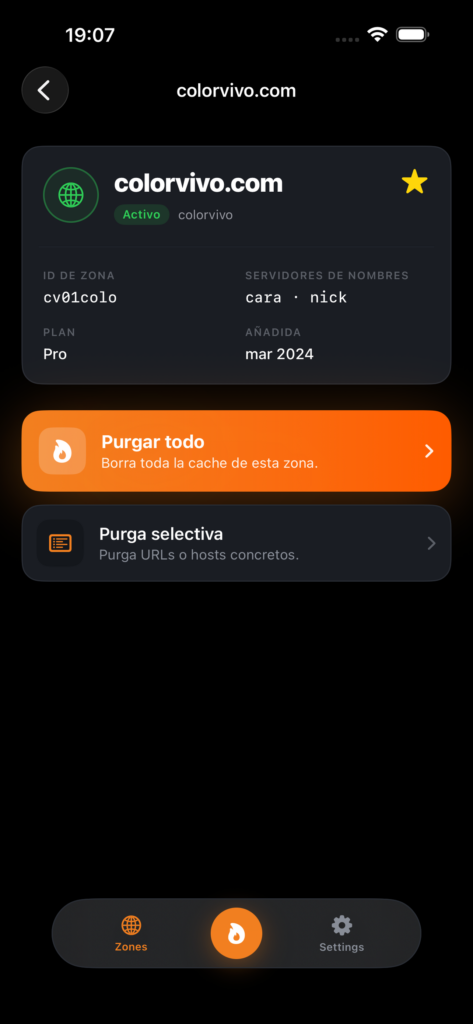
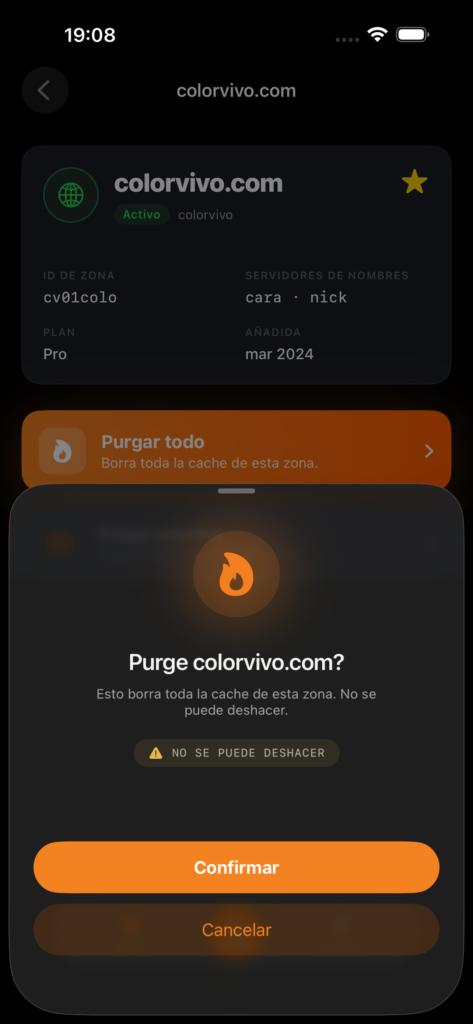
The selective purge allows pasting up to 30 URLs or hostnames at once, with the app automatically splitting batches to comply with Cloudflare API limits. This small yet well-thought-out automation is probably one of the most useful features, solving a real daily operational need without requiring the user to consider limits, batching, or additional validation.
API tokens instead of global keys
One particularly sensible design decision in FlarePurge is in its authentication approach. The app does not rely on the old email + Global API Key scheme but instead requires API tokens with minimal permissions. Specifically, it recommends Zone:Zone:Read for listing zones and Zone:Cache Purge:Purge for clearing cache, with an optional Account:Read permission if zones are to be grouped by account name.
This detail matters because it reduces the risk surface. Asking for the Global API Key for a purging utility would be excessive, granting broader administrative access than necessary. Enforcing granular tokens aligns with Cloudflare’s modern practice and positions the app in a more secure and mature operational category.
Additionally, according to the developers, these tokens are stored in the system’s Keychain within a shared App Group, designed for future extensions. By default, tokens remain only on the device, but users can enable synchronization via iCloud Keychain in Settings.
No backend, no analytics, and certificate pinning
The app distinguishes itself further by emphasizing privacy. FlarePurge ensures that it does not include analytics, does not use third-party SDKs, does not phone home, and does not route traffic through its own infrastructure. All traffic goes directly from the device to api.cloudflare.com over TLS 1.2+, employing certificate pinning based on Cloudflare’s SPKI SHA-256 public certificate hashes.
This model is especially relevant for security-conscious users, as it offers a “zero backend” promise that isn’t just marketing but an architectural choice to minimize complexity and eliminate common trust vectors. There are no intermediate servers, proxies, or telemetry collection for monetization.
Favorites are stored in the user’s private CloudKit database, which, according to the app, leaves no developer-side access to this data. Technically, the message is clear: FlarePurge aims to be a local client with optional synchronization within the Apple ecosystem, not a SaaS platform disguised as a native app.
Apple-first product, with desktop on the roadmap
Currently, FlarePurge is available on iOS 17+ and iPadOS 17+. Its website indicates that versions for Mac, Android, and Windows will arrive later. The mention of Mac is notable because the product appears well-positioned for desktop: keyboard shortcuts like ⌘F, ⌘R, or ⌘,, a sidebar design, and a future menu bar integration.
If that version maintains the same approach, it could appeal strongly to technical users managing multiple zones and needing a quick utility—almost a launcher—for frequent purge operations. On mobile, it fits as a tool for quick intervention. On desktop, it could develop into a specialized small console.
It’s also worth noting that the app is presented as 100% free, with no ads, no in-app purchases, and no subscription. Its creators leave open the possibility of adding optional pro features later but assure that the purge flow will remain free. In a segment where many technical productivity tools have shifted toward subscription models, that decision can be a significant factor in initial adoption.
A small client for repetitive operations
FlarePurge doesn’t aim to sell a revolution. Its strength lies in identifying a repetitive, somewhat clunky task on mobile and turning it into a native, fast, and security-conscious utility. In an environment like Cloudflare, where many operations are still handled via a generic web panel, this can be more valuable than it seems at first glance.
Behind the project is Color Vivo Internet, SL, a Spanish company based in Madrid and Herencia (Ciudad Real). The FAQ states that the idea originated with David Carrero and emphasizes an important legal and branding point: FlarePurge is not affiliated with Cloudflare, Inc.
For a tech-focused audience, perhaps the most interesting takeaway is that it’s not a large platform, a SaaS, or management suite. It’s a well-scoped utility that understands a very specific problem and solves it with a coherent architecture. Sometimes, in software, that’s worth more than an endless list of features.
