
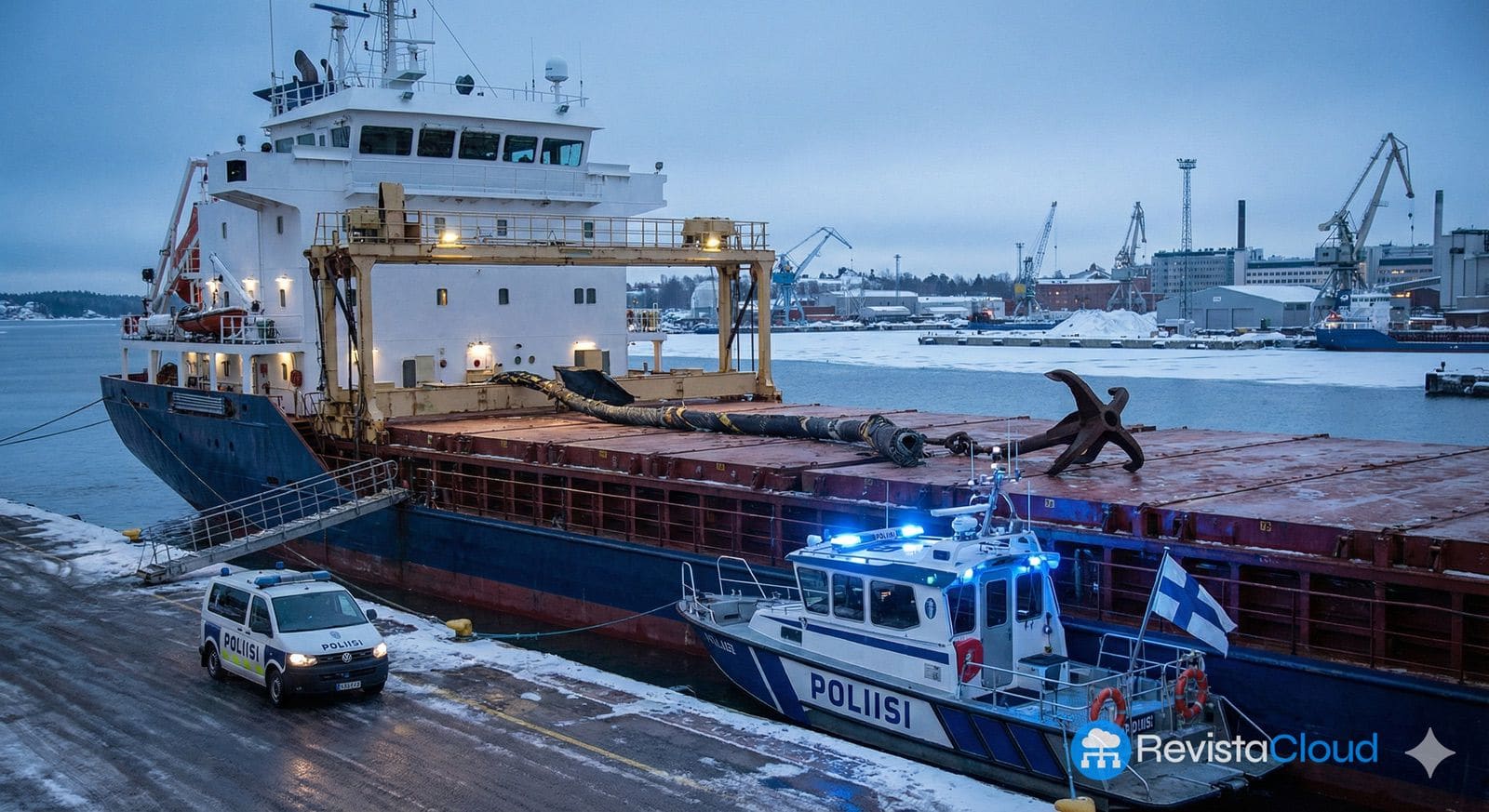
Finland has reactivated all its critical infrastructure protection protocols after a failure was detected in a submarine telecommunications cable connecting Helsinki with Tallinn, a strategic route beneath the Gulf of Finland. Authorities intervened with a suspicious cargo ship, the Fitburg, and opened a criminal investigation for and Aggravated Interference with Telecommunications, in a regional context marked by sensitivity to potential “hybrid warfare” episodes in the Baltic Sea.
A “Silent” but Essential Cable for Daily Life
Submarine cables often go unnoticed until they fail. But their role is hard to overstate: they are the physical highway through which data and digital services travel, supporting the real economy, from corporate communications to connectivity services for operators. In this case, the affected cable belongs to Elisa, one of Finland’s leading operators, and is considered critical infrastructure.
According to details released by authorities and local media, the incident was detected when the operator identified a fault in the underwater segment between the Finnish and Estonian capitals. A rapid response was activated: patrol boats and aerial support located the suspicious vessel in the area, and it was observed that its anchor or anchor chain was in the water, a significant clue in these types of failures, since prolonged dragging can damage cables on the seabed.
The Fitburg, Under Control with a Criminal Investigation Ongoing
Finnish authorities inspected and took control of the Fitburg, a cargo ship registered under Saint Vincent and the Grenadines. The vessel, according to published information, was on a route from St. Petersburg (Russia) to Haifa (Israel) when the incident occurred.
The police focus at this stage remains on verifiable facts: what happened, how it happened, and who made operational decisions onboard. Meanwhile, there have been arrests for questioning: Finnish police have detained two crew members; additionally, some sources citing local authorities have indicated that the entire crew (14 people) has been held as part of the investigation. Such discrepancies are common when some individuals are formally suspected and others are under custody or control measures while facts and responsibilities are clarified.
National Commissioner Ilkka Koskimäki, quoted by the press, stressed that no speculation will be made regarding whether the damage was carried out “on behalf of another state” until conclusive results are available. It is a brief but highly significant phrase in an environment where each incident is interpreted in geopolitical terms.
Did Users Experience Impact? The Network Redirects… but the Risk Remains
Publicly, authorities indicated that services were not interrupted because traffic was able to be rerouted. This highlights the paradox of modern connectivity: networks are designed to withstand localized failures, but each incident makes clear that there is a physical vulnerable point beneath the sea. Redundancy saves the service “today,” but patterns of events increase costs, operational tension, and long-term surveillance needs.
Another complicating factor is that Estonian authorities reported that another cable—attributed to the Swedish operator Arelion—also suffered damage around the same time, though it is unclear if both incidents are directly related.
Why the Baltic Sea Has Become a “Critical Infrastructure” Battleground
The Baltic Sea hosts busy maritime routes and a dense network of cables and pipelines linking Nordic and Baltic countries to the rest of Europe. After Russia’s invasion of Ukraine in 2022, heightened scrutiny has fallen on incidents that, while technically “accidental” in some cases, fuel fears of below-threshold tactics: pressure, wear, ambiguity, and plausible deniability.
This context led to the deployment of specialized surveillance and deterrence measures. NATO launched the Baltic Sentry operation to strengthen protection and monitor threats against submarine infrastructure, with some analyses describing the Fitburg case as the first vessel seized since this effort began, specifically because the goal is to respond quickly to signals of anomalies (such as anchor dragging in sensitive areas).
Moreover, the investigation has recent precedents: Finland previously acted against a petroleum tanker linked to Russia (the Eagle S case) for cable damage, and Moscow has denied involvement in such episodes. This historical pattern makes each new incident more than just a technical issue—it becomes a matter of broader concern.
What Is Really Being Investigated: From “Damage” to “Operation Mode”
Technically, investigators typically focus on very specific scenarios:
- Vessel trajectory and its correlation with the exact damage site.
- Condition and use of mooring system (anchor/chain) and dragging durations.
- Nautical, communication, and operational decision records onboard.
- Weather conditions and maritime traffic in the area.
- Possible evasive maneuvers or abnormal behavior after detecting the fault.
In other words, rather than immediate narratives, the goal is to find an operational trail that fits with the cable rupture. In this case, Finnish police are investigating under serious criminal categories, indicating a process with high evidentiary requirements and international cooperation (at least with Estonia, given the damage occurred within its exclusive economic zone).
The Political Message: “We Are Ready”
Finnish President Alexander Stubb used the episode to emphasize that Finland is prepared for “various security challenges” and will respond as the situation demands. It is a message meant to convey calm—and capability—but also serve as a deterrent: any threat to critical infrastructure will be met with immediate response.
Frequently Asked Questions
How can an anchor damage a submarine communications cable?
If a vessel navigates with its anchor or chain deployed and drags along the seabed, it can hook or press against the cable, causing cuts, crushing, or displacement that result in signal failure.
Why is a cable between Helsinki and Tallinn so important for connectivity?
Because it connects capital cities and key digital exchange routes in a region with high densities of submarine infrastructure. Although there are alternative routes, damage increases risks and costs and decreases available redundancy.
Does this confirm sabotage or could it be an accident?
For now, it’s prudent to speak of presumed responsibility by the vessel and ongoing criminal investigation. Cables can be damaged accidentally (anchors, fishing, construction), but investigations aim to determine the “how” and “why.”
What measures are being reinforced in the Baltic Sea to protect submarine cables?
Patrols, monitoring, and international cooperation have been intensified. NATO has advanced a specific approach (Baltic Sentry) to deter and respond swiftly to suspicious incidents against submarine infrastructure.
source: cybersecuritynews. AI-generated image.