
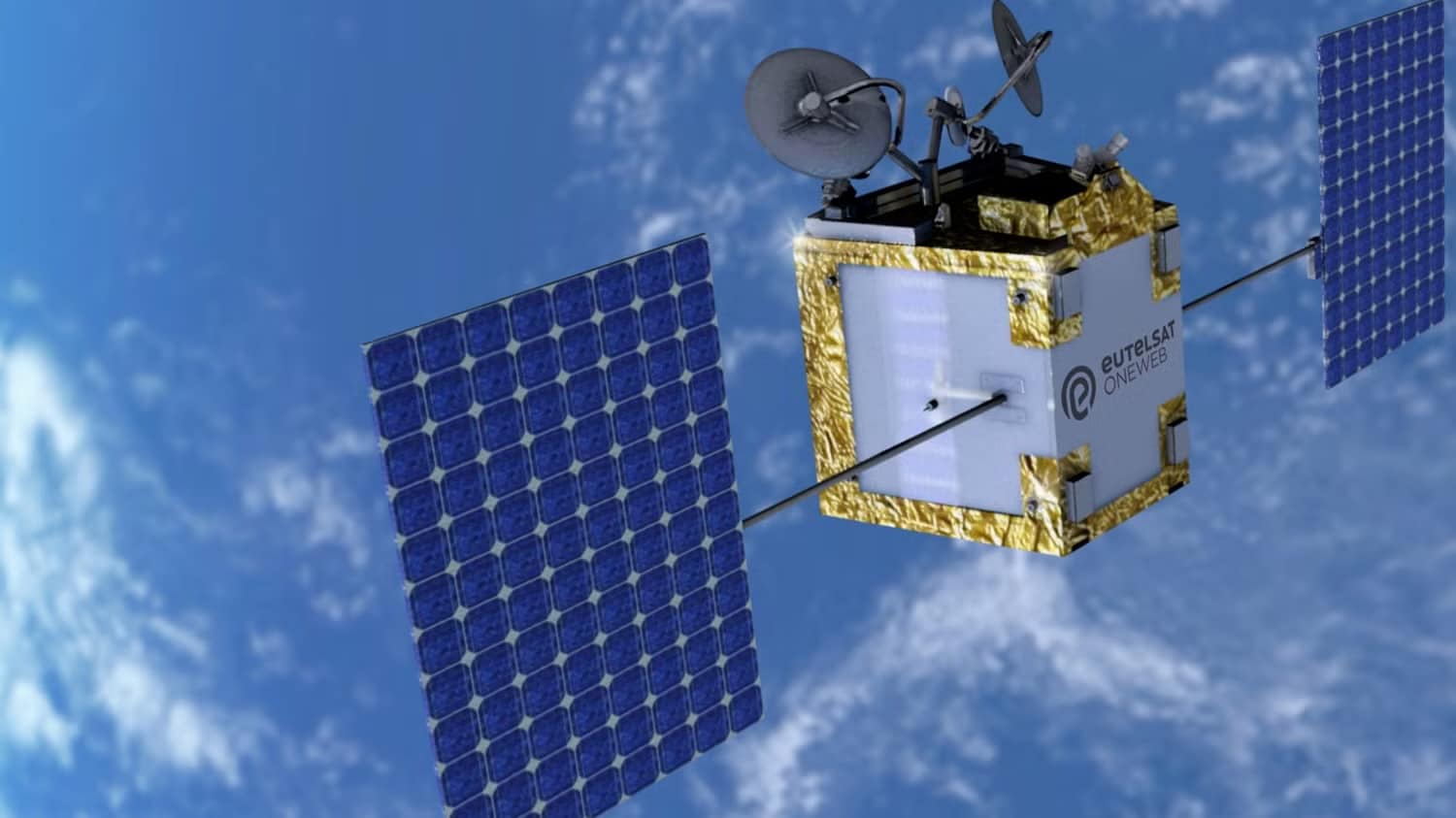
Eutelsat expects IRIS², the European satellite constellation with which the European Union wants its own alternative to Starlink, to generate more than €10 billion in revenue between 2032 and 2040. Its CEO, Jean-François Fallacher, reiterated this to investors on October 29, 2026, while presenting first-quarter results for its 2026-27 fiscal year, in which the low-earth-orbit (LEO) business grew 30%.
Eutelsat and IRIS² in 30 seconds
- Eutelsat expects more than €10 billion in IRIS²-linked revenue between 2032 and 2040.
- It will invest around €3.4 billion between 2027 and 2034 and has ordered 330 low-earth-orbit satellites.
- The first satellites will launch starting in 2029, and the commercial constellation should be complete by around 2032.
- In the fiscal first quarter it booked €286 million in revenue (down 2.4%), and its LEO business grew 30%.
IRIS² (Infrastructure for Resilience, Interconnectivity and Security by Satellite) is the program through which the EU wants secure, homegrown satellite communications for governments, armed forces, and critical-infrastructure operators, in a market dominated today by SpaceX’s Starlink. It’s being developed by the SpaceRISE consortium, made up of Eutelsat, SES, and Hispasat, with a budget put at around €10.6 billion. Eutelsat leads the low-earth-orbit segment, where it brings OneWeb’s expertise, building on the sovereign alternative to Starlink that CloudNews covered when IRIS² moved into deployment.
€3.4 Billion in Investment and 330 Satellites
In August, after clearing the program’s first review, Eutelsat detailed its commitment, as reported by AFP via Boursorama and ABC Bourse: it will invest €3.39 billion between 2027 and 2034, of which €2.23 billion will go to the program’s shared infrastructure and €1.16 billion to commercial capacity, such as Ku-band payload and the ground segment. Its share of IRIS² includes 264 dual-band (military Ka and Ku) satellites and another 66 military-Ka-only satellites, 330 in total, with an architecture of inclined orbits, steered-beam antennas, compatibility with non-terrestrial 5G networks, and optical inter-satellite links.
The first Ka-band satellites will launch starting in 2029, and the commercial Ku-band constellation should be fully operational by mid-2032. In the meantime, Eutelsat is extending OneWeb’s life through 2034 with 229 additional satellites, on top of the 440 second-generation satellites already ordered, for around €1 billion. Fallacher summed up the moment at the time: “We are now moving from the planning phase to the execution phase.”
What the First-Quarter Results Show
According to Eutelsat’s earnings release, revenue for the quarter ended September 30 was €286 million, down 2.4% year over year (down 0.9% on a like-for-like basis). The LEO business grew 30.1% and, according to SatNews, reached €70.9 million, which drove 11.9% growth in connectivity. By contrast, video — the traditional geostationary satellite business — fell around 18%, to roughly €110 million, according to Via Satellite.
IRIS² already shows up in the accounts: the order backlog includes €8.9 billion in future revenue tied to building the program, and the company recognized €5 million of that in the quarter, a figure it expects to grow significantly over the rest of the fiscal year. Eutelsat confirms all of its financial targets, and Fallacher expects LEO growth to offset the decline in the geostationary business this year.
A Starlink Alternative That Won’t Be Complete Until 2032
Timing is IRIS²’s biggest challenge. Starlink already has thousands of satellites in service, while the European constellation won’t be complete for another six years. Eutelsat itself has acknowledged that the system will need to offer competitive pricing and performance to win customers, a concern shared by carriers such as Orange and Deutsche Telekom. The €10 billion forecast is, therefore, a long-term company target, not committed revenue.
The debate over European technological sovereignty goes beyond space. In Spain, CloudNews reported that Telefónica and Indra are weighing a sovereign cloud for public administrations and critical infrastructure, a customer profile very similar to the one IRIS² wants to serve from space.
Frequently Asked Questions
What is IRIS²?
The European Union’s satellite constellation for secure, homegrown communications for governments, armed forces, and critical infrastructure, as a European alternative to services like Starlink.
How much does Eutelsat expect to earn from IRIS²?
More than €10 billion between 2032 and 2040, according to the company. It’s a long-term target, not committed revenue.
When will IRIS² be operational?
The first satellites will launch starting in 2029, and the commercial low-earth-orbit constellation should be complete by mid-2032.
How much is Eutelsat investing in IRIS²?
About €3.39 billion between 2027 and 2034, for 330 low-earth-orbit satellites and the associated commercial infrastructure.
Sources:
- Eutelsat: First Quarter 2026-27 Revenues
- Via Satellite: Eutelsat Sets €10B Target for OneWeb Revenue from 2032 to 2040
- SatNews: Eutelsat Q1 LEO Revenue Rises 30% to €70.9M
- Boursorama (AFP): Iris², Eutelsat investira 3,4 milliards d’euros
- ABC Bourse: Eutelsat engage 3,4 milliards d’euros dans IRIS²
- Sharecast (Hargreaves Lansdown): Eutelsat reports near 60pc surge in LEO revenue
