
For years, business productivity has been dominated by two major platforms: Microsoft 365 and Google Workspace. Documents, spreadsheets, presentations, email, storage, calendar, video calls, and real-time collaboration have become centered within closed ecosystems—very user-friendly but difficult to replace when an organization desires more control over its data, providers, or technological architecture.
In Europe, this dependency is beginning to be seen as more than just a software issue. It impacts digital sovereignty, auditability, regulatory compliance, data localization, and the true freedom to switch providers without overhauling half the organization. Against this backdrop, Euro-Office emerges—a European open-source initiative aiming to provide a collaborative alternative to Microsoft Office and Google Docs, with a first public release scheduled for June 9, 2026.
The proposal is accompanied by another nearby movement: Office EU, a European productivity suite based on open technologies, hosted on European infrastructure, and aimed at companies, public administrations, and teams that want to work with email, files, documents, and video calls without being completely tied to U.S. platforms.
A European suite for documents, spreadsheets, and presentations
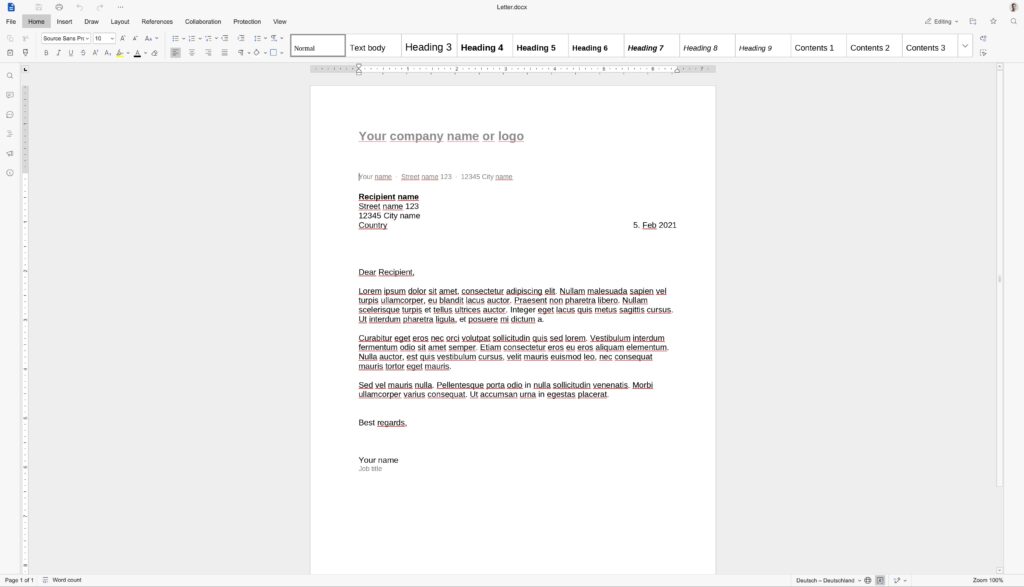
Euro-Office is not designed as a traditional desktop application. Its approach is that of a collaborative web editor that can be integrated into other European storage, document management, wikis, project environments, or corporate workspaces. The idea is that users can open, edit, and share documents, spreadsheets, presentations, and PDFs directly within the environment where they already manage their files.
The project promises compatibility with widely used formats like DOCX, XLSX, and PPTX, as well as open formats such as ODT, ODS, and ODP. This is crucial. The biggest barrier to switching office suites is rarely creating a simple document, but correctly opening years of legacy files, maintaining templates, preserving formatting, working with complex sheets, and reducing user resistance accustomed to the Microsoft Office interface.
To facilitate this transition, Euro-Office favors a familiar interface, with a ribbon menu design similar to what Microsoft popularized years ago. It may seem like a minor detail, but in corporate deployments, the cost of change isn’t just about licensing. It also involves training, internal issues, user resistance, and productivity loss during migration.
Key players behind the initiative include prominent figures in the European open-source software and cloud services ecosystem, such as IONOS, Nextcloud, EuroStack, XWiki, OpenProject, Soverin, Abilian, BTactic, Open-Xchange, and Office.eu. The composition reflects the project’s broader intent: not just building a word processor, but creating a piece of a broader European workspace ecosystem.
Office EU versus Microsoft 365 and Google Workspace
Office EU presents itself as a European productivity suite with email, storage, documents, calendar, contacts, communication, and video calls. Its core ideas are European hosting, open technologies, and reduced exposure to non-European jurisdictions. Comparatively, Office EU does not deny the maturity of Microsoft 365 or Google Workspace but aims to position itself as an alternative for European teams prioritizing control, transparency, and operational simplicity.
Microsoft 365 remains the de facto standard in many companies, thanks to its compatibility with Office, integration with Teams, OneDrive, SharePoint, Exchange, Entra ID, and the entire Microsoft enterprise ecosystem. Google Workspace, on the other hand, offers a very smooth cloud experience, especially powerful for organizations accustomed to native browser work using Gmail, Drive, Docs, Meet, and Calendar.
The question is whether all organizations need that level of integration, or if some can benefit more from adopting a simpler, auditable environment hosted under European control. For public administrations, universities, regulated SMEs, professional firms, NGOs, or data-conscious companies, this distinction can be significant.
| Criterion | Office EU / Euro-Office | Microsoft 365 | Google Workspace |
|---|---|---|---|
| Main focus | European productivity, digital sovereignty, open technologies | Global enterprise suite with deep corporate integration | Native cloud suite focused on collaboration and simplicity |
| Provider origin | European | United States | United States |
| Data hosting | Focus on European infrastructure | Global infrastructure with regional options | Global infrastructure with management and compliance options |
| Open source | Euro-Office is presented as open source; Office EU leverages open technologies | Proprietary | Proprietary |
| Collaborative documents | Integrated web-based collaboration within participating platforms | Word, Excel, and PowerPoint online and desktop | Google Docs, Sheets, and Slides native in browser |
| Office compatibility | Supported formats: DOCX, XLSX, PPTX (announced) | Industry reference for these formats | Good import/export, works best with Google formats |
| Open formats | Supports ODT, ODS, ODP | Available, but not the dominant use | Supported via import/export |
| Email and calendar | Included in Office EU | Exchange / Outlook | Gmail / Calendar |
| Video calls | Included in Office EU | Teams | Google Meet |
| Best suited for | Public sector, education, European SMEs, data-sensitive organizations | Large companies with a consolidated Microsoft ecosystem | Cloud-first teams and Google-using organizations |
| Main challenges | Maturity, adoption, support, and compatibility with complex documents | Vendor dependency, licensing complexity | Vendor dependency, less control over the environment |
Digital sovereignty is played out in everyday tools
The debate around digital sovereignty often focuses on the cloud, data centers, artificial intelligence, or cybersecurity. However, a significant part of technological dependence lies in much more everyday tools: email, documents, calendars, shared storage, and video calls.
These tools handle vast amounts of sensitive information—contracts, files, financial sheets, HR documents, minutes, internal reports, client communications, health data, R&D projects, or public documentation—every day. For this reason, governments, universities, and regulated sectors are increasingly paying closer attention to these platforms.
Europe isn’t starting from zero. Established projects like Nextcloud, Collabora Online, LibreOffice, Open-Xchange, XWiki, and OpenProject have been offering parts of the open workspace ecosystem for years. The difference now is that the message is grouped under a more market-friendly concept: a European alternative to Microsoft 365 and Google Workspace.
The key will be turning this collection of components into a coherent experience. Organizations don’t just buy software; they buy a way of working. For a European suite to truly compete, it must excel in collaborative editing, permission control, search, centralized administration, mobility, security, migrations, support, and integration with corporate identities.
A promising alternative with clear challenges
Euro-Office and Office EU arrive at a favorable moment but face significant hurdles. Microsoft and Google don’t dominate the market just out of inertia. Their platforms work well, are integrated into millions of business processes, and boast vast ecosystems of partners, training, support, and connected applications.
Compatibility will be a decisive test. A simple document rarely causes issues, but a spreadsheet with advanced formulas, macros, charts, external connections, or complex formatting can complicate migrations. The same applies to corporate templates, approval workflows, inherited permissions, or automations built over years around Microsoft 365 or Google Workspace.
Additionally, project governance must be carefully managed. In open-source initiatives, transparency isn’t just a reputation factor; it’s integral to the product. Licenses, attribution, community involvement, code security, maintenance, and decision-making processes will all be critical if Euro-Office aims to earn the trust of governments and regulated businesses.
The scheduled launch on June 9 should not be seen as an immediate replacement for U.S. giants. More realistically, it marks the beginning of an alternative that can grow in specific use cases: organizations with a strong focus on sovereignty, educational environments, public administrations, teams working with open formats, or companies seeking dependency reduction without sacrificing browser-based collaboration.
Europe’s advantage won’t be in copying every feature of Microsoft 365 or Google Workspace but in offering a sufficiently good alternative—more controllable and aligned with European regulatory requirements. If Euro-Office and Office EU succeed in combining usability, support, and technical trust, they can carve out a space that has been poorly served so far: the European digital office with a genuine independence goal.
Frequently Asked Questions
What is Euro-Office?
Euro-Office is a European open-source initiative for collaborative editing of documents, spreadsheets, presentations, and PDFs. It is designed as an integrated web editor to be embedded within other platforms, not as a standalone application.
What is Office EU?
Office EU is a European productivity suite combining documents, email, storage, calendar, contacts, communication, and video calls. Its focus is on European hosting, privacy, and data control.
Can Euro-Office replace Microsoft 365?
It could be an alternative for organizations prioritizing digital sovereignty, open formats, and infrastructure control. However, Microsoft 365 currently holds a clear edge in maturity, advanced compatibility, and enterprise ecosystem support.
What differentiates Office EU from Google Workspace?
Google Workspace stands out for its seamless, mature cloud experience. Office EU aims to offer a more controllable alternative for European teams that prefer hosting in Europe, open technologies, and reduced dependency on U.S. providers.
