
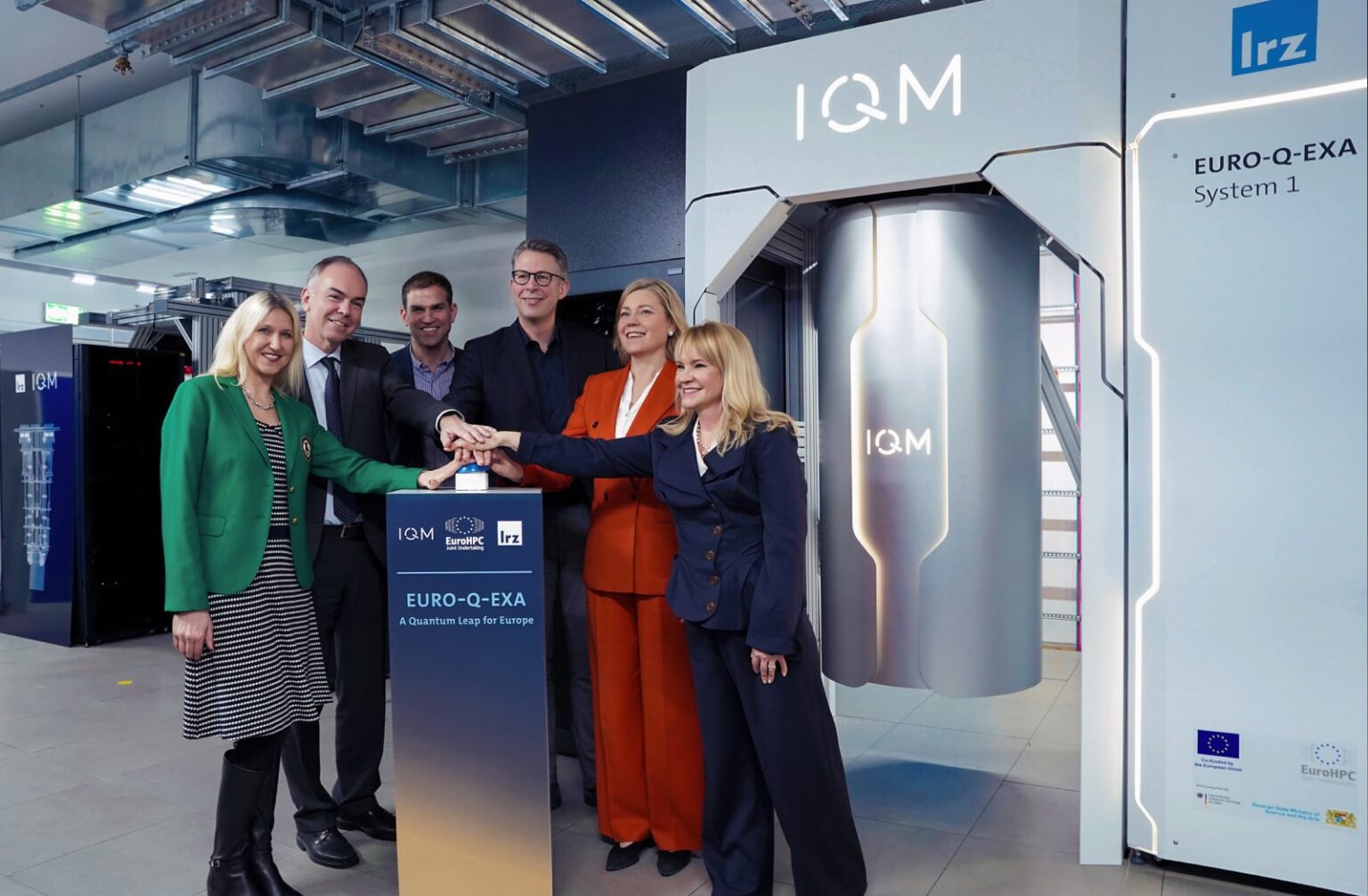
Europe has just taken a visible — and measurable — step in its strategy for technological sovereignty: Euro-Q-Exa, the first quantum computer from the EuroHPC Joint Undertaking program deployed in Germany, is now operational at the Leibniz Supercomputing Centre (LRZ) in Garching, near Munich. The facility is not merely a “lab showroom.” According to the involved entities, the goal is to integrate quantum computing into the core of the European supercomputing (HPC) ecosystem, with local control, qualified personnel, and the capacity to evolve the infrastructure within the continent.
The initial system is based on the Radiance platform from IQM Quantum Computers and starts with 54 superconducting qubits. The roadmap anticipates a significant expansion: a second system with 150 qubits before the end of 2026, increasing operational capacity and providing room to experiment with hybrid quantum-classical cases that, in theory, are where the first practical value is expected to emerge.
It’s not “cloud access”: it’s operating the machine, learning, and retaining knowledge
The key difference of Euro-Q-Exa, as presented, lies in the deployment model. Instead of merely offering remote access to a black box, the infrastructure is installed, hosted, and operated at LRZ, which compels — and simultaneously enables — the development of internal expertise: daily operation, maintenance, system evolution, and talent training in a real scientific production environment.
This “operational ownership” has become a sovereignty argument. IQM CEO Jan Goetz summed it up with a compelling idea: countries that “own” open quantum infrastructure, not just cloud access, will lead. Meanwhile, the European Commission emphasizes that, with an embryonic quantum market, the window to build own capabilities is now, not when technology matures and the landscape is divided.
A quantum computer connected to the SuperMUC-NG supercomputer
Euro-Q-Exa integrates into LRZ’s HPC environment and, according to EuroHPC, will be coupled to the SuperMUC-NG supercomputer, a detail that signals the project’s orientation: hybrid quantum-classical workflows in a center already operating infrastructure at national and European scales. Practically, this means researchers can design and test workflows where the classical part (HPC) prepares data, simulates, optimizes, or validates, while the quantum component is explored for specific subroutines.
The cited use cases focus on intensive computational research areas: climate modeling, computational pharmacology, or research into . Quantum is not promoted as a “replacement” for HPC; the narrative is more pragmatic: allowing quantum to mature within a supercomputing operational environment where performance, reproducibility, and practical value can be measured.
Funding and political dimension: 25 million euros and a message to industry
The deployment also carries budgetary and political implications. The European Commission states that the system is owned by EuroHPC, with a cost of 25 million euros, of which 10 million is contributed by EuroHPC, with the rest financed by German and Bavarian public authorities. The announcement highlights co-financing from the German Federal Ministry of Research, Technology, and Space (BMFTR) and the Bavarian Ministry of Science and Arts (StWK).
Institutional statements repeat the message: quantum capacity “in Europe, for Europe.” European Commission Vice-President for Technological Sovereignty, Henna Virkkunen, argued that the bloc has already co-funded the first European quantum systems and highlighted that this is beginning to be “an operational reality,” not a distant promise. From Bavaria, Minister Markus Blume linked Euro-Q-Exa to a broader goal: combining quantum computing, supercomputing, and artificial intelligence to enhance computational power available for research and industry.
A cog in a continental plan: six European centers with quantum systems
Euro-Q-Exa is not an isolated case. It is part of EuroHPC’s plan to deploy six quantum computers across some of Europe’s most advanced supercomputing centers. In addition to Germany, the program includes facilities in Czech Republic, France, Italy, Poland, and Spain, with the aim of creating a shared infrastructure and knowledge base, and preventing European quantum capabilities from relying solely on external providers and platforms.
For LRZ, with over 60 years of operating digital infrastructure for diverse scientific communities, Euro-Q-Exa is a natural step: integrating an emerging technology without disrupting the service model for users, support, and scaling. Its board president, Dieter Kranzlmüller, stressed the idea of “combining strengths” between quantum and supercomputing to open new avenues for research with European technology.
What changes from now on: from inauguration to routine
Beyond the inaugural event, the key question for the technical community is what happens when the novelty becomes routine. The timeline anticipates an accelerated learning phase during 2026: integrating tools, standardizing workflows, training personnel, and most importantly, validating which parts of scientific work benefit from the hybrid approach.
The expansion to 150 qubits before the end of 2026 creates both pressure and opportunity: more qubits alone do not guarantee practical advantage, but they open a larger space for experimentation by teams aiming to develop algorithms, pipelines, and methodologies that can survive hardware evolution. This is, in essence, the sovereignty argument repeated in all communications: it’s not just about “having a machine,” but about building cumulative capacity — operational, scientific, and industrial — that remains in Europe.
Frequently Asked Questions (FAQ)
What is Euro-Q-Exa and where is the quantum computer installed in Germany?
Euro-Q-Exa is a quantum system from the EuroHPC program installed at the Leibniz Supercomputing Centre (LRZ) in Garching, near Munich, Germany.
How many qubits does Euro-Q-Exa have, and when will it expand to 150 qubits?
The initial system operates with 54 superconducting qubits and is planned to be complemented by a 150-qubit system before the end of 2026.
What does it mean to integrate a quantum computer with a supercomputer like SuperMUC-NG?
It involves enabling hybrid quantum-classical workflows: using HPC for data preparation, simulation, and validation, while exploring quantum for specific routines within the same operational environment.
How much did Euro-Q-Exa cost, and who funds it?
The European Commission estimates the cost at 25 million euros, with 10 million contributed by EuroHPC and the rest financed by German and Bavarian public authorities, along with the institutional co-financing mentioned earlier.
via: meetiqm