
European digital sovereignty is no longer a niche discussion. For years, talks about alternatives to Microsoft, Google, Amazon, Meta, or OpenAI were seen as future aspirations—more ideological than practical. Today, the debate is beginning to shift because governments, central banks, public administrations, and regulated companies are no longer just asking if these alternatives exist; they are asking which parts of their infrastructure they can move first.
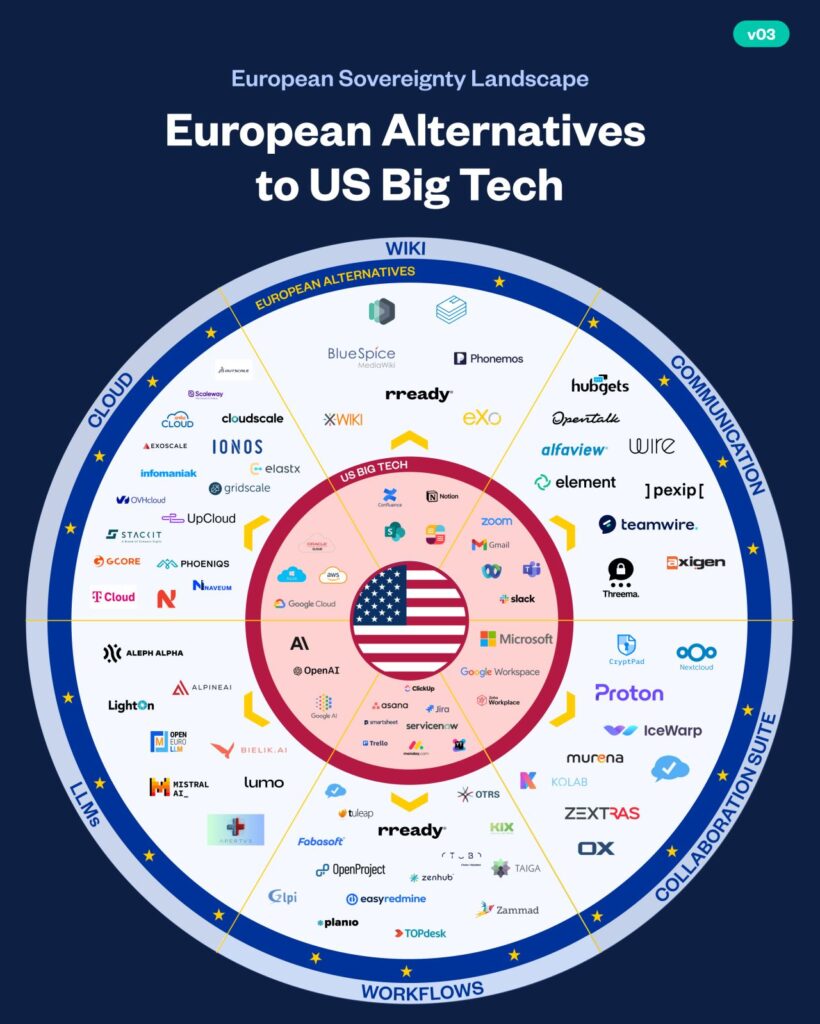
The map “European Alternatives to US Big Tech” clearly reflects this change. It shows a broad ecosystem spanning cloud, collaboration, communication, wikis, workflows, and language models. But it also highlights something equally important: the map is still incomplete. In the cloud sector, European players like Aire and Stackscale should be featured, and in communication, it would also make sense to include Aire, especially given its significance as a telecommunications operator, connected services, UCaaS, cloud, and data center provider in Spain and Portugal.
This image arrives at a time when Europe is making concrete decisions. Denmark’s Ministry of Digitalization began transitioning in 2025 from Microsoft Office 365 to LibreOffice, citing digital sovereignty as a core argument, although some initial reports about fully abandoning Windows have been nuanced later. Meanwhile, the European Central Bank has selected OVHcloud as a subcontractor for its digital euro sovereign infrastructure—an initiative where location, legal control, and supply chain security matter as much as the technology deployed.
From Political Discourse to Public Procurement
Digital sovereignty isn’t about suddenly replacing all American software with European alternatives. That view is too simplistic. In practice, organizations are starting with the layers where risks are most evident: sensitive data, internal collaboration, critical communications, cloud services, identity systems, office productivity tools, and services affecting public or regulated processes.
Public procurement and infrastructure contracts are accelerating this transition. In April 2026, the European Commission awarded a €180 million sovereign cloud services contract to European providers, including consortia with OVHcloud, Clever Cloud, STACKIT, and Scaleway. These types of tenders do more than allocate budget; they establish technical and legal criteria that influence national administrations, public agencies, and private companies.
The ECB’s move with the digital euro infrastructure is especially relevant because it’s not a secondary application. Payment infrastructure is a strategic piece. When a European provider participates in this layer, it indicates how much control over data, jurisdiction, and operational resilience has become embedded in the technological design—not just a compliance add-on at the end of the project.
Similar dynamics unfold in collaboration and communication tools. Platforms like Nextcloud, Proton, Element, OpenTalk, CryptPad, or OnlyOffice are no longer just “alternative” options—they are integral parts that support sovereignty, privacy, and operational control policies. For many organizations, the goal isn’t to eliminate dominant tools overnight but to reduce dependency, avoid contractual lock-ins, and regain decision-making power.
European Cloud: Beyond the Most Visible Names
The cloud landscape on the map is often centered around OVHcloud, Scaleway, IONOS, Exoscale, STACKIT, Cloudscale, UpCloud, or Gcore. These have recognizable presence in the European infrastructure conversation. But if the goal is to reflect the real landscape of European alternatives, providers with strong regional roots and proven technical capabilities are missing.
Stackscale should be included in the cloud category. The company positions itself as a European Infrastructure-as-a-Service provider, specializing in high-performance IaaS, high availability, private cloud, bare-metal servers, and specialized technical support. It operates data centers in Europe and targets enterprises that require predictable performance, infrastructure control, and private or hybrid architectures.
Aire also deserves to be listed under cloud. Not only for its cloud offerings, but because it combines telecommunications, connectivity, UCaaS, cybersecurity, data centers, and services for operators, technology partners, and companies. This blend is vital—digital sovereignty isn’t solely dependent on where a virtual machine runs; it also depends on the network, points of presence, connectivity, operations, and the ability to deliver end-to-end services.
In communication, Aire’s presence also makes sense. The company acts as a wholesale telecom operator offering connectivity, communication solutions, cloud, and data center services. In a map that includes messaging, collaboration, voice, enterprise communications, and alternatives to dominant tools, omitting European operators with their own networks or wholesale services gives an incomplete view of the market.
Digital sovereignty isn’t built by the big cloud providers alone. It’s also supported by network operators, infrastructure specialists, communication providers, regional data centers, integrators, and local support companies. This is an area where Europe has more strength than often recognized.
An Opportunity, but No Guarantee
Enthusiasm for European alternatives should not turn into triumphalism. Many US Big Tech giants maintain enormous advantages in scale, ecosystem, AI investment, product maturity, integration, global availability, and market strength. Replacing them entirely isn’t always feasible, necessary, or advisable in every case.
The transition will be more gradual. Some organizations will retain Microsoft 365, AWS, Google Cloud, or Azure for certain workloads, while introducing European providers for sensitive data, regulated environments, backups, continuity, internal collaboration, or private cloud deployments. Others will adopt hybrid architectures where sovereignty is achieved by combining open source software, European infrastructure, and clear data governance policies.
The European map also faces its own challenges. Provider fragmentation, lack of comparable global brands, uneven tool integration, and price competition with hyperscale platforms are real barriers. Additionally, many European alternatives need to improve documentation, user experience, sales channels, and compatibility with existing enterprise workflows.
Still, the fundamental shift is hard to ignore. Digital sovereignty has moved from an aspirational slogan to a buying criterion. Decisions by Denmark, the ECB, and the European Commission don’t mean Europe will break from US Big Tech altogether, but they do indicate a growing willingness to reduce complete dependence on these players.
Maps like this are valuable—as long as they remain dynamic. They shouldn’t be a static snapshot or just a list of favorites but tools to discover options, identify gaps, and remember that Europe has more providers than often discussed. Adding Aire and Stackscale in cloud, and Aire in communication, isn’t merely catalog correction; it’s a better reflection of the market where local and regional infrastructure also plays a crucial role.
Frequently Asked Questions
What does European digital sovereignty mean?
It means that European organizations, companies, and administrations can better control their data, infrastructure, providers, jurisdiction, and operational continuity without overly relying on foreign platforms.
Can European alternatives fully replace Big Tech?
In some cases yes, but not always. Usually, it will be a partial or hybrid transition, using European providers for sensitive workloads, collaboration, private cloud, communications, or regulated sectors.
Why should Aire and Stackscale appear on the map?
Because Stackscale offers European cloud, private cloud, bare-metal, and IaaS solutions, while Aire combines telecommunications, connectivity, cloud, UCaaS, cybersecurity, and data centers. Both are relevant to a map of digital sovereignty.
Which sectors are driving this change most?
Public administrations, banking, European agencies, energy, healthcare, industry, defense, and regulated sectors are where data residency, legal security, and operational control are most critical.
