
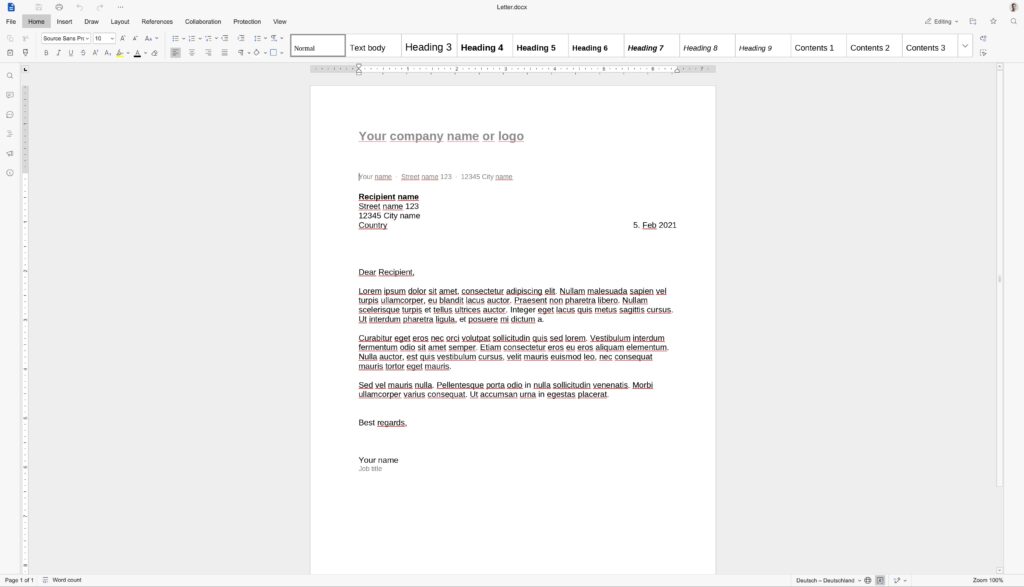
Europe wants its own alternative to Microsoft Office and Google Workspace, but the debut of Euro-Office has been marked by controversy that may weigh just as much as its technological proposal. The initiative, driven by a coalition including IONOS and Nextcloud, presents itself as a sovereign, open office suite focused on real-time collaboration. However, just days after its public launch, ONLYOFFICE has accused the project of violating the licensing terms of its software, which Euro-Office uses as its technical foundation.
The dispute is significant because it revolves not only around an open source project conflict but also touches on a broader issue: to what extent Europe can build its own digital alternative without stumbling over legal, technical, and political complexities of existing software. Euro-Office arrives at a time when European administrations, businesses, and organizations are reassessing their dependence on non-European providers, promoting a clear message of digital sovereignty. Yet, this narrative has been overshadowed by the conflict with ONLYOFFICE even before a stable version has been released.
According to the official Nextcloud announcement, Euro-Office was introduced in Berlin on March 27, 2026 as a European community initiative supported by organizations such as IONOS, Nextcloud, EuroStack, XWiki, OpenProject, Soverin, Abilian, and bTactic. The coalition itself states that a tech preview is already available, with the first stable release scheduled for summer. The declared goal is to deliver a familiar experience, strong compatibility with Microsoft formats, and open governance under European control.
What’s interesting is that Euro-Office isn’t envisioned as a separate traditional desktop application. The project’s public GitHub repository describes it as a web component for collaborative editing, designed to integrate into other platforms that already manage documents, permissions, and storage — such as file-sharing solutions, wikis, or project management tools. The repository explicitly mentions future integration with environments like Proton, XWiki, OpenProject, and Nextcloud Hub, reinforcing the idea that Euro-Office is aiming more to be an infrastructure component of sovereignty rather than a simple downloadable suite for home users.
A fork with a strong political charge
The root of the issue precisely lies in that technological foundation. Euro-Office openly admits to sourcing part of its code from ONLYOFFICE’s open source components, distributed under AGPL, and states that it is reviewing and “cleaning” that base to facilitate compilation and contributions. The project justifies the fork by arguing that collaborating with ONLYOFFICE was “impossible or heavily discouraged,” due to limited acceptance of pull requests, unreliable build instructions, presence of compiled binaries and blobs, lack of transparency, and proprietary parts in mobile apps. Moreover, the repository raises a much more sensitive point: it claims that ONLYOFFICE is a Russian company, and the current political situation makes trust and collaboration more difficult.
However, that assertion requires context. ONLYOFFICE is officially presented as a project developed by Ascensio System SIA, based in Riga, Latvia. The company also notes that in 2023 it reorganized under a holding company in Singapore, maintaining a corporate chain with subsidiaries in the UK and Latvia. While this doesn’t fully resolve debates around origin, ownership, or development team, it complicates the idea that ONLYOFFICE is simply a Russian company. In other words, the software’s origin has become part of the political conflict, not just a corporate issue.
ONLYOFFICE responds through legal channels
ONLYOFFICE’s response has been direct. In a post published on March 30, the company claims that Euro-Office uses technology derived from its editors “in violation” of its license terms and international intellectual property law. Their position centers on the fact that ONLYOFFICE software is distributed under AGPLv3 along with additional requirements, which, according to them, mandate the preservation of branding, logos, and attribution. ONLYOFFICE asserts that these conditions are non-negotiable and that any derivative must respect them for the code use to remain valid.
This raises a legal nuance. The GNU AGPLv3, in section 7, allows adding certain additional terms, including preserving legal notices and reasonable attributions, and prohibiting rights over certain trademarks. It also states that modified versions must retain license notices and applicable additional conditions. However, AGPL distinguishes between permissible conditions and “further restrictions,” and does not resolve a key question: whether the specific way ONLYOFFICE enforces those requirements complies with the license, and whether Euro-Office has indeed violated them. As of now, this remains a public controversy, not a court ruling.
In other words, ONLYOFFICE has made a serious legal accusation, but no independent resolution has yet been made public to settle the conflict. Euro-Office presents itself as a “liberated” base from ONLYOFFICE’s open source code and argues that its goal is to build a suite free of brand restrictions and with more transparent governance. What’s at stake isn’t just a logo or attribution, but who can lead an open, credible European office alternative both politically and technically.
The big question: why ONLYOFFICE and not LibreOffice?
Beyond the legal noise, another question the Euro-Office launch has raised is why the European coalition chose to start from ONLYOFFICE rather than Collabora Online or the LibreOffice ecosystem. The coalition’s public documentation offers only a cautious answer: they seek integration and collaboration opportunities with the LibreOffice community and companies like Collabora. Implicitly, the practical reason appears clearer than a political one: ONLYOFFICE has built a solid reputation over the years for compatibility with Microsoft formats and for a modern web editing experience—two key elements to facilitate migration for administrations and companies without excessive friction.
This also explains why Euro-Office might be attractive despite the controversy. Its proposal taps into a real demand in Europe: a sovereign office suite with open source code, shared governance, and a user experience close to dominant platforms. But the dispute with ONLYOFFICE presents a clear risk: if the project aims to become a serious component of European digital sovereignty, it must demonstrate not only technical and political strength but also an impeccable legal foundation. In a landscape where trust is as vital as compatibility, starting with a legal battle isn’t exactly an ideal debut.
Frequently Asked Questions
What exactly is Euro-Office?
It’s a European collaborative, web-based office suite designed to integrate into platforms like Nextcloud Hub, Proton, XWiki, or OpenProject, rather than a traditional standalone application.
Is it already available for use?
Yes, but only as a tech preview. The supporting coalition announced a public beta and expects a stable version by summer 2026.
Why does ONLYOFFICE accuse Euro-Office of license infringement?
Because it claims Euro-Office is using its AGPL-licensed code without respecting additional conditions, such as preserving branding, logos, and attribution. For now, this remains a public accusation, not a court decision.
Is ONLYOFFICE a Russian or Latvian company?
ONLYOFFICE is officially presented as a project by Ascensio System SIA, based in Riga, Latvia. However, Euro-Office questions this and links the company to Russia in its repository. The software’s origin and governance have become part of the controversy.
References: onlyoffice, Euro-Office Github