
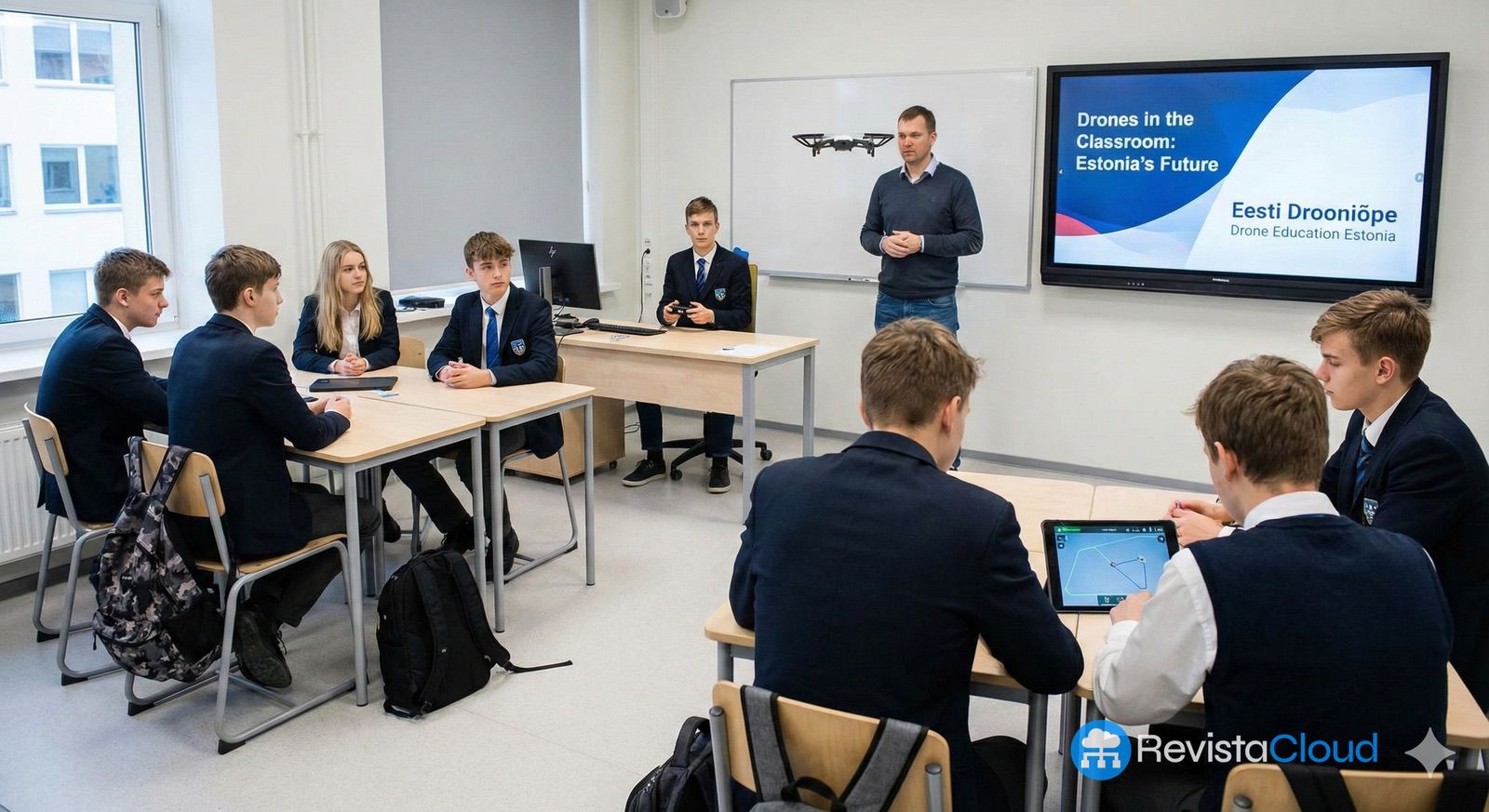
Estonia is once again leading the way in technology education and defense. The Baltic country has launched this fall a pilot program for 4th-year secondary school students / 11th grade (the tenth year in their system) to learn how to operate drones at school, within an elective course that combines simulation, theory, and real flight practices.
The initiative, developed by the Defence Resources Agency in collaboration with the Estonia Aviation Academy, is integrated into the existing mandatory defense training but with a clearly technical focus: the goal is not to train soldiers, but to prepare future specialists in unmanned systems in a controlled and safe environment.
An elective course with simulators, theory, and real flight
The new “drone technology” course is currently being offered at 10 high schools, with plans to expand to more schools if demand grows.
The course structure is well-defined:
- 35 hours of total training
- 25 hours of theory, covering basic principles of aerodynamics, legislation, air safety, drone components, civil and defense use cases, and responsible operation standards.
- 10 hours of practical training, initially in simulators and later with real flights, always under supervision and following strict safety protocols.
The program is designed so that students start in a virtual environment—where they can make mistakes without risk—and build confidence before operating outside. Upon completion, students are prepared to obtain the A1/A3 operator competency certification, the basic requirement for flying drones in many regulated environments.
Defense, industry, and talent: a strategic bet
Estonia has been a case study in digitalization, cybersecurity, and e-government for years. Now, it aims to apply that same approach to unmanned systems training, in a context where drones are already a key component in both civilian and military spheres.
“Getting young people familiar with unmanned systems early on is essential not only for national security but also for the development of Estonia’s defense industry,” said Rene Ehasalu, head of the Defence Estonia Cluster. According to him, local companies are developing top-tier capabilities in drones and need engineers and operators to enter the workforce with a solid foundation in these technologies.
The course is envisioned as an entry point: those who complete it successfully will be better positioned to pursue advanced studies in engineering, aviation, robotics, or defense technologies, or to join an expanding industrial sector.
It’s not military training—it’s technological literacy
One message the Estonian Ministry of Defense and the Estonia Aviation Academy want to emphasize is that this is not strictly military training.
The program:
- Is conducted during school hours, like any other elective.
- Uses drones in controlled environments with civil safety standards.
- Focuses on responsibility, regulations, and civilian and dual-use applications (rescue, logistics, inspections, precision agriculture, etc.).
The academy’s rector, Koit Kaskel, highlights that the course offers “basic knowledge and practical flight experience” that can be applied across multiple professional paths, from engineering to operating advanced systems in various sectors.
A drone ecosystem that looks beyond Estonia
Although Estonia is a small country, it has built a much larger defense and aerospace ecosystem than one might expect for its size. In the unmanned systems sector, companies like Milrem Robotics, Threod, KrattWorks, Jotel, and Lendurai develop everything from robotic ground platforms to aerial surveillance and reconnaissance solutions.
Many of these solutions are designed with interoperability in mind, for example integrating with tools used by allies such as the U.S. Army’s Tactical Awareness Kit (TAK). The goal is for Estonian systems to naturally fit into joint operations with European and transatlantic partners.
Estonia plans to allocate more than 5% of its GDP to defense by 2026, one of the highest figures within NATO. This budget effort aims not only at purchasing equipment but also at quickly developing and testing new technologies and deploying them to armed forces and security services. Training young people in drone use aligns with this vision: in a few years, having a generation that naturally understands how these systems work.
Education, resilience, and digital culture
The drone program in secondary schools reflects Estonia’s approach to national resilience. Defense education extends beyond military aspects: it incorporates technological skills, cybersecurity awareness, and hands-on abilities for acting in an environment where the line between civilian and military is increasingly blurred.
As a country pioneering online voting, digital identity for citizens, and e-residency, teaching teenagers to operate unmanned systems is a logical step: drones are now part of urban, rural, industrial, and security landscapes. Understanding their operation, regulation, and responsible use will be as crucial as understanding the Internet or social media.
What can the rest of Europe learn?
While many education systems are still debating whether to include robotics or basic programming, Estonia has moved directly into specialized training in critical technologies for the next decade. Its initiative raises several interesting questions for other European countries:
- Should secondary education address dual-use technologies like drones, cybersecurity threat analysis, or artificial intelligence applied to security?
- How to balance defense training with the promotion of democratic values and civilian applications?
- Who should design and oversee the curriculum: ministries of education, defense, universities, or industry?
Currently, Estonia has responded by combining efforts from ministries, defense agencies, academia, and private companies into a single pilot project. If this model is validated and expanded to more schools, it could serve as a benchmark for other states seeking to modernize their education amidst an increasingly complex geopolitical landscape.
Frequently Asked Questions about the drone program in Estonian schools
Which courses offer the drone program in Estonia?
The course targets 10th grade, roughly equivalent to the first years of upper secondary school or high school. It is an elective added to the existing mandatory defense training in Estonia’s education system.
Is this a military-focused course?
No. Although it is part of defense education and supported by the Ministry of Defense, the primary aim is to introduce students to unmanned systems technology, emphasizing safety, regulations, and civilian and industrial applications.
What topics are covered in the drone course?
The program comprises 35 hours of training: 25 hours of theory covering technical fundamentals, regulations, and safety, and 10 hours of practical exercises. Students start with simulators and progressively move to real flights under supervision, with the goal of obtaining the A1/A3 pilot certification.
What career opportunities could this training open for students?
The skills learned can serve as a foundation for further studies in engineering, aviation, robotics, or defense technologies, and for entering the drone and autonomous systems industry. It also lays the groundwork for official drone pilot certifications enabling operation in professional regulated environments.