
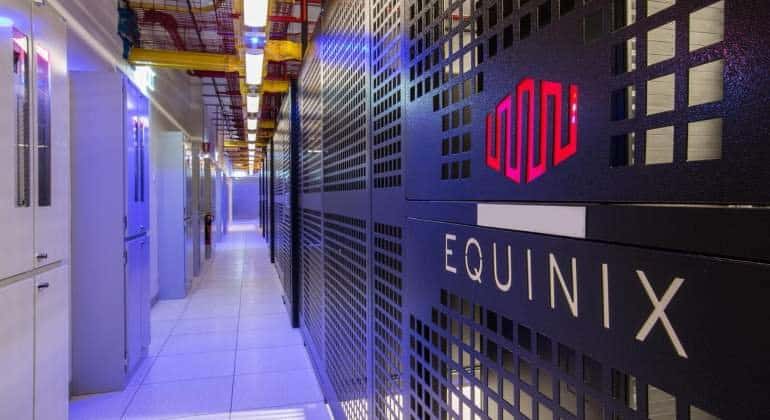
Equinix will inaugurate its new MD5 data center in Alcobendas on May 22nd, a facility set to strengthen Madrid’s role as one of Southern Europe’s leading digital interconnection hubs. The project comes alongside a €460 million investment announced for expanding the company’s campus in the Madrid municipality, which is recognized by the Community of Madrid as a Special Action Project.
The opening of MD5 is not just another expansion within Spain’s data center landscape. The facility has been designed for high-density loads, especially those related to artificial intelligence, GPU accelerators, and infrastructures demanding more power per rack than traditional colocation or conventional cloud environments. When fully configured, the center will have an installed capacity of up to 9.6 MW, with 4 MW available in the first phase.
A center designed for denser racks
The growth of artificial intelligence is changing the physical architecture of data centers. GPU-based workloads not only consume more energy—they concentrate that consumption in less space, generate more heat, and require redesigns in cooling, electrical distribution, and rack placement. MD5 is specifically created to meet this demand.
Valentín Pinuaga, CEO of Equinix Spain, explained to DISRUPTORES – EL ESPAÑOL that about 80% of the projects on the waiting list for the new building are of very high densities. This figure helps explain why Equinix is clearly separating conventional loads from the new needs linked to AI. While existing centers will continue to host standard cloud services, databases, enterprise connectivity, and classic colocation, MD5 will handle loads that require more power, greater thermal dissipation, and more specialized engineering.
This change is significant. A traditional data center may operate with moderate energy densities per rack. In AI environments, especially when systems with multiple GPUs are involved, these figures increase drastically. This necessitates more advanced cooling solutions, such as closed-loop systems or direct liquid cooling in certain scenarios, along with additional operational space around equipment.
The launch of MD5 also aligns with Equinix’s global expansion strategy. The company maintains an international roadmap to support increasing demand for AI, cloud, and distributed digital infrastructures. According to its public expansion schedule, Equinix plans to open the Madrid MD5 center in the second quarter of 2026.
Madrid gains prominence, but energy remains the limiting factor
Alcobendas has already established itself as one of Spain’s most relevant areas for digital infrastructure. Equinix entered Spain in 2017 through the acquisition of Itconic, which included the MD1 and MD2 centers, and has since expanded its presence with new assets on the campus. The company itself states that its facilities in Alcobendas constitute the largest interconnection campus in the Iberian Peninsula.
The Community of Madrid promotes this expansion as an element to attract technological investment and strengthen its national position in data centers. According to regional government, Madrid hosts 46 data centers and accounts for over 50% of Spain’s installed capacity. It also emphasizes that its recognition as a Special Action Project facilitates the development of infrastructure deemed vital for the digital economy.
However, growth faces tensions. Access to energy and saturation of the electrical grid have become two major constraints for the sector’s expansion in Madrid. The demand for new connections, the need for reliable power, and infrastructure deployment timelines can influence the actual pace at which new centers are built and activated.
This issue is especially critical when it comes to AI. It’s not enough to build buildings equipped for servers; available energy, redundancy, telecom connectivity, energy agreements, proper cooling, and permits aligned with strict industrial schedules are all necessary. Delays in any of these elements can postpone the market availability of the announced capacity.
AI is changing the demand profile
MD5 arrives at a time when many companies are seeking not just hosting capacity but environments capable of supporting AI inference near users, GPU-as-a-service platforms, high-performance workloads, and hybrid architectures connected to cloud providers, networks, and end clients.
Pinuaga pointed out that what Equinix is observing in Spain, at least for now, are not large foundational model training projects but rather demand related to distributed inference and deployment close to the point of consumption. This distinction matters. Massive training often takes place in large campuses with abundant energy and tight cost controls, whereas inference requires proximity, low latency, connectivity, and integration capacity within the local business ecosystem.
Here, Madrid has a natural advantage: it concentrates companies, operators, tech providers, international networks, and corporate demand. Interconnection becomes a key differentiator. An AI-ready data center must not only support dense racks but also enable efficient connections to public clouds, private networks, enterprise clients, and critical digital services.
Equinix’s strategy further consolidates Spain’s role within European digital infrastructure. The country combines international connectivity, submarine cable arrivals, available land across regions, a growing digitalized business network, and rising demand for cloud and AI services. Madrid remains the main hub, although regions like Aragón, Catalonia, Andalusia, and others are gaining ground in new projects.
Therefore, the inauguration of MD5 is more than just the opening of a new technical building. It marks the transition from a generation of data centers designed for generalist workloads to one prepared for high density, advanced cooling, and the energy pressures driven by AI. The opportunity is clear, but so are the challenges: energy supply, electrical grid capacity, sustainability, and transforming investment into tangible value for Spain’s tech ecosystem.
Frequently Asked Questions
When will Equinix inaugurate the MD5 data center?
The opening is scheduled for May 22, 2026, at the Equinix campus in Alcobendas, Madrid.
What will be the capacity of MD5?
The data center will have up to 9.6 MW of installed capacity in its final configuration, with 4 MW available in the first phase.
Why is MD5 important for artificial intelligence?
Because it is designed for high-density workloads, such as GPU infrastructures, AI inference, and services that require more energy and cooling than a conventional data center.
What is the main challenge to continued growth in Madrid?
Access to energy and saturation of the electrical grid are two major constraints that could slow capacity expansion to meet rising demand.
