
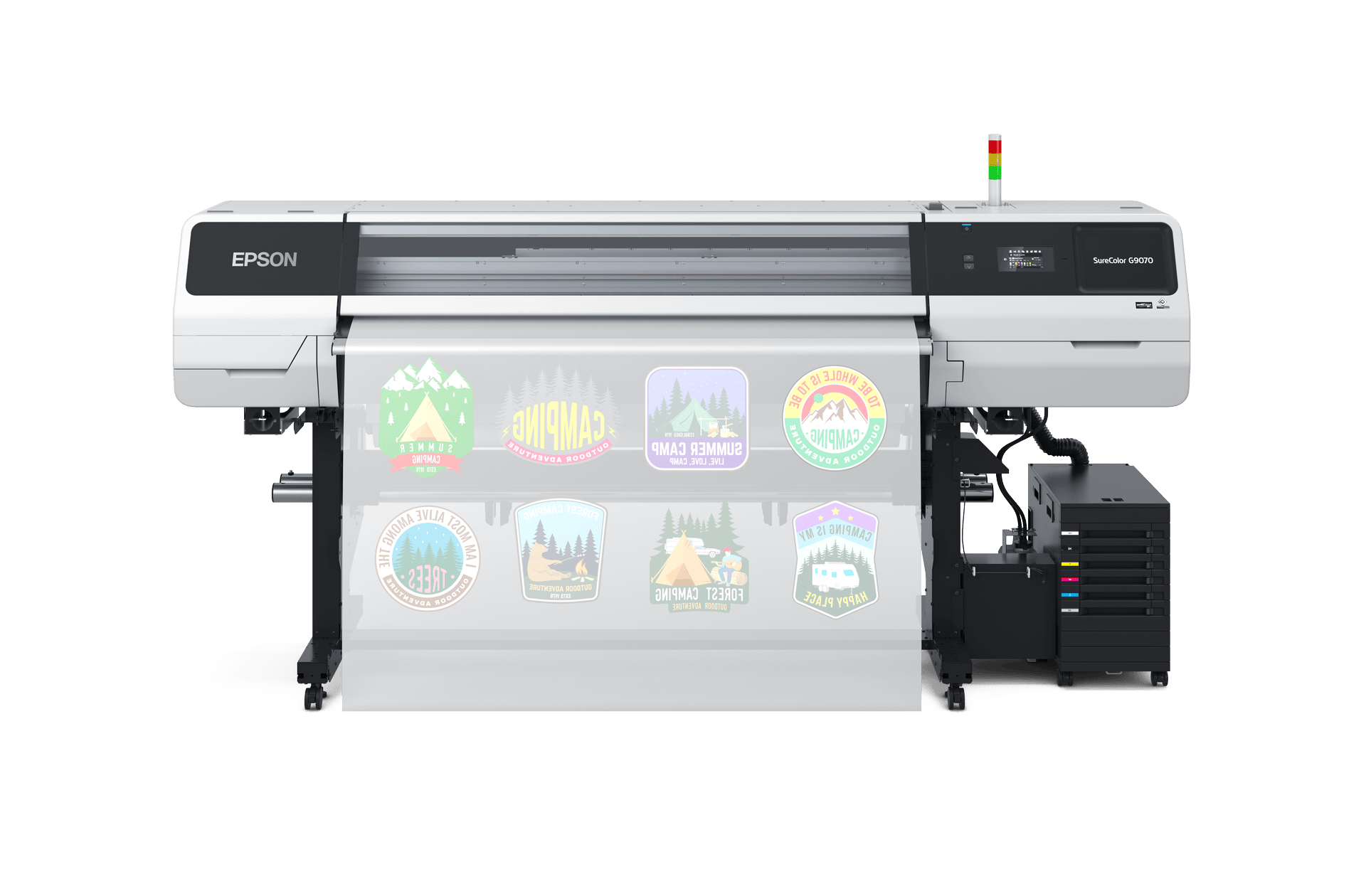
The textile personalization industry is experiencing a new cycle of acceleration. While print shops and apparel decorators compete to deliver increasingly faster orders—with shorter runs—direct-to-film (DTFilm/DTF) printing is establishing itself as an attractive option: it allows for preparing transfers with vivid color and high detail, which can then be applied to various fabrics. In this context, Epson has announced a new addition to its SureColor G-Series lineup: the SureColor G9070, a large-format printer designed for continuous production, aiming to address one of the industry’s main challenges: combining speed, consistency, and manageable maintenance in everyday operations.
The company unveiled the device on January 22, 2026 in Long Beach, California, coinciding with Impressions Expo, where the G9070 was showcased at booth #449. Epson describes it as the first expansion of its large-format DTFilm printer line, positioning it as a response to a market that, according to the brand, has been dominated by generic equipment with limited support—forcing many businesses to “learn to fix on the fly” during production.
A clear goal: keeping DTFilm production moving
Epson has built the G9070’s narrative around one core idea: reducing downtime. The printer is designed to operate under a “no downtime” philosophy, combining automatic maintenance routines with control and verification features to prevent surprises mid-run.
In concrete terms, Epson claims production speeds of up to 350 ft²/h, approximately 32.5 m²/h, and a width of 64 inches (around 162.6 cm). This size directly targets volume jobs, large graphics, and batch transfer orders—where bottlenecks are often not just about image quality but about the ability to process orders without interruptions.
Operational advantage: simultaneous printing on two rolls
One of the most notable differentiators is the dual-roll (twin-roll) capability. The SureColor G9070 can print simultaneously on two rolls of material, a feature designed to sustain the pace in environments handling diverse orders or where maximizing machine uptime is critical.
Practically, this flexibility offers two operational benefits: it enables parallel production planning (e.g., two types of jobs or order streams) and reduces the need for consumable changes and associated downtime for reconfigurations. In a workshop facing demand peaks, these details often determine whether an order ships “today” or is postponed to the next day.
Color consistency without constant supervision
Epson ensures that the G9070 maintains speed without sacrificing precision. It combines a replaceable PrecisionCore Micro TFP printhead with Nozzle Verification Technology and UltraChrome DF inks. The goal is clear: prevent operators from having to constantly monitor for micro-injection failures or output variations, which in transfer production can multiply waste and redo’s.
It also features a high-capacity ink system with sealed packs, designed to reduce handling, errors, and “accidents” that, in many businesses, translate into hours of lost productivity and material waste. Epson emphasizes that this system is intended for intensive use: long runs, extended shifts, and the need for stable operation.
Remote management, cost tracking, and alerts: making production “monitorable”
Beyond printing, Epson promotes the idea that a modern print shop requires visibility. That’s where Epson Cloud Solution PORT comes into play—a platform that promises job tracking, cost accounting, and alerts to keep teams informed. These tools are well-received in businesses with multiple machines or shifts, as they transform daily operations into data: what’s printing, upcoming operational costs, and when a machine needs attention before breaking down.
Epson notes, however, that system functions depend on internet connection and a compatible browser—a standard for cloud-based tools but a relevant consideration for workshops with strict network policies or isolated environments.
Inks and compliance: the growing importance of product safety
As textile printing approaches closer to the end consumer, compliance and safety requirements are becoming more prominent. Epson highlights that its UltraChrome DF inks are OEKO-TEX ECO PASSPORT certified, CPSIA compatible, and described as . This messaging targets businesses printing for brands, campaigns, or clients demanding guarantees on materials and processes.
This aspect is critical: in third-party orders, the ink isn’t just a consumable but a contractual requirement. In the personalization economy, a shop that can credibly certify its production chain often has a competitive edge.
Support and service: the argument against “generic hardware”
Epson explicitly states that in the DTFilm segment, part of the market has relied on generic machines with uneven support. For a print shop, the issue isn’t just about a machine breaking down; it’s the opportunity cost when it happens during a busy campaign. To address this, Epson mentions on-site repair options and a service network aimed at minimizing downtime and protecting delivery timelines.
Commercial availability is expected by summer 2026 through Epson Professional Imaging distributors.
Epson frames the launch within an industrial innovation narrative
In the same announcement, Epson reiterates its corporate positioning: a global group led by Seiko Epson, with annual sales exceeding 1 trillion yen, and an ambitious sustainability goal: to be “carbon negative” and eliminate the use of non-renewable underground resources like oil and metals by 2050. This context helps explain why the manufacturer aims to compete in industrial segments where reliability, maintenance, and efficiency are as crucial as the final result.
Frequently Asked Questions
What does DTFilm or direct-to-film printing mean, and what types of garments is it used for?
DTFilm (DTF) is a printing method that creates transfers on film for later application to garments. It’s commonly used for T-shirts and personalized apparel due to its flexibility and suitability for short or mixed runs.
What is the announced printing speed for the Epson SureColor G9070 in DTF production?
Epson reports speeds of up to 350 ft²/h, approximately 32.5 m²/h, targeted at shops requiring high productivity in transfer orders.
What advantages does dual-roll (twin-roll) printing bring to a large-format DTF printer?
It allows printing on two rolls simultaneously, reducing changeover time, improving job scheduling, and supporting continuous production in environments with many orders or large graphics.
What certifications does Epson mention for UltraChrome DF inks, and why are they important in textile printing?
Epson highlights OEKO-TEX ECO PASSPORT and CPSIA compliance, and describes the inks as non-toxic. These are crucial for shops printing for brands or clients with strict requirements on safety and material compliance.
via: news.epson